










Ganesh Benzoplast Wins Supreme Court IBC Appeal on Scheme Dues
Key highlights
- The Supreme Court allowed Ganesh Benzoplast's Civil Appeal No. 3097 of 2026 on 16 November 2026.
- STC had received ₹2,18,88,421, the maximum recoverable under the sanctioned rehabilitation scheme.
- The Court set aside the NCLAT's 21 January 2026 remand order and restored the NCLT's 13 February 2020 order.
- The judgment, reported as 2026 INSC 1223, held that Section 9 cannot be used to quantify an uncrystallised liability.
powered by IRIS
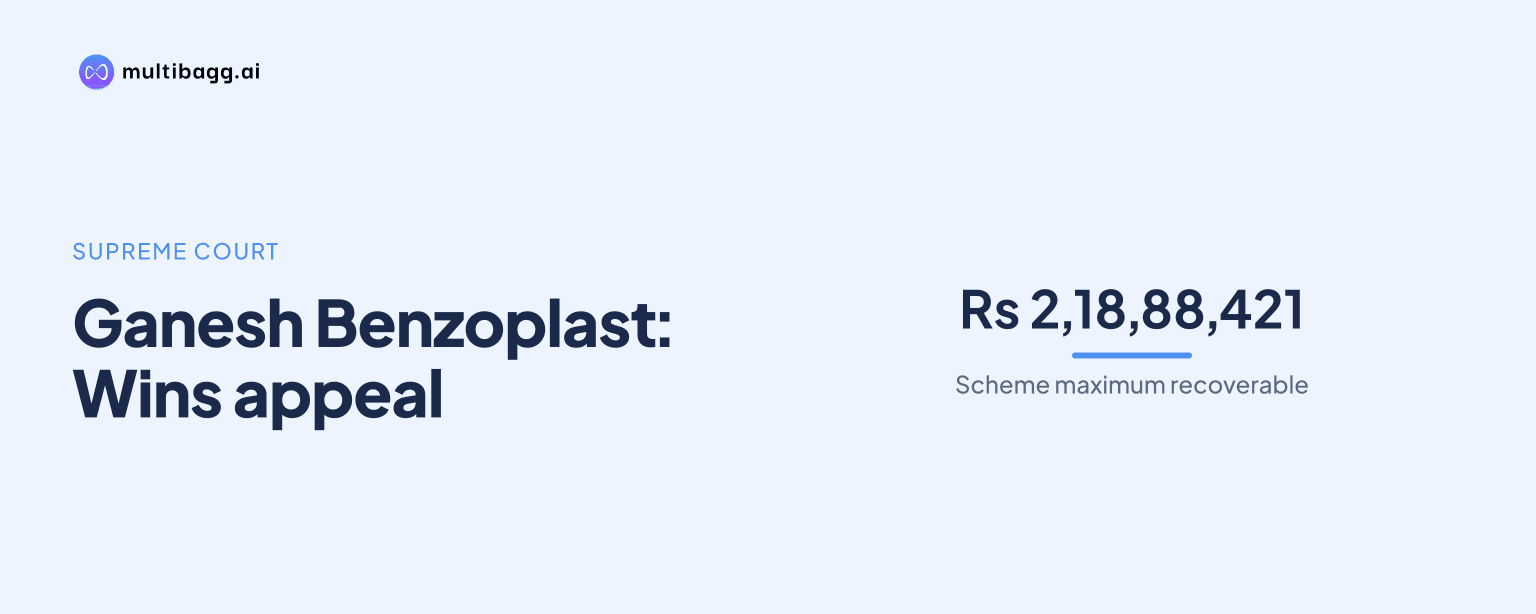
Ganesh Benzoplast Limited won its Supreme Court appeal on 16 November 2026 after the Court held that ₹2,18,88,421 already paid under a sanctioned rehabilitation scheme represented the maximum amount recoverable by State Trading Corporation of India, leaving no surviving basis for its Section 9 IBC petition.
Know Ganesh Benzoplast inside out
Results, valuation, peers and who's buying, in one view.
What did the Supreme Court decide in the Ganesh Benzoplast case?
The Supreme Court allowed Ganesh Benzoplast's appeal, set aside the National Company Law Appellate Tribunal's order dated 21 January 2026, and restored the National Company Law Tribunal's order dated 13 February 2020. The decision was delivered in M/s. Ganesh Benzoplast Ltd. v. The State Trading Corporation of India, Civil Appeal No. 3097 of 2026, reported as 2026 INSC 1223.
A bench of Justice Sanjay Kumar and Justice Sanjeev Sachdeva delivered the reportable judgment on 16 November 2026. Justice Sanjay Kumar authored the ruling. The Court held that State Trading Corporation of India, or STC, could not use the insolvency process to seek dues beyond the treatment provided under the sanctioned rehabilitation arrangement.
The ruling concerns the effect of the particular rehabilitation scheme considered by the Court. It does not establish a general rule that debts can be discharged by payment of 25% of principal in every case.
Why was STC's Section 9 insolvency petition disposed of?
STC's Section 9 petition was disposed of because it had already received the maximum amount payable under the applicable rehabilitation scheme. The amount paid was ₹2,18,88,421, which the Court recorded as the full recovery available to STC under the arrangement.
STC had sought the initiation of corporate insolvency resolution process against Ganesh Benzoplast under Section 9 of the Insolvency and Bankruptcy Code, 2016. Section 9 is the route available to an operational creditor for starting insolvency proceedings when an operational debt has not been paid and the statutory requirements are met.
The Supreme Court found that there was no adjudicatory purpose in reviving the petition once the scheme-based maximum had been paid. It restored the NCLT Mumbai Bench's earlier disposal of Company Petition (IB) No. 1975/MB/2018.
How does a sanctioned rehabilitation scheme bind creditors?
A sanctioned rehabilitation scheme binds unsecured creditors according to the classification and treatment of their claims under that scheme. The Supreme Court reaffirmed that STC could not bypass the reduction in its dues by invoking Section 9 of the IBC after the scheme's prescribed payment had been made.
The dispute arose from a rehabilitation arrangement approved in the BIFR era. Such schemes were designed to set out the financial restructuring and settlement terms applicable to a sick industrial company and its stakeholders. The Court's ruling gives effect to that approved treatment rather than permitting a creditor to reopen its original claim through a later insolvency application.
The Court also addressed claims where liability remains contingent. It clarified that insolvency proceedings cannot be used to establish and quantify an uncrystallised liability. A Section 9 proceeding is not a mechanism for converting an uncertain or unresolved claim into an admitted operational debt.
Got a follow-up? Ask IRIS
What was the procedural sequence before the final ruling?
The final Supreme Court ruling reversed the NCLAT's decision to remand the matter and restored the NCLT's earlier disposal order. The sequence shows that the key question was whether STC could continue its insolvency petition despite receiving the amount stipulated under the rehabilitation scheme.
On 13 February 2020, the NCLT Mumbai Bench disposed of STC's Section 9 petition. The NCLAT Principal Bench in New Delhi subsequently passed a remand order on 21 January 2026 in Company Appeal (AT)(INS) No. 753 of 2021.
Ganesh Benzoplast challenged that NCLAT order before the Supreme Court. In the final order, the Court allowed the company's appeal and restored the NCLT's position. The Court also directed that the parties bear their own costs.
What does the judgment mean for investors and insolvency proceedings?
The judgment confirms that an approved rehabilitation scheme can determine the extent of recovery available to an unsecured creditor. For Ganesh Benzoplast, the immediate outcome is that STC's Section 9 insolvency process will not proceed on the claim addressed by the scheme, as the Court found nothing remained for adjudication after payment of ₹2,18,88,421.
For the insolvency framework, the decision draws a distinction between enforcing a crystallised operational debt and using insolvency proceedings to determine a disputed, contingent, or uncrystallised liability. The Court's finding means the IBC route cannot be used to improve upon the recovery treatment already fixed under the applicable sanctioned scheme.
No share-price movement, financial penalty, compensation amount, or revised financial liability from this STC litigation was provided in the case information. Investors should therefore distinguish the legal result from any unverified assessment of a near-term financial or market impact.
Conclusion
The Supreme Court's decision gives final effect to the rehabilitation scheme's treatment of STC's dues against Ganesh Benzoplast. By restoring the NCLT order, the Court confirmed that payment of the scheme-prescribed maximum ended the basis for continuing the Section 9 insolvency petition.
The ruling leaves an important legal marker for claims arising from older rehabilitation arrangements: creditors cannot use the IBC to reopen reduced dues or quantify liabilities that have not crystallised. The disclosed proceedings do not identify a further scheduled hearing in this STC matter after the 16 November 2026 judgment.