










Gujarat Energy Limited doubles H1 LNG cargo imports to 24
Key highlights
- GEL imported 24 LNG cargoes in H1FY27, compared with 12 cargoes in H1FY26.
- GEL added 13 CNG stations in Q2FY27, taking its network to 857 stations.
- GEL added about 1,08,000 domestic PNG customers in H1FY27.
- GEL reported H1FY27 city-gas volumes of 11.5 MMSCMD, up about 31% year on year.
powered by IRIS
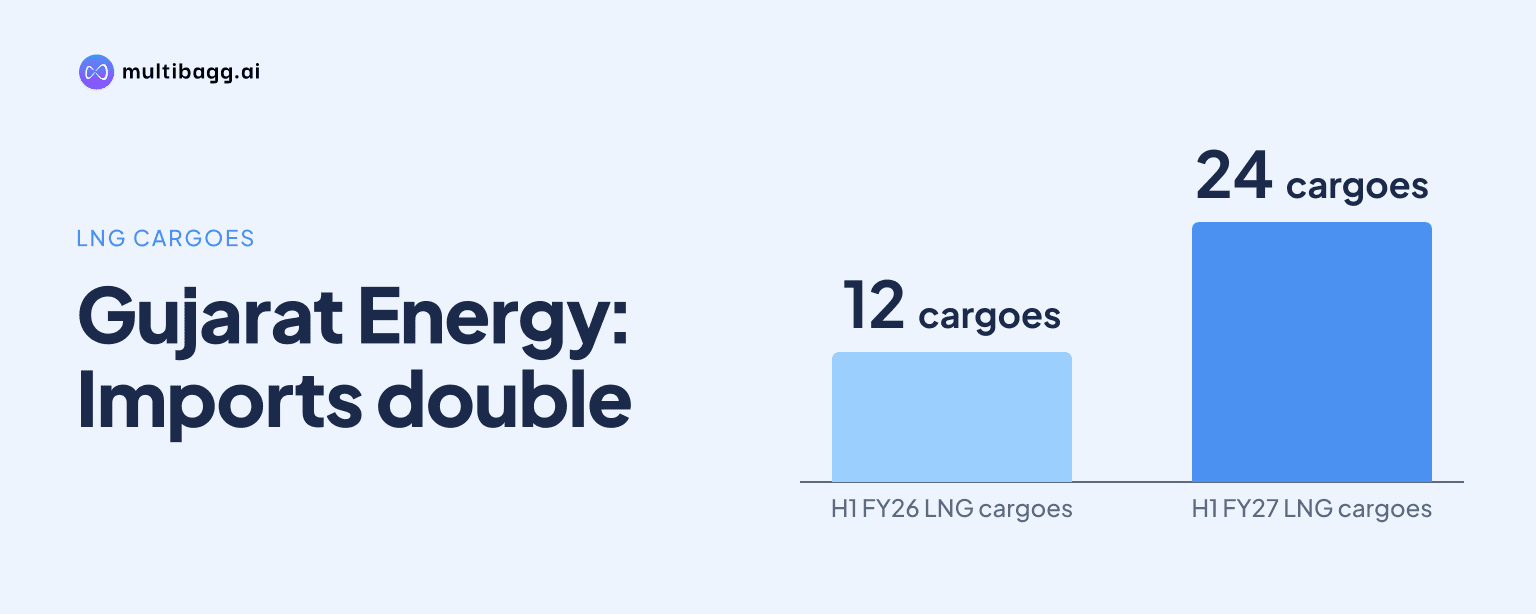
Gujarat Energy Limited (GEL) imported 24 liquefied natural gas (LNG) cargoes in H1FY27, double the 12 cargoes reported in H1FY26, as city-gas distribution volumes rose about 31% year on year to 11.5 million metric standard cubic metres per day (MMSCMD). GEL also added 13 compressed natural gas stations and about 1,08,000 domestic piped natural gas customers during the half year.
Know Gujarat Energy inside out
Results, valuation, peers and who's buying, in one view.
How did GEL's LNG imports change in H1FY27?
GEL doubled LNG cargo imports to 24 cargoes in H1FY27 from 12 cargoes in H1FY26. The company imported 14 cargoes, including partial cargoes, in Q2FY27, which represented more than half of its reported H1FY27 cargo count.
The increase in cargo imports coincided with higher city-gas distribution volumes. GEL reported city-gas volumes of 10.7 MMSCMD in Q2FY27, about 24% above the prior-year quarter, and 11.5 MMSCMD in H1FY27, about 31% higher year on year. The company attributed the volume growth to industrial demand and CNG penetration.
GEL's board approved the execution of long-term LNG sourcing agreements with international suppliers for about 0.8 million tonnes per annum (MTPA), with tenures of up to 10 years and pricing linked to Henry Hub. Chairman Shri M K Das said the proposed agreements are intended to reduce dependence on spot LNG cargoes and secure reliable and sustainable supply.
How many CNG stations did GEL add in Q2FY27?
GEL added 13 CNG stations in Q2FY27, taking its network to 857 stations as of H1FY27. CNG volume rose about 11% year on year to 3.67 MMSCMD in Q2FY27 and about 12% to 3.72 MMSCMD in H1FY27.
The half-year CNG volume of 3.72 MMSCMD was higher than the 3.67 MMSCMD reported for Q2FY27, while year-on-year growth was 12% for H1FY27 against 11% for Q2FY27. GEL reported that 857 stations were operating across its CNG network at the half-year point.
GEL distributed about 15.38 MMSCMD of natural gas in Q2FY27 through a network of more than 46,690 kilometres of gas pipelines. Its reported operations covered six states and one union territory, providing context for the 857-station CNG footprint.
How many domestic PNG customers did GEL add?
GEL added about 49,000 domestic piped natural gas (PNG) customers in Q2FY27 and about 1,08,000 customers in H1FY27. The company said it supplied natural gas to more than 25.3 lakh households in Q2FY27.
The H1FY27 domestic additions included customers connected in both quarters, while the release does not disclose an H1FY26 domestic-customer addition figure. Managing Director Smt. Avantika Singh said GEL's focus was to use its gas-sourcing portfolio to expand city-gas distribution, strengthen CNG infrastructure and accelerate domestic PNG penetration across its geographical areas.
GEL's household base of more than 25.3 lakh households shows the scale of its existing domestic network alongside the about 1,08,000 additions reported for H1FY27. The company did not disclose the number of domestic customers by state, union territory or geographical area in the release.
Got a follow-up? Ask IRIS
What infrastructure is supporting GEL's city-gas growth?
GEL's medium-density polyethylene (MDPE) pipeline network reached 43,148 kilometres and its steel pipeline network reached 3,542 kilometres as of 30 September 2026. The two disclosed categories total 46,690 kilometres, matching the company statement that its gas-pipeline network exceeded 46,690 kilometres in Q2FY27.
GEL incurred capital expenditure of about Rs 181 crore in Q2FY27, taking cumulative H1FY27 spending to about Rs 308 crore. The company reiterated FY27 capital-expenditure guidance of about Rs 1,000 crore, so its reported half-year expenditure was part of the stated annual programme.
The board also approved execution of a firm regasification agreement for LNG cargo slots at GSPC LNG Limited's Mundra LNG Terminal. This planned terminal access is separate from the proposed 0.8 MTPA long-term supply agreements and is a disclosed mechanism for handling LNG cargoes.
How did GEL's financial results compare with the operating expansion?
GEL reported revenue from operations of Rs 9,826.08 crore in Q2FY27, up 59.4% year on year from Rs 6,164.86 crore. H1FY27 revenue increased 61.3% to Rs 19,496.34 crore from Rs 12,089.20 crore in H1FY26, alongside the increase in city-gas volumes and LNG cargo imports.
Earnings before interest, tax, depreciation and amortisation (EBITDA), including other income, increased 19.5% to Rs 1,019.40 crore in Q2FY27 and 43.1% to Rs 2,501.57 crore in H1FY27. EBITDA margin was 10.37% in Q2FY27 versus 13.84% a year earlier, and 12.83% in H1FY27 versus 14.46% in H1FY26.
Profit after tax rose 21.8% year on year to Rs 639.27 crore in Q2FY27 and 50.8% to Rs 1,637.24 crore in H1FY27. Revenue growth exceeded EBITDA growth in both disclosed periods, while the operational update recorded 24 LNG cargoes, 13 new CNG stations and about 1,08,000 new domestic PNG customers in H1FY27.
Conclusion
GEL's H1FY27 update shows supply activity and distribution expansion progressing alongside higher gas volumes. LNG cargo imports doubled to 24 from 12 in H1FY26, city-gas volumes rose about 31% to 11.5 MMSCMD, and the company expanded access through 13 CNG stations and about 1,08,000 domestic PNG customer additions.
The next disclosed milestones are progress toward FY27 capital expenditure of about Rs 1,000 crore after about Rs 308 crore in H1FY27, execution of the proposed 0.8 MTPA LNG agreements and firm Mundra regasification slots. GEL has also issued an expression of interest for LNG-station franchisees and compressed biogas plants with 200 tonnes-per-day capacity, split equally between Gujarat and locations outside Gujarat.