










Gensol fund use remains unverified for Rs 538.6033185 crore
Key highlights
- Crisil could not verify use of Rs 538.6033185 crore in Gensol preferential-issue proceeds for the quarter ended September 30, 2026.
- Gensol’s revised issue proceeds of Rs 538.6033185 crore were lower than the original Rs 900.0965389 crore estimate after undersubscription.
- Working capital had the largest revised allocation at Rs 194.4747824 crore.
- Crisil cited six earlier qualified issuer-non-cooperation reports between May 15, 2025 and August 14, 2026.
powered by IRIS
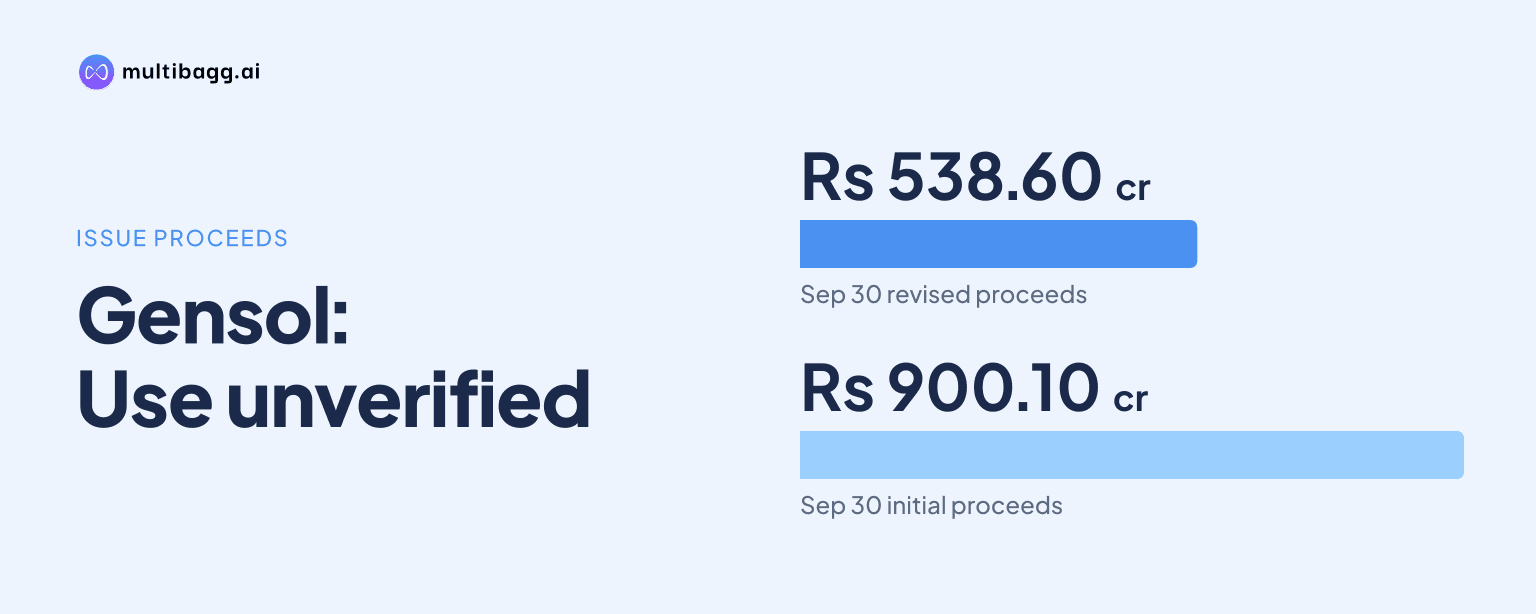
Gensol Engineering Limited’s Rs 538.6033185 crore preferential-issue proceeds remained unverified for the quarter ended September 30, 2026, because Crisil Ratings Limited could not obtain the documents needed to assess utilisation, deviations, project delays or deployment of unutilised funds. The Resolution Professional also said complete historical records were unavailable during the Corporate Insolvency Resolution Process.
Know Gensol Engineering inside out
Results, valuation, peers and who's buying, in one view.
Why could Crisil not verify Gensol’s fund use?
Crisil could not verify Gensol’s fund use because Gensol did not provide the necessary documents and information required under the monitoring agreement and Regulation 162A of the Securities and Exchange Board of India (SEBI) Issue of Capital and Disclosure Requirements Regulations, 2018. Its November 12, 2026 report for the quarter ended September 30, 2026 was consequently qualified with the status “issuer not cooperating.”
Crisil said it requested the material through emails dated September 11, October 8, October 16 and November 5, 2026, as well as a letter dated October 30, 2026. Without those records, Crisil could not establish whether proceeds were used for the stated objects, whether implementation had been delayed, how unutilised funds were deployed, or whether there had been a deviation and its range.
The September 2026 report recorded that no supporting documents or information had been supplied to Crisil for that quarter. Crisil said its inability to issue a comprehensive view was solely due to Gensol’s non-cooperation, while also stating that a monitoring agency does not conduct an audit or independently verify information, certifications or statements it receives.
How long has Gensol’s monitoring qualification continued?
The September 2026 qualification followed six earlier qualified issuer-non-cooperation reports cited by Crisil: May 15, August 14 and November 13, 2025, followed by February 13, May 15 and August 14, 2026. The September 2026 outcome therefore continued a reporting gap rather than representing a one-quarter interruption in monitoring.
The position differs from the period immediately after the June 18, 2024 warrant allotment. Gensol had informed stock exchanges that the preferential issue was undersubscribed, reducing projected proceeds from Rs 900.0965389 crore to Rs 538.6033185 crore. Crisil said the resulting proportional reduction in the object costs was supported by a legal opinion dated August 5, 2024.
Crisil reported no further object-cost revision for the quarters ended September 30 and December 31, 2024. However, it has been unable to confirm whether costs changed in the seven quarters from March 31, 2025 through September 30, 2026, because Gensol did not provide all required documents and information.
How has CIRP affected Gensol’s records?
Gensol’s Corporate Insolvency Resolution Process (CIRP) has limited the Resolution Professional’s ability to verify historical deployment of the preferential-issue proceeds. In Gensol’s November 17, 2026 filing, Keshav Khaneja was identified as the Resolution Professional, exercising the board’s powers after their suspension under the CIRP.
The Resolution Professional told Crisil that it did not have access to complete historical records, books, supporting documents and other information relating to use and deployment of the proceeds. It further said the available data and documentary records were insufficient to independently verify and confirm use of funds raised in the preferential issue.
This is a limitation on verification, rather than a Crisil finding that money was diverted or used improperly. For the quarter ended September 30, 2026, Crisil did not confirm either that proceeds had been used according to the stated objects or that a deviation had occurred.
Gensol disclosed that financial creditors had initiated insolvency proceedings before the National Company Law Tribunal under the Insolvency and Bankruptcy Code, 2016. The filing cited a July 27, 2025 announcement on Mr Khaneja’s appointment as Interim Resolution Professional, followed by a September 30, 2025 Form G publication seeking expressions of interest, with December 14, 2025 set as the deadline for resolution-plan submissions.
Got a follow-up? Ask IRIS
What were Gensol’s preferential-issue proceeds intended for?
Gensol’s June 18, 2024 preferential issue comprised warrants convertible into equity shares. The Rs 538.6033185 crore revised issue proceeds reflected undersubscription, compared with the Rs 900.0965389 crore initial estimate that assumed conversion of all warrants and receipt of the associated conversion money.
Working capital was the largest revised object, at Rs 194.4747824 crore, or more than the Rs 119.6767891 crore allocated to investment in the leasing subsidiary. The other revised allocations were Rs 68.8141538 crore for investment in the manufacturing subsidiary, Rs 50.8626354 crore for inorganic growth opportunities and Rs 104.7749578 crore for general corporate purposes.
Crisil was appointed under a February 5, 2024 monitoring agreement to monitor the revised proceeds. For each of the five objects at September 30, 2026, it could not determine whether the cost had changed, whether funds were used in line with the disclosed object, whether implementation was delayed, or what had happened to any unutilised amount.
The report also listed events Crisil considered potentially unfavourable to the viability of the objects. Gensol had disclosed on April 24, 2025 that SEBI’s April 15, 2025 interim order barred Gensol and its two named promoters from accessing the securities market and from holding director or key managerial positions at Gensol, while also directing a forensic audit.
Gensol separately disclosed on April 28, 2025 that the Directorate of Enforcement had conducted search and seizure action under the Foreign Exchange Management Act, 1999. Crisil also noted that credit-rating agencies revised ratings to “default” in March 2025 because of delayed debt servicing, and said Gensol’s share price had fallen significantly below the warrant price, which could deter payment of the remaining warrant amount.
The monitoring report further cited Gensol’s July 14, 2026 disclosure that IREDA classified loan accounts of Gensol and Gensol EV Lease Limited as “Fraud” under the Reserve Bank of India’s Fraud Risk Management Directions, 2024, and reported the matter to the Reserve Bank of India. These disclosures do not establish use of preferential-issue funds, which remained unverified in Crisil’s September 2026 report.
Conclusion
The September 2026 report leaves Rs 538.6033185 crore of revised preferential-issue proceeds without external confirmation of their use. Crisil’s finding is that missing information prevented monitoring, not that it identified a deviation, diversion or misuse. The verification gap extends across working capital, two subsidiary investments, inorganic growth and general corporate purposes.
The key unresolved matter is whether the CIRP process enables the Resolution Professional or Gensol to obtain the historical books and supporting records identified as unavailable. If records are provided in a later monitoring period, Crisil could assess fund utilisation, any revisions to the five objects, implementation delays and the deployment of unutilised proceeds.