










Glenmark reports 170-plus ISB 2001 subjects; ISB 2301 IND CY26
Key highlights
- Glenmark says more than 170 subjects have been dosed with ISB 2001 in the Phase 1 TRIgnite-1 study.
- ISB 2001 dosing includes 42 subjects in dose escalation and more than 130 in dose expansion.
- IGI intends to submit an IND for solid-tumour asset ISB 2301 by the end of CY26.
- Updated ISB 2001 Phase 1 data were accepted for an oral presentation at the American Society of Hematology meeting in 2026.
powered by IRIS
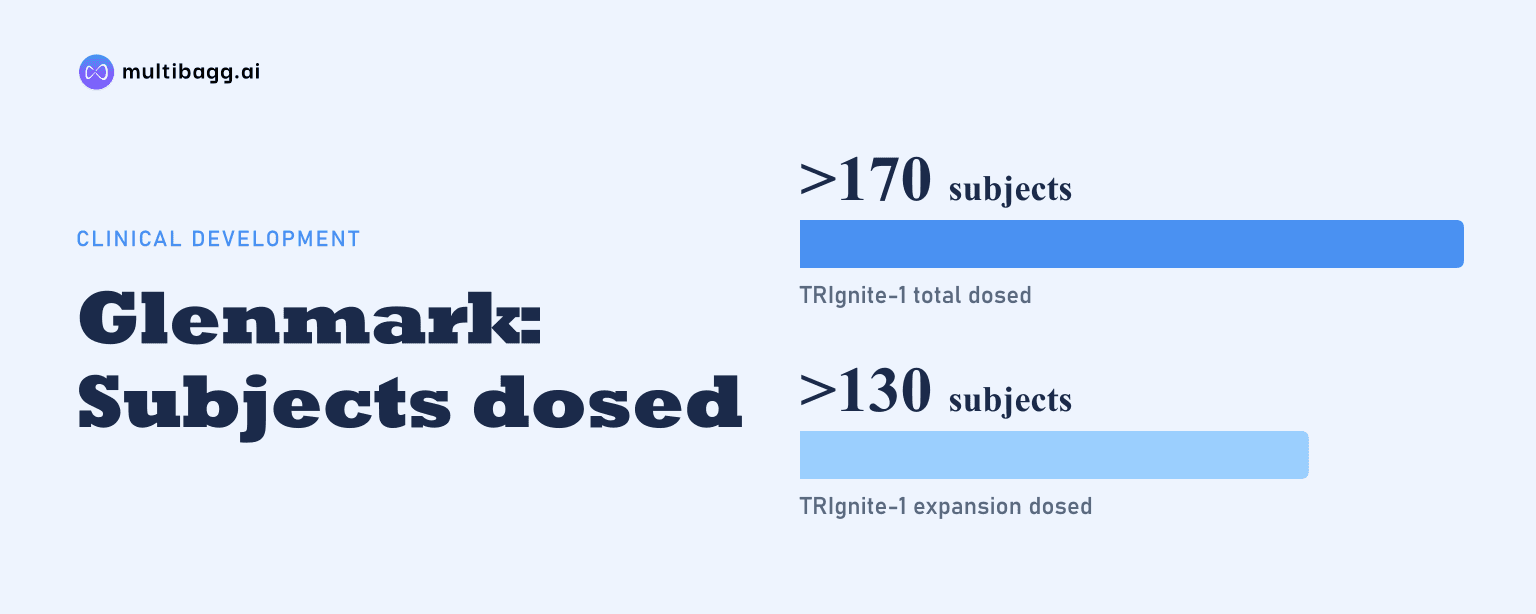
Glenmark says more than 170 subjects have been dosed in the Phase 1 TRIgnite-1 study of ISB 2001, while IGI intends to submit an investigational new drug application for solid-tumour asset ISB 2301 by the end of calendar 2026. The dosing count includes 42 subjects in dose escalation and more than 130 in dose expansion.
Know Glenmark Pharmaceuticals inside out
Results, valuation, peers and who's buying, in one view.
How many subjects has Glenmark dosed with ISB 2001?
Glenmark has dosed more than 170 subjects with ISB 2001, also called ABBV-2001, in the Phase 1 TRIgnite-1 study. The pipeline identifies ISB 2001 as a CD38 × BCMA × CD3 T-cell engager for multiple myeloma, making it the only one of the four listed oncology assets shown in Phase 1.
The disclosed total comprises 42 subjects in dose escalation and more than 130 subjects in dose expansion. Based on the minimum disclosed numbers, the expansion group is more than three times the size of the dose-escalation group, showing that the study has moved beyond its initial 42-subject dose-finding cohort.
Glenmark’s pipeline chart places ISB 2001 in Phase 1 rather than Phase 2 or Phase 3 and lists AbbVie and Glenmark in the rights column. A note states that IGI will partner with Glenmark to develop, manufacture and commercialize ISB 2001 in territories outside AbbVie’s licensed markets.
What has Glenmark disclosed about ISB 2001 Phase 1 data?
Glenmark says safety and efficacy data from all ISB 2001 subjects continue to be promising and are consistent with data previously presented at the American Society of Clinical Oncology meeting in 2025. This is the company’s qualitative assessment, as the update gives no response-rate, adverse-event, duration-of-response or survival figures.
The presentation also does not provide separate safety or efficacy results for the 42 subjects in dose escalation and the more than 130 subjects in dose expansion. The patient-exposure count is therefore the main quantitative evidence of progress in this update, rather than a basis for comparing clinical outcomes between the two Phase 1 cohorts.
Updated TRIgnite-1 Phase 1 data were accepted for an oral presentation at the American Society of Hematology meeting in 2026. Glenmark identifies the session as “Multiple Myeloma: Pharmacologic Therapies: The March of Immunotherapy,” but does not disclose the presentation date, the updated dataset’s numerical results or the number of subjects to be included.
The stated comparison is between the earlier 2025 presentation and the data available at the time of Glenmark’s update, which the company says remain consistent. Glenmark does not state a target date for ISB 2001 to begin a Phase 2 or Phase 3 trial, so the accepted 2026 oral presentation is the next disclosed clinical-data event.
Got a follow-up? Ask IRIS
When will ISB 2301 enter clinical development?
IGI intends to submit an investigational new drug application, or IND, for ISB 2301 by the end of calendar 2026, which Glenmark abbreviates as CY26. ISB 2301 is described as a first-in-class multispecific immune cell activator targeting solid tumours.
The intended IND filing distinguishes ISB 2301 from ISB 2001, which has already dosed more than 170 subjects in Phase 1. Glenmark’s oncology pipeline does not show ISB 2301 in Phase 1, Phase 2 or Phase 3, and the company does not provide a trial protocol, specific tumour type, study location or enrolment target.
An IND submission is a planned regulatory step rather than a disclosed regulatory clearance or confirmed clinical-trial start. Glenmark attributes the year-end CY26 objective to IGI, leaving the timing dependent on IGI completing and submitting the application by that date.
The two assets also differ in mechanism as described by Glenmark. ISB 2001 is specifically identified as a CD38 × BCMA × CD3 T-cell engager for multiple myeloma, while ISB 2301 is described more broadly as a multispecific immune cell activator for solid tumours.
Which Glenmark oncology assets remain preclinical?
ISB 2302 and ISB 2501 remain in early preclinical development, according to Glenmark’s update. ISB 2302 is a bispecific immune modulator for hematologic and solid tumours, while ISB 2501 is a trispecific T-cell engager for solid tumours.
These two assets are earlier than ISB 2301, which has a stated IND-submission objective for the end of CY26, and earlier than ISB 2001, which is in the TRIgnite-1 Phase 1 study. Glenmark’s chart lists IGI in the rights column for ISB 2301, ISB 2302 and ISB 2501.
The oncology group consequently spans three disclosed development points: more than 170 dosed subjects in Phase 1 for ISB 2001, a planned IND filing for ISB 2301, and early preclinical status for ISB 2302 and ISB 2501. Glenmark does not give clinical-start targets for ISB 2302 or ISB 2501 in this presentation.
Conclusion
Glenmark’s update places ISB 2001 at the forefront of its disclosed oncology pipeline, with more than 170 subjects dosed in Phase 1, including more than 130 in dose expansion compared with 42 in dose escalation. ISB 2301 represents the next proposed transition into clinical development, while ISB 2302 and ISB 2501 remain early preclinical programmes.
The next disclosed events are the oral presentation of updated ISB 2001 Phase 1 data at the American Society of Hematology meeting in 2026 and IGI’s intended ISB 2301 IND submission by the end of CY26. Glenmark has not disclosed numerical data for the planned presentation or a confirmed start date for an ISB 2301 clinical trial.