








Globe sets 1:360 swap after Rs 1.41 crore NAV valuation
Max Plan at ₹4,999/yr₹8,999

Find your next multibaggerBe a Pro Investor
Research stocks and track your picks on the go. Download the app.
Key highlights
- Globe’s INDIGENX and ORIJEAN division was valued at Rs 1.41 crore as of November 30, 2025.
- The proposed entitlement is one Morabia share for every 360 Globe shares.
- Morabia is proposed to issue 12.51 lakh shares against Globe’s 45.04 crore existing shares.
- Morabia’s NAV was Rs 2.25 crore, or Rs 11.27 per share, on November 30, 2025.
powered by IRIS
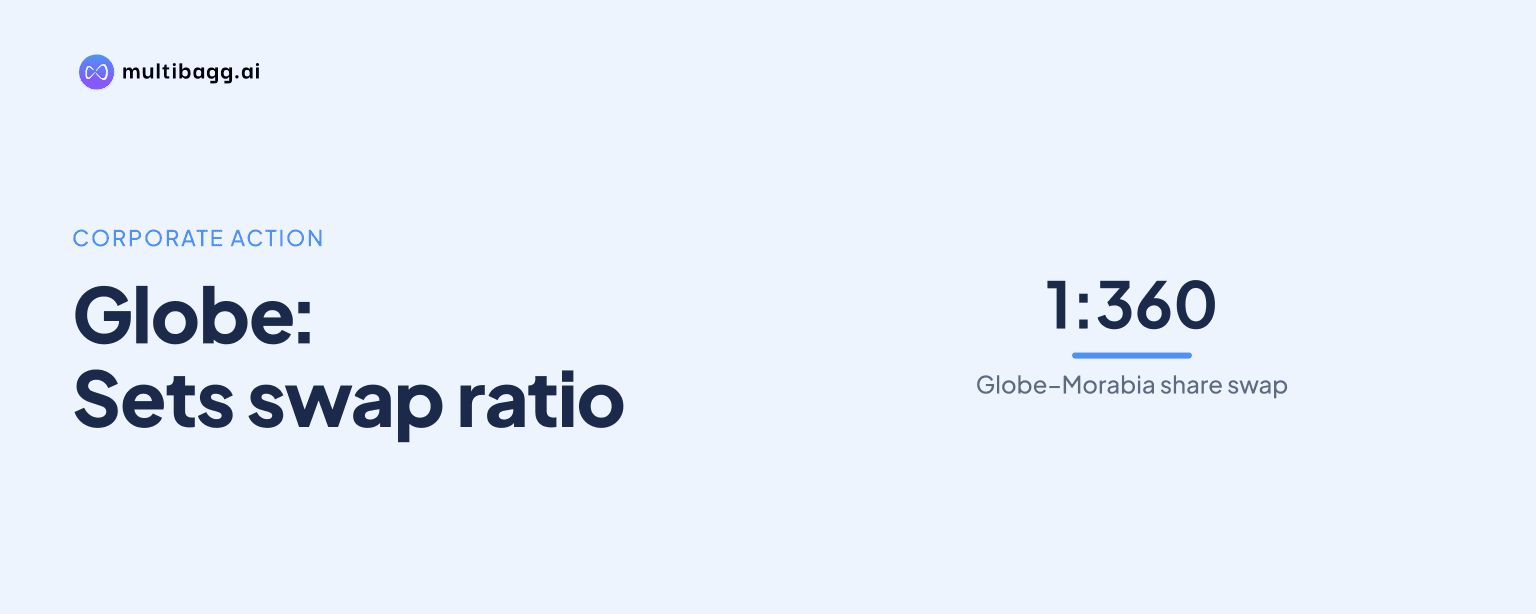
Globe Enterprises (India) Limited valued its INDIGENX and ORIJEAN division at Rs 1.41 crore as of November 30, 2025, supporting a proposed entitlement of one Morabia Creations Limited share for every 360 Globe shares. The exchange ratio was derived solely from net asset value, or NAV, rather than cash-flow forecasts or comparable-company multiples.
Know Globe Enterprises (India) inside out
Results, valuation, peers and who's buying, in one view.
What is Globe’s proposed share-swap ratio?
Globe shareholders are proposed to receive one equity share in Morabia for every 360 fully paid Globe equity shares under the demerger of the INDIGENX and ORIJEAN division. The February 2, 2026 valuation report calculates that Morabia would issue 12.51 lakh shares against Globe’s existing 45.04 crore shares as at the November 30, 2025 valuation date.
The calculation equates to 0.0027778 Morabia share for each Globe share, while the report presents the inverse entitlement as 360:1. Morabia’s book value per share and proposed issue price were both put at Rs 11.27. The demerged unit’s value, spread across Globe’s 45.04 crore shares, was calculated at Rs 0.03130 per Globe share.
The proposed issuance forms part of a Scheme of Arrangement under Sections 230 to 232 of the Companies Act, 2013. Globe is identified as the demerged company and Morabia as the resulting company, meaning the proposed transfer covers the INDIGENX and ORIJEAN undertaking rather than Globe’s entire textile business.
How did Globe value INDIGENX and ORIJEAN?
Globe’s registered valuer used the NAV method and arrived at a Rs 1.41 crore net worth for INDIGENX and ORIJEAN on November 30, 2025. Under this asset-based method, book-value liabilities are deducted from book-value assets. The division’s report recorded Rs 1.41 crore of current assets and no allocated liabilities, leaving net worth at the same amount.
Inventory represented Rs 1.10 crore of the division’s assets, while trade receivables were Rs 31.44 lakh. The valuation working reported no property, plant and equipment, intangible assets, non-current investments, cash and cash equivalents, loans and advances, or other current assets for the demerged unit at the valuation date.
The report also showed no non-current liabilities or current liabilities allocated to the INDIGENX and ORIJEAN division. This differs from Morabia, whose Rs 2.25 crore net worth was assessed across 20 lakh shares. The difference between Morabia’s Rs 2.25 crore net worth and the division’s Rs 1.41 crore valuation was Rs 84.37 lakh.
Why did Globe not use cash-flow forecasts or comparable companies?
Globe’s valuer did not apply a discounted free cash flow method because reliable, defensible future cash-flow projections were considered uncertain amid business restructuring, operational realignment and changes in scale and strategy. The method normally estimates free cash flows to the firm and discounts them using weighted average cost of capital, or WACC, but the report did not derive a forecast-based value for either entity.
The valuer also excluded comparable company multiples, saying it could not identify listed or unlisted businesses with sufficiently similar business models, scale, asset base, risk profile and earnings characteristics. It cited differences in revenue mix, capital structure, growth stage and operating geography as factors that could make multiples unreliable for the November 30, 2025 exercise.
The report therefore selected NAV as the sole valuation method for the exchange ratio. It stated that NAV is commonly used in mergers, demergers, acquisitions and restructuring where asset backing is relevant, while also noting that the method reflects historical net assets rather than current earnings, peer performance or enterprise values.
Got a follow-up? Ask IRIS
What information supported Globe’s valuation?
Globe’s valuation used management discussions, the draft scheme, audited financial statements for March 31, 2023, March 31, 2024 and March 31, 2025, and provisional financial statements for November 30, 2025. Procurve Valux Private Limited was appointed on December 20, 2025 and submitted its valuation report on February 2, 2026.
A March 11, 2026 addendum said Globe’s financial information, including revenue, profitability and net-worth figures, had been drawn from provisional management financial statements that were subsequently subject to limited review by Globe’s statutory auditors. For Morabia, the valuer said it subsequently received and reviewed audited financial statements for the same period.
The addendum said there was no material discrepancy between Morabia’s provisional and audited net worth. It also confirmed no change to the valuation method, assumptions or final conclusion. As a result, the Rs 1.41 crore division value, Rs 2.25 crore Morabia net worth and 1:360 exchange ratio remained unchanged after the March 11 clarification.
What approvals and disclosures remain for Globe’s scheme?
Globe’s board approved the Scheme of Arrangement on February 7, 2026, according to the March 11 addendum. The National Stock Exchange of India’s July 6, 2026 observation letter required Globe to make specified disclosures before seeking approval from shareholders and the National Company Law Tribunal, or NCLT.
The exchange said financial information in the scheme, including that used for the valuation report, must not be more than six months old. It also requested the value of assets and liabilities transferred to Morabia, a post-scheme Morabia balance sheet, and the impact of the transaction on Globe’s revenue-generating capacity and future prospects.
The July 6 letter further requested three-year data on revenue, profit after tax, earnings before interest, depreciation, tax and amortisation, or EBIDTA, and earnings per share for Globe and Morabia. It required disclosure of the scheme rationale, shareholder impact, business synergies and cost-benefit analysis, and stated that the Morabia equity shares proposed under the scheme must be issued only in dematerialised form.
Conclusion
Globe’s proposed demerger assigns Rs 1.41 crore of book-value net worth to INDIGENX and ORIJEAN, principally comprising Rs 1.10 crore of inventory and Rs 31.44 lakh of receivables. Against Morabia’s Rs 2.25 crore NAV and Rs 11.27 per-share value, that calculation produces the proposed one-for-360 entitlement without using earnings forecasts or peer valuation multiples.
The next disclosed milestone is the approval process requiring shareholder and NCLT consideration under Sections 230 to 232 of the Companies Act, 2013. Before then, Globe must address the NSE’s July 6, 2026 requirements, including updated financial information, transferred asset and liability details, a post-scheme Morabia balance sheet, and disclosures on the impact on Globe’s revenue-generating capacity.

