










Gokaldas Exports Ltd flags $1.75 million US receivable risk
Key highlights
- A customer of GEL's MDIPL unit filed for Chapter 11 protection in a US court on April 22, 2024.
- MDIPL's outstanding receivable from the customer was $1.75 million at the disclosure date.
- GEL said it cannot assure full or partial recovery despite MDIPL holding a trade credit risk policy.
- GEL reported 21% year-on-year consolidated income growth in material dated August 12, 2026.
powered by IRIS
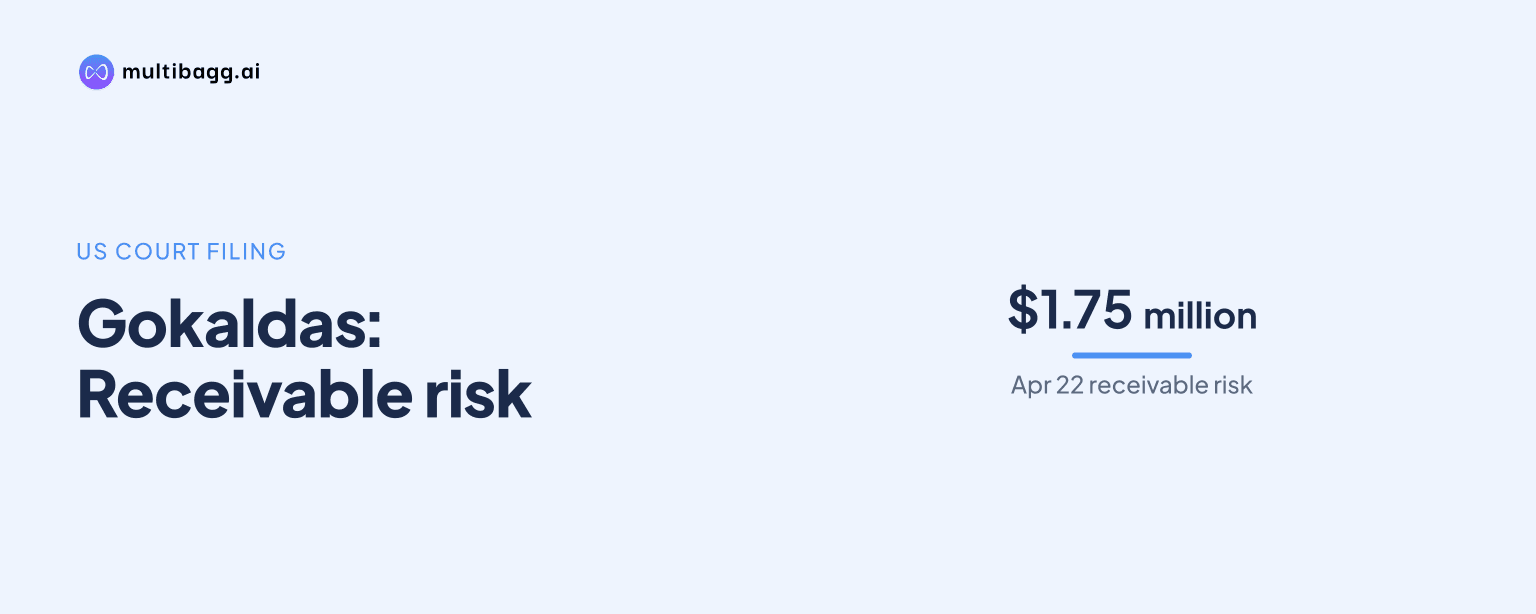
Gokaldas Exports Ltd flagged a $1.75 million outstanding receivable after a customer of its MDIPL unit filed for Chapter 11 bankruptcy protection in a US court on April 22, 2024. The disclosure matters because GEL said recovery of the dues or related losses cannot be assured and could affect its financial results.
Know Gokaldas Exports inside out
Results, valuation, peers and who's buying, in one view.
Why did GEL disclose the US customer bankruptcy?
GEL disclosed that one customer of MDIPL, a unit of the company, sought Chapter 11 bankruptcy protection in the United States on April 22, 2024. Reuters reported the development on April 25, 2024, saying the customer had an outstanding receivable of $1.75 million as of that date.
Chapter 11 is a reorganisation process under US bankruptcy law. It allows a business to continue operations while it restructures its finances through a reorganisation plan. The filing therefore does not, by itself, establish the final recovery amount for creditors, including suppliers such as MDIPL.
The company identified the development in its placement document as a customer-credit risk. Its business growth is dependent on revenue growth among customers in their respective markets, and a customer's financial distress can interrupt collections for goods already supplied.
GEL also referred to the wider risk that exceptional events, including the Covid-19 pandemic, can weaken customers' ability to pay creditors. The company stated that customers facing such financial pressure may file for bankruptcy and may not pay outstanding dues.
How large is the outstanding amount and what protection does GEL have?
The disclosed receivable from the MDIPL customer was $1.75 million as of the date of the placement document. GEL said MDIPL holds a trade credit risk policy, which is intended to provide protection against customer-payment risks under the policy terms.
However, GEL explicitly stated that it cannot assure or guarantee recovery of the dues or losses, either partly or fully, in such cases. The final financial effect would depend on the bankruptcy process, the customer's reorganisation outcome, the status of the receivable and any applicable policy recovery.
The disclosure does not provide a provision amount, expected recovery amount or claim settlement timeline for this customer. It instead notes that an inability to recover amounts could affect GEL's financial results.
What has GEL experienced with earlier customer bankruptcies?
GEL has disclosed prior instances of financial stress among US customers. In fiscal 2019, Sears Holdings Corporation and certain affiliates, including K Mart Corporation, filed for bankruptcy under US law. GEL said it had to provide for certain receivables, although it realised some amount under legal directions.
In fiscal 2021, another customer, JC Penney Company Inc., filed for reorganisation of its business and credits in a US court. GEL said all its dues were realised in that case. These two cases show that outcomes can differ materially depending on the customer and the relevant legal process.
The MDIPL customer filing is therefore not the company's first exposure to a customer restructuring, but the available disclosure does not state whether the current case will resemble either prior outcome. The company has limited its comments to the receivable amount, insurance cover and the absence of any recovery assurance.
GEL also stated that the group does not recognise a contingent liability but discloses its existence in the consolidated financial statements. This accounting treatment is relevant for investors assessing credit-risk disclosures alongside reported earnings and cash collections.
Got a follow-up? Ask IRIS
What does the disclosure mean for GEL's business and investors?
The immediate issue for GEL is the collectability of the $1.75 million receivable rather than a disclosed change in orders, production or customer concentration. Any unrecovered amount could affect reported financial results, as the company has stated, while insurance recoveries would depend on the trade credit policy and its terms.
The US market remains important to GEL's business. A separate report said the company earns about 70% of its revenue from the US and plans to expand production at factories in Kenya and Ethiopia, which face a 10% US levy. That reported strategy indicates the significance of US trade conditions to the group, though GEL has not linked the MDIPL customer bankruptcy to tariffs or its African manufacturing expansion.
More recent company material dated August 12, 2026 said consolidated income grew 21% year-on-year and that the India business grew 16% year-on-year. GEL said growth came from across geographies and customers rather than a single customer or market. The same material said operations for a customer were expected to commence in Q2, without naming that customer.
For investors, the bankruptcy disclosure should be considered with these separate operating updates. The supplied material does not quantify the effect of the $1.75 million receivable on quarterly profit, cash flow or consolidated income, so those effects cannot be calculated from the disclosed information.
What should investors monitor in subsequent GEL disclosures?
Investors should monitor whether GEL provides an update on the Chapter 11 claim, insurance recovery, any accounting provision and the net impact on results. The key unresolved issue is the amount, if any, ultimately collected from the customer or recovered through the trade credit risk policy.
The company also has a scheduled-results context in the supplied disclosures. A May 25, 2026 communication referred to Q2FY27 results on November 5, 2026 and an earnings call on November 6, 2026 at 12:30 hours. Any available results material and call commentary would be relevant for checking whether management discussed receivable collections, customer credit conditions or the financial effect of this case.
Conclusion
GEL's disclosure places a defined $1.75 million customer receivable under scrutiny following an MDIPL customer's Chapter 11 filing in the US. The company has trade credit risk cover but has made clear that recovery is not assured, making the eventual collection outcome more important than the filing alone.
The next disclosed reference points are the Q2FY27 results dated November 5, 2026 and the November 6, 2026 earnings call. Investors should look for confirmed information on recoveries, provisions, insurance claims and whether the customer event affected collections or reported financial performance.