










Gokul Refoils Q2 Revenue Reaches ₹72.21 Crore
Key highlights
- Gokul Refoils reported standalone Q2 revenue of ₹72.21 crore, up 233.8% from ₹21.64 crore a year earlier.
- Standalone total income rose 217.0% year on year to ₹73.64 crore in the quarter ended September 30, 2026.
- Standalone net profit declined 33.0% to ₹0.90 crore from ₹1.35 crore in the year-ago quarter.
- The board approved unaudited standalone and consolidated Q2 and half-year results for the period ended September 30, 2026.
powered by IRIS
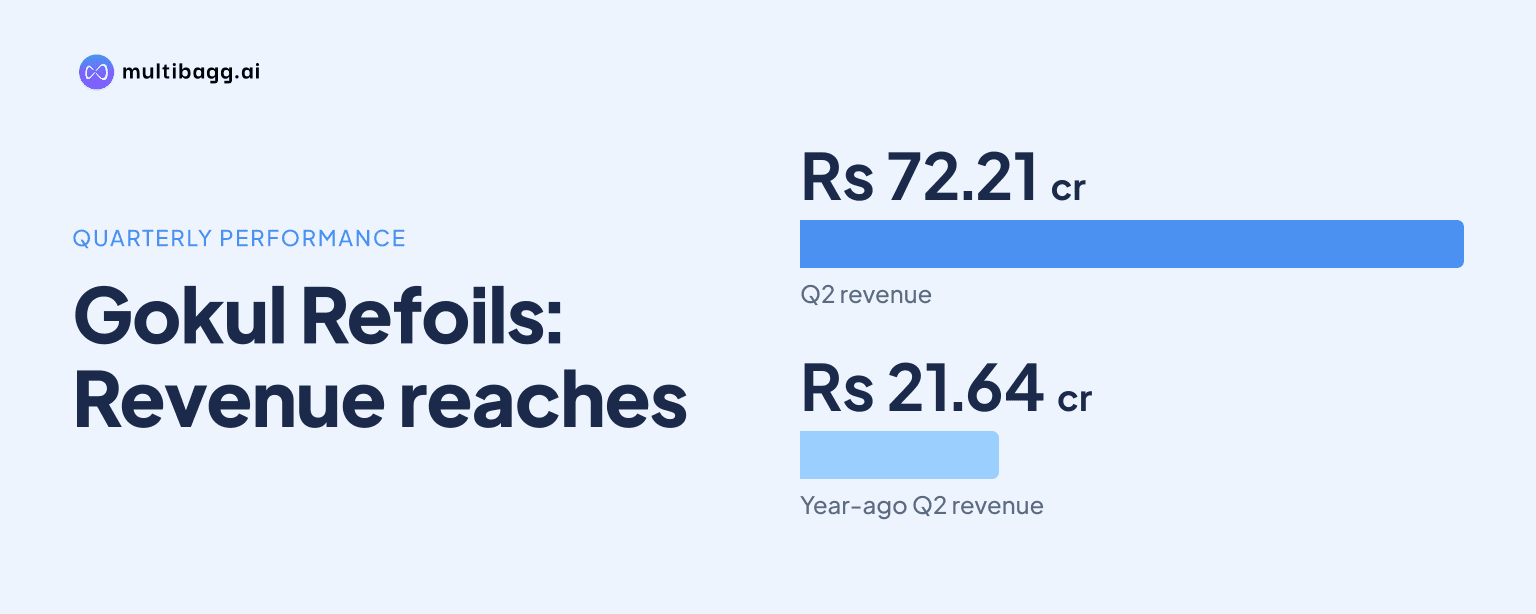
Gokul Refoils and Solvent Ltd reported standalone revenue from operations of ₹72.21 crore for the quarter ended September 30, 2026, compared with ₹21.64 crore a year earlier, while net profit declined to ₹0.90 crore from ₹1.35 crore. The board approved unaudited standalone and consolidated results for the quarter and half-year period.
Know Gokul Refoils and Solvent inside out
Results, valuation, peers and who's buying, in one view.
What did Gokul Refoils report for the September 2026 quarter?
Gokul Refoils and Solvent Ltd, referred to as Gokul Refoils, reported a sharp year-on-year increase in standalone revenue from operations for the quarter ended September 30, 2026. Revenue stood at ₹72.21 crore, against ₹21.64 crore in the corresponding quarter of the previous year.
This represents an increase of about 233.8% from the year-ago quarter. Total income rose to ₹73.64 crore from ₹23.23 crore over the same comparison period, an increase of about 217.0%.
Profitability, however, moved in the opposite direction. Standalone net profit was ₹0.90 crore, compared with ₹1.35 crore in the year-ago quarter. This is a decline of about 33.0%, despite the substantial rise in revenue and total income.
The figures supplied for the update are stated in lakhs and have been converted to crore for consistent presentation. Revenue of ₹7,220.84 lakh equals ₹72.21 crore, while net profit of ₹90.32 lakh equals ₹0.90 crore.
Why did the board meeting matter to investors?
The board meeting mattered because Gokul Refoils considered and approved unaudited standalone and consolidated financial results for the second quarter and half year ended September 30, 2026. Such approval formally places the period's financial performance before shareholders and the market through the company's reporting process.
The company had previously intimated that its board would meet on November 14, 2026 to consider these results. The company also indicated that trading restrictions for designated persons would remain in place until 48 hours after the results announcement, in line with the stated insider-trading compliance process.
The result update distinguishes between standalone and consolidated financial statements. The quarterly revenue, total income and net-profit figures highlighted in the supplied information are described as standalone figures. Investors should therefore avoid treating them as consolidated numbers unless the detailed financial statements confirm the same measures.
How do the key Q2 figures compare with last year?
Gokul Refoils recorded higher revenue and total income than in the September 2025 quarter, but lower standalone net profit. The divergence means the expansion in reported income did not translate into higher profit for the quarter on the figures provided.
The data indicates that profit fell by ₹0.44 crore year on year. The supplied update does not provide a detailed breakup of costs, other income, exceptional items, tax, margins or segment performance. It therefore does not establish the precise reason for the change in net profit.
Got a follow-up? Ask IRIS
What does the revenue-profit gap indicate?
The revenue-profit gap indicates that the company reported significantly higher sales and total income while retaining a lower amount as net profit than it did a year earlier. For investors, this makes profit conversion an important part of assessing the quarterly outcome rather than focusing on the revenue increase alone.
No conclusion on operating margins can be drawn from the reported revenue and net-profit figures alone. A full assessment would require the detailed profit-and-loss statement, including raw-material costs, employee expenses, finance costs, depreciation, tax and other expenses.
The reported numbers should also be read carefully because the supplied material contains references to other periods and figures that are not consistent with the standalone data presented for the September 2026 quarter. The clearly stated standalone quarterly figures are the basis for this report.
What should investors monitor after the results approval?
Investors should monitor the detailed unaudited standalone and consolidated financial statements released following the board's approval. The detailed disclosures can clarify the composition of revenue, expenses, profit before tax, cash-flow information and any notes that explain the year-on-year movement in profit.
The half-year results are also relevant because they provide a broader view than a single quarter. Any disclosed comparison of half-year revenue, profitability and balance-sheet items would help investors evaluate whether the September-quarter profit decline was limited to the quarter or reflected a wider trend.
Gokul Refoils operates in the edible oils sector, where reported financial performance can be influenced by procurement, processing, pricing and distribution conditions. The supplied information does not attribute the profit movement to any specific industry or company factor, so those explanations should be taken only from the company’s detailed filing.
Conclusion
Gokul Refoils reported standalone revenue of ₹72.21 crore and total income of ₹73.64 crore for the quarter ended September 30, 2026, substantially above the year-ago figures. But standalone net profit declined 33.0% to ₹0.90 crore, making the quarterly result a mix of strong reported income growth and weaker profit conversion.
The next item to watch is the detailed unaudited standalone and consolidated filing approved by the board for the quarter and half year ended September 30, 2026. Investors can use that disclosure to assess expenses, margins, half-year performance and the reasons, if stated, for the movement in profit.