










Granules India Limited cuts Scope 1 and 2 emissions 45.7%
Key highlights
- Granules reported a 45.7% absolute reduction in Scope 1 and 2 emissions as of FY26.
- Granules reported a 9% absolute reduction in Scope 3 emissions as of FY26.
- Renewable electricity represented 98% of Granules’ electricity mix in FY26, against a 100% target for 2030.
- Granules reported 93% waste diversion from landfill and 39% wastewater recycling in FY26.
powered by IRIS
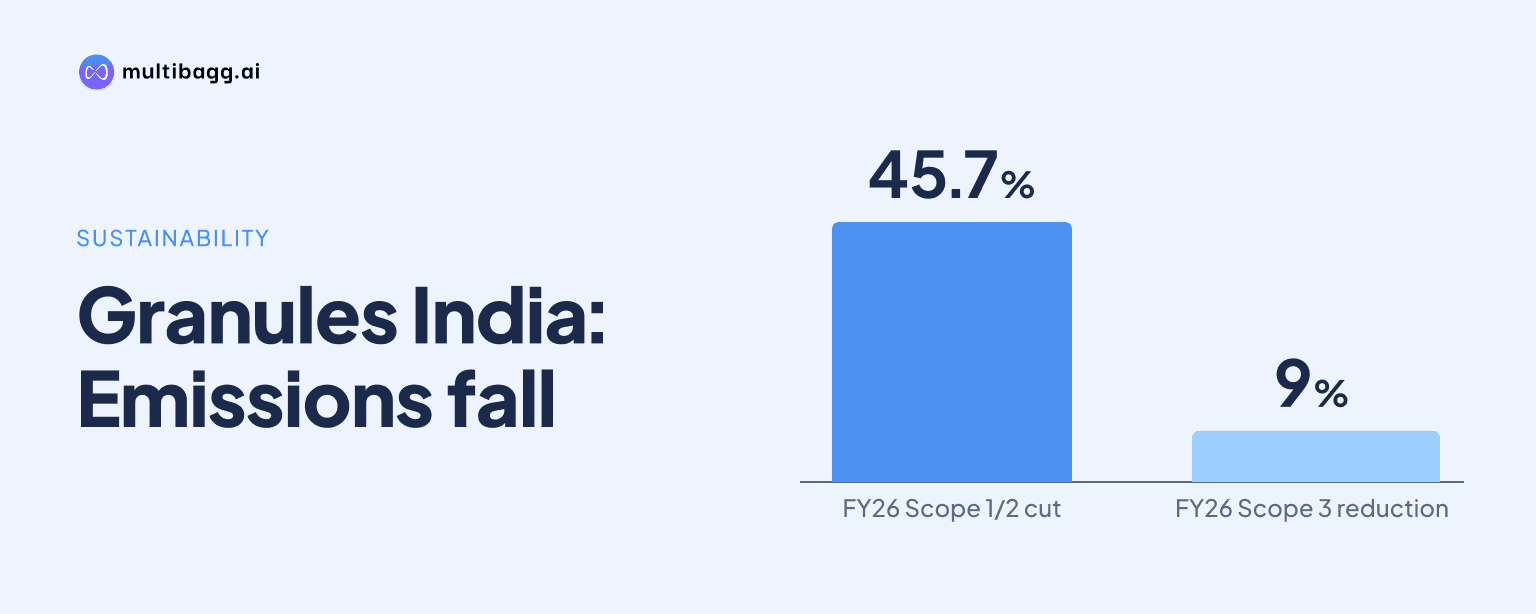
Granules reported a 45.7% absolute reduction in Scope 1 and 2 emissions as of FY26, compared with a 9% absolute reduction in Scope 3 emissions. The company disclosed the figures against its goal of a 42% absolute reduction across Scope 1, 2 and 3 by 2030 from FY23, alongside a net-zero commitment for 2050.
Know Granules India inside out
Results, valuation, peers and who's buying, in one view.
What did Granules report on emissions in FY26?
Granules reported a 45.7% absolute reduction in Scope 1 and 2 emissions as of FY26. The company presented this operational-emissions result in its sustainability scorecard alongside a 9% absolute reduction in Scope 3 emissions. The 36.7-percentage-point difference shows that reported progress varied materially between operational emissions and the wider value-chain category.
The FY26 presentation does not disclose tonnes of carbon dioxide equivalent, facility-level emissions, or a separate split between Scope 1 and Scope 2. It therefore establishes the reported percentage reduction but not the volume of emissions eliminated or each operational category’s contribution. Granules’ disclosed climate framework includes net zero by 2050 and a 2030 reduction goal measured from FY23.
How does Granules’ FY26 result compare with its 2030 goal?
Granules’ 45.7% Scope 1 and 2 reduction was 3.7 percentage points above the 42% figure in its 2030 climate goal. However, the presentation defines that target as a reduction across Scope 1, 2 and 3 from FY23, while reporting Scope 1 and 2 separately from Scope 3. The comparison does not establish that the combined 2030 target has been achieved.
Scope 3 progress was 9% as of FY26, or 33 percentage points below the stated 42% target figure. The presentation does not identify purchased goods, suppliers, transport, products or other value-chain categories that account for Scope 3 emissions or reductions. It does state that 82% of key suppliers, by procurement-spend coverage, had been assessed through environmental, social and governance criteria.
Granules says its near-term, long-term and net-zero targets have been validated and approved by SBTi and aligned to a 1.5°C pathway. That validation concerns the company’s disclosed targets, while the FY26 scorecard reports 45.7% Scope 1 and 2 progress and 9% Scope 3 progress. The presentation does not provide an annual emissions-reduction trajectory between FY26 and 2030.
Got a follow-up? Ask IRIS
What environmental operating measures did Granules disclose?
Granules reported that renewable electricity represented 98% of its electricity mix as of FY26, against a target to source 100% renewable electricity by 2030. The difference is 2 percentage points, making renewable electricity the closest disclosed environmental measure to its stated 2030 threshold. The company did not provide megawatt-hours of renewable power or identify facilities covered by the 98% share.
Water and waste measures were reported separately from emissions. Granules said it recycled 39% of wastewater as of FY26 under a water-positivity target for 2032, and diverted 93% of waste from landfill against a zero-waste-to-landfill target for 2030. The presentation does not provide wastewater volumes or total waste generated, so these percentages cannot be converted into absolute operating volumes.
Granules also reported zero reportable and fatal incidents under its workplace-safety objective. Its zero-waste-to-landfill certification covers Bontapally, Vizag Unit-IV, Unit-V and Genome Valley, with Bureau Veritas certifying a 93% overall waste-diversion rate and a Platinum Rating. Gagillapur and Bontapally were certified by the CII-Triveni Water Institute as “Aspiring Water Positive Plant” facilities.
What other sustainability commitments did Granules disclose?
Granules reported that its social programmes had positively touched more than 4.5 lakh lives, compared with a target to touch 1 million lives through corporate social responsibility programmes by FY2030. The company also reported a 26% increase in women’s employment from the FY23 comparison point, against its objective of a 100% increase by 2030. The presentation does not give underlying employee numbers or programme beneficiaries by location.
Supplier assessment was above the company’s stated coverage threshold in FY26. Granules reported that 82% of key suppliers had been assessed through ESG criteria, compared with its goal of covering at least 80% of suppliers by procurement spend. This was 2 percentage points above the stated threshold, although the disclosure does not provide the supplier count or assessment outcomes.
The presentation lists several external ratings and memberships with dates. Granules reported an EcoVadis Gold rating in May 2025, placing it in the top 5%, a CDP Climate Change score of A for 2025, and an S&P Global ESG score of 62 out of 100 as of 18 December 2025. It also says it joined the UN Global Compact in September 2023, became a PSCI Supplier Partner in July 2025, and joined the Women’s Empowerment Principles in December 2025.
Conclusion
Granules’ FY26 scorecard reports a 45.7% absolute reduction in Scope 1 and 2 emissions and a 98% renewable-electricity share, while Scope 3 reduction was 9%. The difference matters because the 2030 climate goal covers Scope 1, 2 and 3 from an FY23 baseline, requiring operational and value-chain progress to be considered separately.
The next disclosed milestones are 100% renewable electricity and zero waste to landfill by 2030, water positivity by 2032, and net zero by 2050. Future Granules disclosures can clarify the combined Scope 1, 2 and 3 outcome, the pathway from the 9% Scope 3 reduction, and supporting emissions volumes or category-level data.