










Graviss retains subsidiary loans as recoverable after erosion
Key highlights
- Three Graviss subsidiaries had accumulated losses exceeding net worth at September 30, 2026.
- Graviss said its interest-free loans to the three subsidiaries were good for recovery.
- Standalone loss after tax narrowed to Rs 2.19 crore in the six months ended September 30, 2026, from Rs 2.50 crore a year earlier.
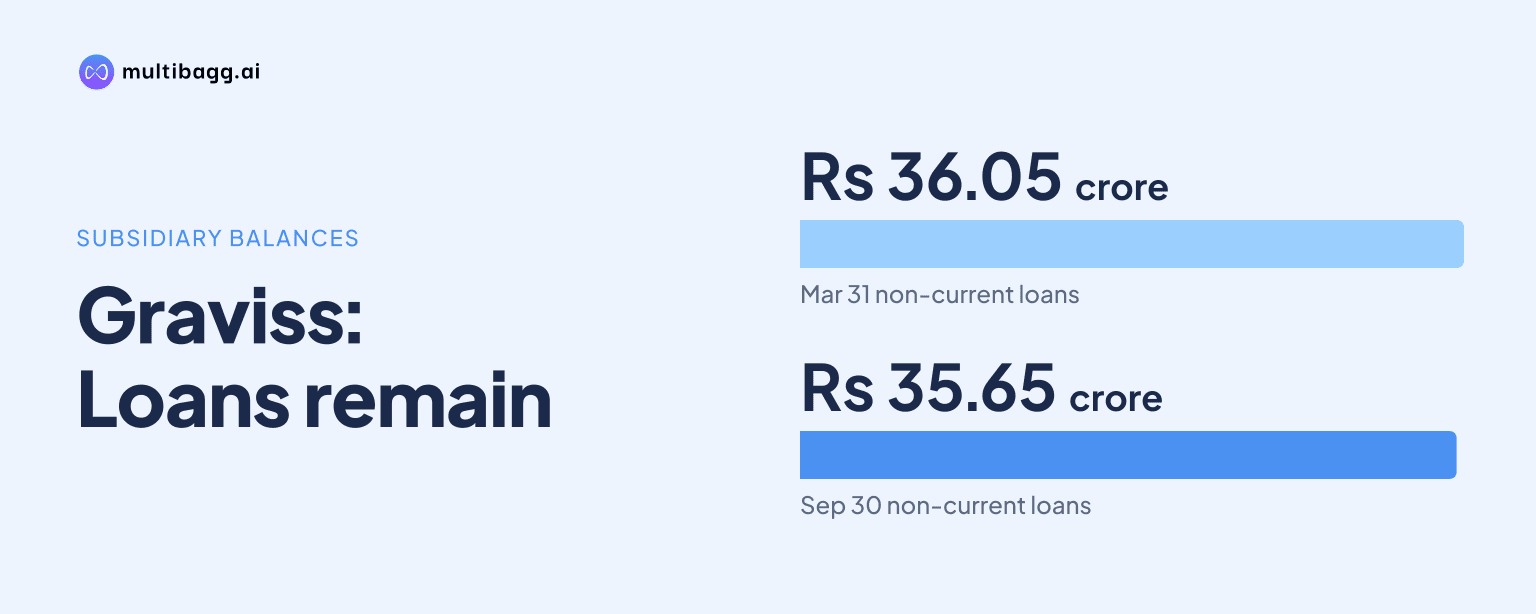
- Standalone non-current loans were Rs 35.65 crore at September 30, 2026, versus Rs 36.05 crore at March 31, 2026.
powered by IRIS
Graviss Hospitality Limited retained its investment values and classified interest-free loans to three subsidiaries as recoverable at September 30, 2026, although their accumulated losses exceeded net worth. Management based that assessment on its long-term interest, expected regular orders and alternate business plans, while the auditor highlighted the matter without modifying its limited-review conclusion.
Know Graviss Hospitality inside out
Results, valuation, peers and who's buying, in one view.
Why does Graviss consider subsidiary loans recoverable?
Graviss considers its interest-free loans to three subsidiaries good for recovery despite their accumulated losses exceeding net worth at September 30, 2026. In the notes to its standalone results for the quarter and six months ended that date, Graviss said it had a long-term interest in the subsidiaries and did not recognise any diminution in the value of its investments.
Graviss said its conclusion rests on management's view that the subsidiaries will get regular orders and are exploring alternate business plans. The November 6, 2026 filing does not state the value of the interest-free loans extended to each subsidiary, the investment value attached to each entity, or a date by which the planned business alternatives are expected to take effect.
The accounting assessment is therefore based on management's stated recovery rationale rather than a disclosed subsidiary-level financial forecast. The standalone note for September 30, 2026 does not quantify accumulated losses, net-worth deficits, expected orders or repayment schedules for any of the three subsidiaries.
Which Graviss subsidiaries are covered by the disclosure?
Graviss's consolidated limited-review report names Graviss Catering Private Limited, Graviss Hotels and Resorts Limited and Graviss Restaurants Private Limited as the three subsidiaries in the group. The standalone results note refers to three subsidiaries whose accumulated losses exceeded net worth as at September 30, 2026, but does not allocate that condition among the named companies.
The distinction between standalone and consolidated reporting is relevant to the disclosure dated November 6, 2026. The standalone note addresses Graviss's own investments and loans, whereas the consolidated report covers the parent and its subsidiaries for the quarter ended September 30, 2026 and the six-month period from April 1, 2026.
Graviss identifies hospitality as its only reportable business segment in the standalone results. As a result, the filing does not provide separate revenue, expense, asset or loss figures for catering, hotels and resorts, or restaurants, and does not identify which subsidiary is expected to receive regular orders.
What did Graviss's auditor conclude on this issue?
A. T. Jain & Co. included the subsidiary losses and recoverability assessment in an emphasis of matter in its limited-review report dated November 6, 2026. The auditor noted that accumulated losses at the three subsidiaries exceeded net worth at September 30, 2026 and recorded management's view that investments had not diminished and loans were recoverable.
The auditor did not modify its conclusion because of the matter. Its report said nothing had come to its attention to indicate that the standalone unaudited results for the period from April 1, 2026 to September 30, 2026 had not made required disclosures or contained a material misstatement.
A. T. Jain & Co. also stated that a review is narrower in scope than an audit and provides moderate assurance. That means the report does not constitute an audit opinion, even though it specifically draws attention to the losses, net-worth erosion and management's assessment of loan recovery.
Got a follow-up? Ask IRIS
How did Graviss's first-half standalone result change?
Graviss reported a standalone loss after tax of Rs 2.19 crore for the six months ended September 30, 2026, compared with a loss of Rs 2.50 crore for the corresponding six months of 2025. Total income rose to Rs 26.41 crore from Rs 23.25 crore, while total expenses increased to Rs 29.04 crore from Rs 26.97 crore.
The higher income and expense base resulted in a loss before tax of Rs 2.63 crore for the 2026 first half, compared with Rs 3.72 crore a year earlier. This period-on-period narrowing in the standalone loss provides context for the parent company, but the filing does not connect it to the financial performance of any one subsidiary.
For the quarter ended September 30, 2026, Graviss reported total income of Rs 12.76 crore and a loss after tax of Rs 1.19 crore. In the preceding quarter ended June 30, 2026, total income was Rs 13.65 crore and the loss after tax was Rs 1 crore, showing that the second-quarter loss increased from the immediately preceding quarter.
What do Graviss's standalone loan and investment balances show?
Graviss reported non-current loans of Rs 35.65 crore at September 30, 2026, down from Rs 36.05 crore at March 31, 2026. Current loans were Rs 21.83 lakh, up from Rs 12.20 lakh at the March 31, 2026 year-end, but the balance sheet does not say what part of either aggregate loan category relates to the three subsidiaries.
Non-current investments stood at Rs 27.82 lakh at September 30, 2026, versus Rs 25.14 lakh at March 31, 2026. Current investments declined to Rs 5.57 crore from Rs 8.92 crore over the same period, and neither investment line can be treated as a disclosed carrying value for investments in the subsidiaries.
Total standalone assets were Rs 243.60 crore at September 30, 2026, compared with Rs 245.69 crore at March 31, 2026. Total equity declined to Rs 213.90 crore from Rs 216.09 crore, while total liabilities increased to Rs 29.70 crore from Rs 29.60 crore.
Conclusion
Graviss has maintained that its investments in three subsidiaries have not diminished and that interest-free loans to them remain recoverable, despite accumulated losses exceeding their net worth at September 30, 2026. The disclosure is significant because the filing provides no subsidiary-level loan amount, investment carrying value, loss figure or net-worth deficit to quantify the exposure.
The next issue to watch is whether the subsidiaries obtain the regular orders anticipated by management and advance their alternate business plans. Graviss disclosed no implementation date, repayment timetable, financial target or net-worth restoration plan in its November 6, 2026 results filing, so subsequent disclosures will show whether its recovery assessment changes.