










Greenlam Industries Limited Revenue Rises 18.2% to ₹796.7 Crore
Key highlights
- Greenlam reported ₹796.7 crore revenue for the quarter ended June 30, 2026, up 18.2% year on year.
- Working capital days improved by 3 days year on year to 56 days in the June 2026 quarter.
- Greenlam's net debt stood at ₹933.7 crore as of June 30, 2026.
- Revenue grew across segments except the engineered door business, with momentum reported domestically and internationally.
powered by IRIS
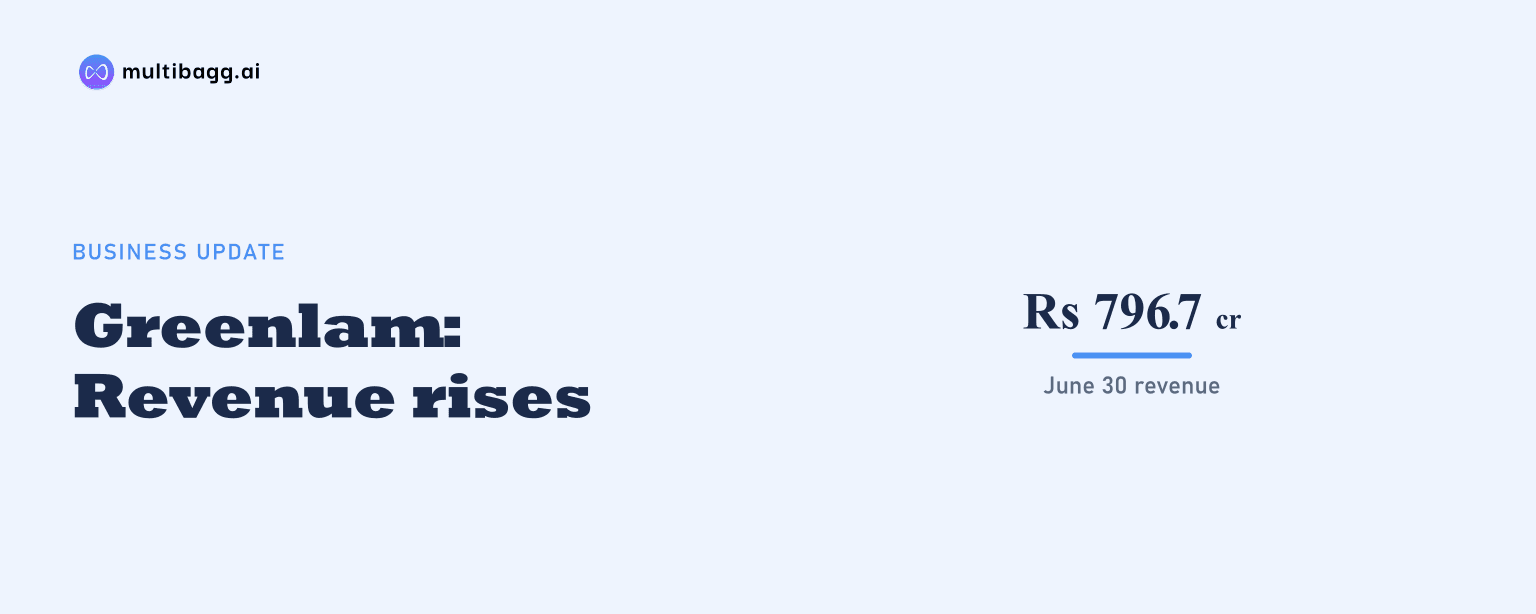
Greenlam Industries Limited reported revenue of ₹796.7 crore for the quarter ended June 30, 2026, an 18.2% year-on-year increase, while working capital days improved by three days to 56 and net debt stood at ₹933.7 crore. The result indicates broad-based revenue growth across most of Greenlam's businesses.
Know Greenlam Industries inside out
Results, valuation, peers and who's buying, in one view.
What did Greenlam report for the June 2026 quarter?
Greenlam reported quarterly revenue of ₹796.7 crore, representing year-on-year growth of 18.2% for the period ended June 30, 2026. The company disclosed these figures in its investor presentation on its financial results. Revenue growth was recorded across segments, except the engineered door business.
The company described the performance as broad-based, supported by continued momentum in both domestic and international operations. The disclosure does not provide segment-wise revenue figures in the available material, so the relative contribution of individual businesses cannot be quantified from the presentation.
Greenlam manufactures laminates and also operates in decorative veneers, engineered wooden flooring, engineered wooden doors, plywood, plain chipboard and prelaminated chipboard. Its laminate portfolio includes compact laminates, fire-retardant laminates, post-forming laminates and other decorative surface products.
Which businesses supported Greenlam's revenue growth?
Greenlam said revenue expanded across its segments except for the engineered door business. Its domestic and international businesses both contributed to the quarter's overall momentum, according to the investor presentation.
The company did not specify why the engineered door business did not record revenue growth during the quarter. It also did not disclose an individual revenue figure, margin, volume or operating metric for that business in the information provided.
The broader product range gives Greenlam exposure to several parts of the interior surfacing and wood-panel market. Laminates remain central to its manufacturing operations, alongside newer or adjacent categories including doors, flooring, plywood and chipboard products.
How did Greenlam's debt and working capital change?
Greenlam's working capital cycle improved by three days year on year to 56 days as of the June 2026 quarter, while net debt was ₹933.7 crore as of June 30, 2026. Working capital days measure the time generally required to convert operating investments such as inventory and receivables into cash.
A reduction in working capital days can support cash conversion, although the presentation does not provide the underlying inventory, receivables or payable balances behind the change. The company also did not provide a comparison figure for net debt from the corresponding prior-year date in the supplied disclosure.
For context, Greenlam had reported net debt of ₹940.1 crore as of March 2026. The June-end figure of ₹933.7 crore was therefore ₹6.4 crore lower than the March-end amount, based on the disclosed numbers. This comparison is between sequential reporting dates and is not a year-on-year comparison.
Got a follow-up? Ask IRIS
How does the June-quarter update compare with earlier disclosures?
Greenlam's June-quarter revenue followed reported growth in its prior disclosed periods. For the quarter ended March 31, 2026, the company reported revenue of ₹857.7 crore, up 25.8% year on year, and net profit of ₹40.5 crore.
For the quarter and nine months ended December 31, 2025, Greenlam had reported quarterly revenue of ₹706.3 crore, up 17.3% year on year. Its gross profit for that period was ₹392.5 crore and gross margin was 55.6%, with gross profit growth of 18.6% year on year.
These previous disclosures show continued reported revenue growth across recent quarters, although quarterly figures are not directly comparable without considering business seasonality, product mix and the reporting-period context. The supplied June 2026 update does not state gross profit, EBITDA, net profit or margin figures.
What does the update mean for investors and the wood-panel industry?
For investors, the main reported development is that Greenlam maintained double-digit revenue growth despite weaker growth in its engineered door business. The company also reported a shorter working capital cycle, while net debt remained at ₹933.7 crore at the end of June 2026.
No share-price movement, valuation measure, dividend announcement or management outlook was included in the supplied material. As a result, the disclosure supports an assessment of operating momentum and balance-sheet metrics, but it does not establish a market reaction or a forward earnings forecast.
For the industry, Greenlam's update reflects activity across domestic and overseas markets for decorative surfaces and related interior products. However, the presentation does not provide broader sector demand data, pricing trends or raw-material cost changes for the June quarter.
Conclusion
Greenlam reported ₹796.7 crore in revenue for the quarter ended June 30, 2026, with 18.2% year-on-year growth across most businesses. Domestic and international momentum supported the result, while the engineered door business was the stated exception. The company's working capital days improved to 56, and net debt was ₹933.7 crore at quarter-end.
The next disclosures to watch are the company's detailed profitability metrics, segment-level performance and any explanation of the engineered door business trend. Investors may also track whether Greenlam maintains its reported revenue momentum while managing net debt and working capital through subsequent quarters.