










GTL Ltd Board to Consider September Quarter Results November 5
Key highlights
- GTL Ltd's board is scheduled to consider September 2026 unaudited results on November 5, 2026.
- The supplied Q2 FY27 summary reports revenue of Rs 289.57 crore, up 8.5% year on year.
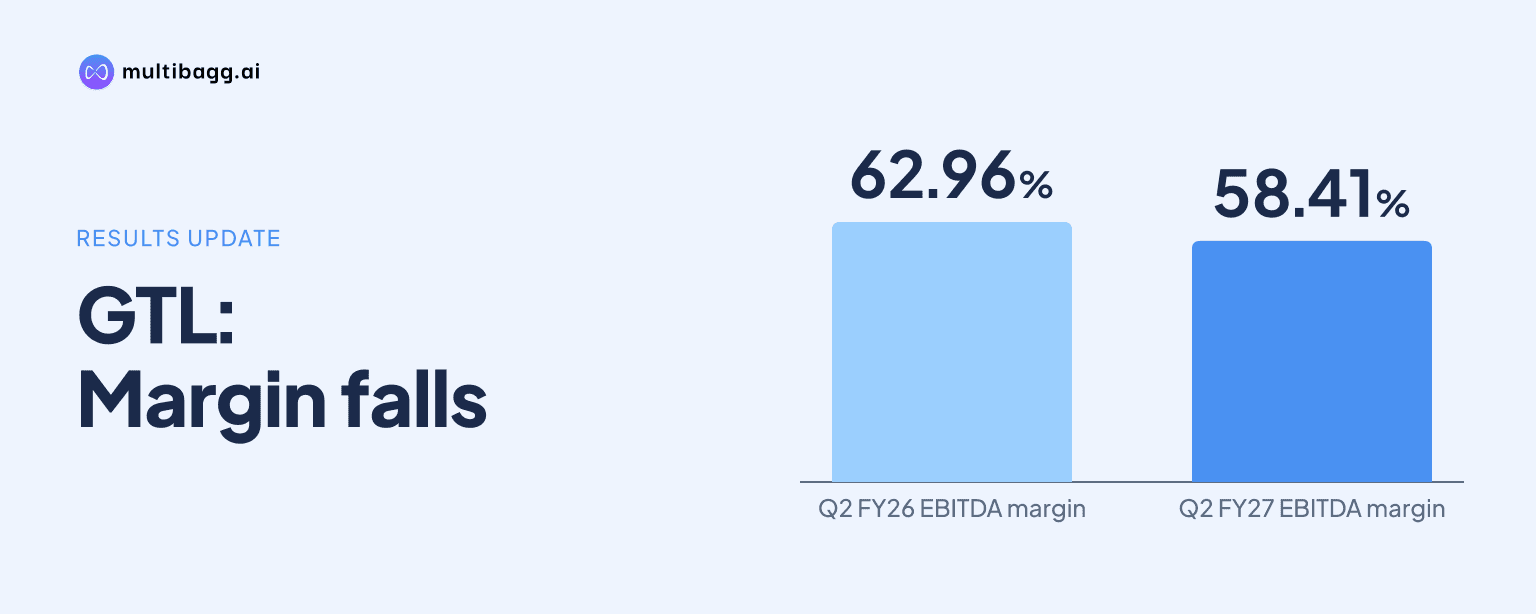
- Reported EBITDA margin was 58.41% in Q2 FY27, compared with 62.96% in Q2 FY26.
- Reported PAT was Rs 120.44 crore in Q2 FY27, up Rs 2.57 crore year on year.
powered by IRIS
GTL Ltd is scheduled to consider and approve unaudited financial results for the quarter and period ended September 30, 2026, at its board meeting on November 5, 2026. The supplied Q2 FY27 summary reports revenue of Rs 289.57 crore, up 8.5% year on year, alongside lower operating and net margins.
Know GTL inside out
Results, valuation, peers and who's buying, in one view.
What will GTL Ltd consider at its November 5 board meeting?
GTL Ltd informed BSE that its board of directors is scheduled to meet on November 5, 2026, to consider and approve unaudited financial results for the quarter and period ended September 30, 2026. The board-meeting intimation was announced on October 29, 2026.
The scheduled meeting relates to the second quarter of FY27, covering the three months ended September 30, 2026, as well as the corresponding half-year period. The company's preceding earnings date in the supplied information is August 11, 2026, for Q1 FY27, while November 5 is listed as the upcoming earnings date for Q2 FY27.
Board-meeting notices are routine regulatory disclosures for listed companies, but they establish the date on which the board is expected to review the period's financial statements. Investors generally use the final exchange filing, including detailed financial statements and notes, as the primary record for quarterly performance.
What Q2 FY27 financial figures are reported for GTL Ltd?
The supplied financial summary states that GTL Ltd reported Q2 FY27 revenue of Rs 289.57 crore, compared with Rs 267.20 crore in Q2 FY26 and Rs 277.12 crore in Q1 FY27. This represents year-on-year revenue growth of 8.5%, or Rs 22.37 crore, and a sequential increase of Rs 12.45 crore.
Profit after tax, or PAT, was stated at Rs 120.44 crore for Q2 FY27, an increase of Rs 2.57 crore from the year-earlier quarter. EBITDA margin was reported at 58.41%, below 62.96% in Q2 FY26. PAT margin was reported at 41.59%, down from the year-earlier level by 2.52 percentage points.
The summary also compares the quarter with Q1 FY27. EBITDA margin was 69.92% in the June 2026 quarter, making the Q2 margin lower by 11.51 percentage points. PAT margin was 49.73% in Q1 FY27, compared with 41.59% in Q2 FY27, a decline of 8.14 percentage points.
What supported GTL Ltd's reported revenue growth?
According to the supplied summary, higher transport volumes across the HP, LP and HAPI networks supported standalone revenue in the September quarter. HP Grid volume increased 9% year on year, LP Grid volume grew 31%, and HAPI Grid volume rose 17%.
These volume movements provide the stated operating explanation for the increase in quarterly revenue. Revenue growth, however, did not result in higher margins compared with either the year-earlier quarter or the immediately preceding quarter, based on the supplied EBITDA and PAT margin figures.
The difference between topline growth and margin movement is relevant when assessing quarterly performance. Revenue rose from both comparison periods, but EBITDA increased by only Rs 92 lakh year on year, according to the supplied information, while PAT increased by Rs 2.57 crore.
Got a follow-up? Ask IRIS
Why do the margin changes matter to investors?
The reported margin decline means that GTL Ltd generated a smaller proportion of revenue as EBITDA and profit after tax than in the comparable periods. EBITDA margin fell 4.55 percentage points year on year, while the decline from Q1 FY27 was 11.51 percentage points.
For investors, this makes the detailed quarterly filing important because it can provide the underlying expense and income components behind the movement in margins. The board notice itself only identifies the agenda as approval of unaudited results and does not provide an explanation for costs, pricing, or other financial line items.
The supplied information also says that the company announced unaudited results for the quarter and half year ended September 30, 2026, on November 3, 2026. This date differs from the November 5 board-meeting date in the BSE intimation, so investors should verify the final exchange filing and board outcome for the formal publication date and complete results.
How does this announcement fit into GTL Ltd's recent reporting cycle?
GTL Ltd's disclosed reporting cycle includes an earlier board meeting scheduled for May 13, 2026, to consider audited results, with that meeting announced on May 6. The June-quarter unaudited results are listed with an earnings date of August 11, 2026, followed by the September-quarter board meeting scheduled for November 5.
The September-quarter review is therefore the next scheduled financial-results event in the supplied timeline. It covers both the second quarter and first half of FY27, allowing investors to assess whether the reported increase in revenue and the lower margins persist over a longer six-month period.
The supplied material also contains separate references to GTL Infrastructure Ltd, including its November 6, 2026 board meeting and Q1 FY27 financial performance. Those references concern a different company and should not be treated as GTL Ltd's financial results or board timetable.
Conclusion
GTL Ltd's November 5 board meeting is scheduled to consider unaudited financial results for the quarter and period ended September 30, 2026. The supplied Q2 FY27 data indicates revenue of Rs 289.57 crore, up 8.5% year on year, while EBITDA and PAT margins were below the corresponding levels in Q2 FY26 and Q1 FY27.
The next item to watch is the formal board outcome and detailed unaudited financial filing for the September quarter and first half of FY27. That disclosure should clarify the final reporting date, the full financial statements, and the factors behind the reported margin movement.