










Gujarat Apollo H1 standalone profit falls 83% on costs
Key highlights
- Gujarat Apollo’s standalone H1 revenue rose 71% to Rs 25.15 crore from Rs 14.70 crore.
- Gujarat Apollo’s standalone H1 profit after tax fell 83% to Rs 51.53 lakh from Rs 2.97 crore.
- Gujarat Apollo’s consolidated H1 profit after tax declined 20% to Rs 2.54 crore from Rs 3.18 crore.
- Two subsidiaries reported combined H1 profit after tax of Rs 2.02 crore and assets of Rs 310.70 crore.
powered by IRIS
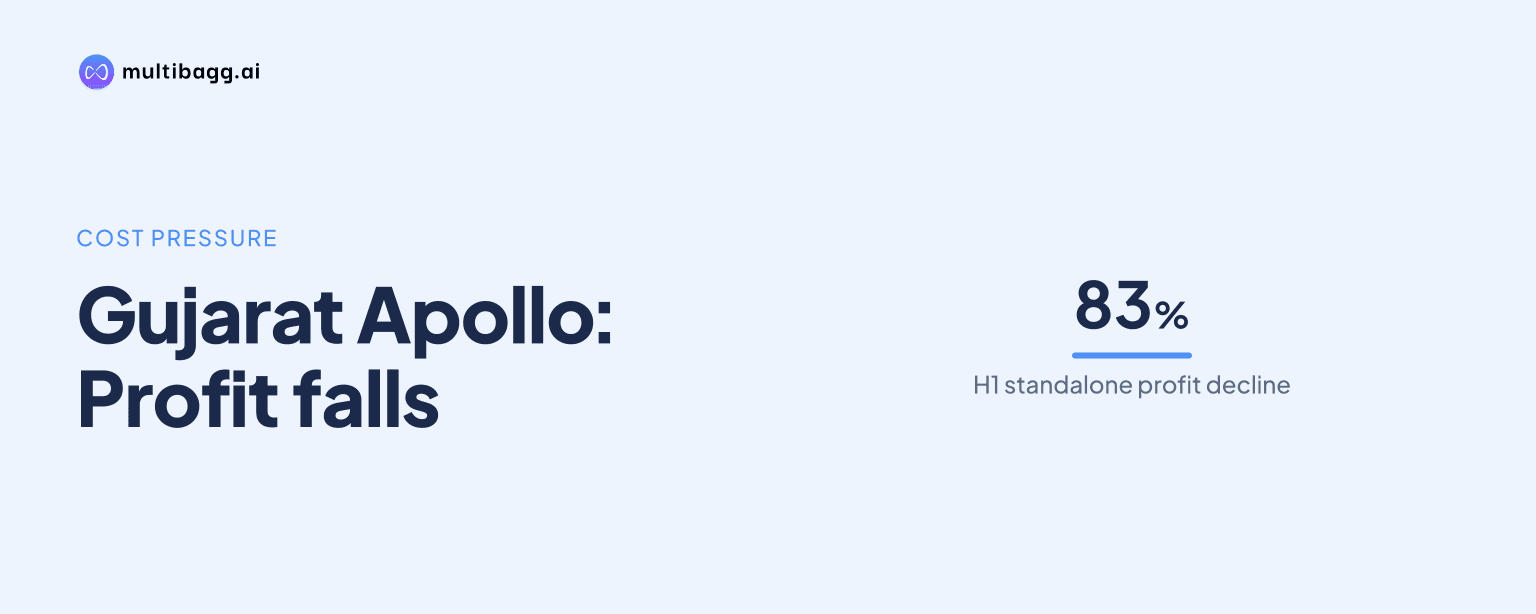
Gujarat Apollo Industries Limited reported standalone profit after tax of Rs 51.53 lakh for the half year ended September 30, 2026, down 83% from Rs 2.97 crore a year earlier, despite revenue from operations rising 71% to Rs 25.15 crore. Gujarat Apollo’s consolidated profit after tax declined 20% to Rs 2.54 crore.
Know Gujarat Apollo Industries inside out
Results, valuation, peers and who's buying, in one view.
Why did Gujarat Apollo’s standalone H1 profit fall?
Gujarat Apollo’s standalone profit fell because expenses grew faster than income in the half year ended September 30, 2026. Total expenses rose to Rs 31.67 crore from Rs 20.15 crore in the corresponding 2025 half, while total income increased to Rs 32.53 crore from Rs 22.46 crore. Profit before tax therefore fell to Rs 86.04 lakh from Rs 2.31 crore.
Tax also changed the final standalone outcome. Gujarat Apollo recorded deferred-tax expense of Rs 34.51 lakh in H1 2026, compared with deferred-tax income of Rs 65.19 lakh in H1 2025. Profit after tax consequently declined to Rs 51.53 lakh from Rs 2.97 crore, and basic earnings per share fell to Rs 0.40 from Rs 2.51.
What changed in Gujarat Apollo’s standalone revenue and costs?
Gujarat Apollo’s standalone revenue from operations increased by Rs 10.44 crore year on year to Rs 25.15 crore in H1 2026. The quarter ended September 30, 2026 contributed Rs 17.74 crore, compared with Rs 8.08 crore in the September 2025 quarter, while the preceding June 2026 quarter contributed Rs 7.41 crore.
Several cost lines increased over the half year. Material consumption rose to Rs 14.67 crore from Rs 9.68 crore, inventory changes rose to Rs 5.26 crore from Rs 1.55 crore, and other expenses increased to Rs 6.03 crore from Rs 4.01 crore. Employee-benefit expense rose to Rs 4.26 crore from Rs 3.58 crore, although finance costs decreased to Rs 41.18 lakh from Rs 56.99 lakh.
How did Gujarat Apollo’s consolidated result compare?
Gujarat Apollo reported consolidated profit after tax of Rs 2.54 crore for H1 2026, down from Rs 3.18 crore in H1 2025. This was Rs 2.03 crore above the standalone profit of Rs 51.53 lakh, showing that results included in the group accounts materially changed the reported outcome relative to the parent-company accounts.
Consolidated revenue from operations increased 25% to Rs 29.95 crore from Rs 23.97 crore, a slower rate than the 71% standalone revenue increase. Consolidated profit before tax was Rs 4.55 crore, compared with Rs 4.68 crore a year earlier, while total tax expense rose to Rs 2.00 crore from Rs 1.50 crore. Basic consolidated earnings per share were Rs 2.14, against Rs 2.93.
Got a follow-up? Ask IRIS
Which entities are included in Gujarat Apollo’s group accounts?
Gujarat Apollo’s consolidated financial statements include wholly owned subsidiaries AEML Investments Limited and Apollo FBC Crushing Equipment’s Limited, along with associate PFH Agri Equipment India Private Limited. The filing says Gujarat Apollo operates in one segment: manufacturing and sale of construction and mining machinery and related spare parts.
The consolidated auditor said the two subsidiaries had combined total assets of Rs 310.70 crore at September 30, 2026, H1 revenue of Rs 11.54 crore and net profit after tax of Rs 2.02 crore. Their total comprehensive income was Rs 1.12 crore. The filing does not provide an entity-by-entity reconciliation from those results to Gujarat Apollo’s consolidated profit.
What do Gujarat Apollo’s balance sheet and cash flows show?
Gujarat Apollo’s standalone total assets were Rs 292.77 crore at September 30, 2026, compared with Rs 288.22 crore at March 31, 2026. Standalone loans and advances were Rs 155.97 crore and investments were Rs 55.32 crore at September 30, while total equity was Rs 263.93 crore, down from Rs 266.01 crore at March 31.
Standalone borrowings totalled Rs 9.39 crore at September 30, 2026, comprising Rs 3.09 crore of non-current borrowings and Rs 6.30 crore of current borrowings. This compared with aggregate borrowings of Rs 10.66 crore at March 31, 2026. Net cash flow from operating activities was Rs 3.35 crore in H1 2026, whereas the full year ended March 31, 2026 recorded an operating cash outflow of Rs 15.99 crore.
What did the auditors say about Gujarat Apollo’s H1 results?
Gujarat Apollo’s standalone auditor issued a limited-review conclusion dated November 14, 2026, stating that nothing had come to its attention to indicate a material misstatement in the unaudited results. The review covered the quarter ended September 30, 2026 and the six-month period from April 1, 2026, under Standard on Review Engagements 2410.
The consolidated auditor also gave an unmodified conclusion on November 14, 2026. It said it had not itself reviewed the two subsidiaries whose combined assets were Rs 310.70 crore and H1 revenue was Rs 11.54 crore, relying instead on other auditors’ reports. The auditor said its conclusion was not modified on that basis.
Conclusion
Gujarat Apollo’s H1 2026 results show a marked difference between parent-company and group performance. Standalone revenue rose to Rs 25.15 crore, but higher expenses and the shift to deferred-tax expense reduced standalone profit to Rs 51.53 lakh. Consolidated profit was higher at Rs 2.54 crore, although it also declined year on year, with subsidiary results material to the group position.
Investors will next watch the results for the quarter ending December 31, 2026 for evidence of whether standalone costs moderate after the Rs 31.67 crore recorded in H1. Gujarat Apollo did not disclose an earnings target or operating guidance in its November 14, 2026 filing, and it did not provide an entity-level earnings reconciliation for the subsidiaries and associate.