








HEG approves Rs 650 crore Mandideep expansion to 115,000 tonnes
MAX Plan at ₹4,999/yr

Find your next multibaggerBe a Pro Investor
Research stocks and track your picks on the go. Download the app.
Key highlights
- HEG approved a Rs 650 crore brownfield expansion at Mandideep.
- Annual graphite-electrode capacity is planned to rise 15% from 100,000 to 115,000 tonnes.
- HEG targets production commencement from the additional capacity in Q1 CY2028.
- HEG exports approximately 65% to 70% of production to more than 35 countries.
powered by IRIS
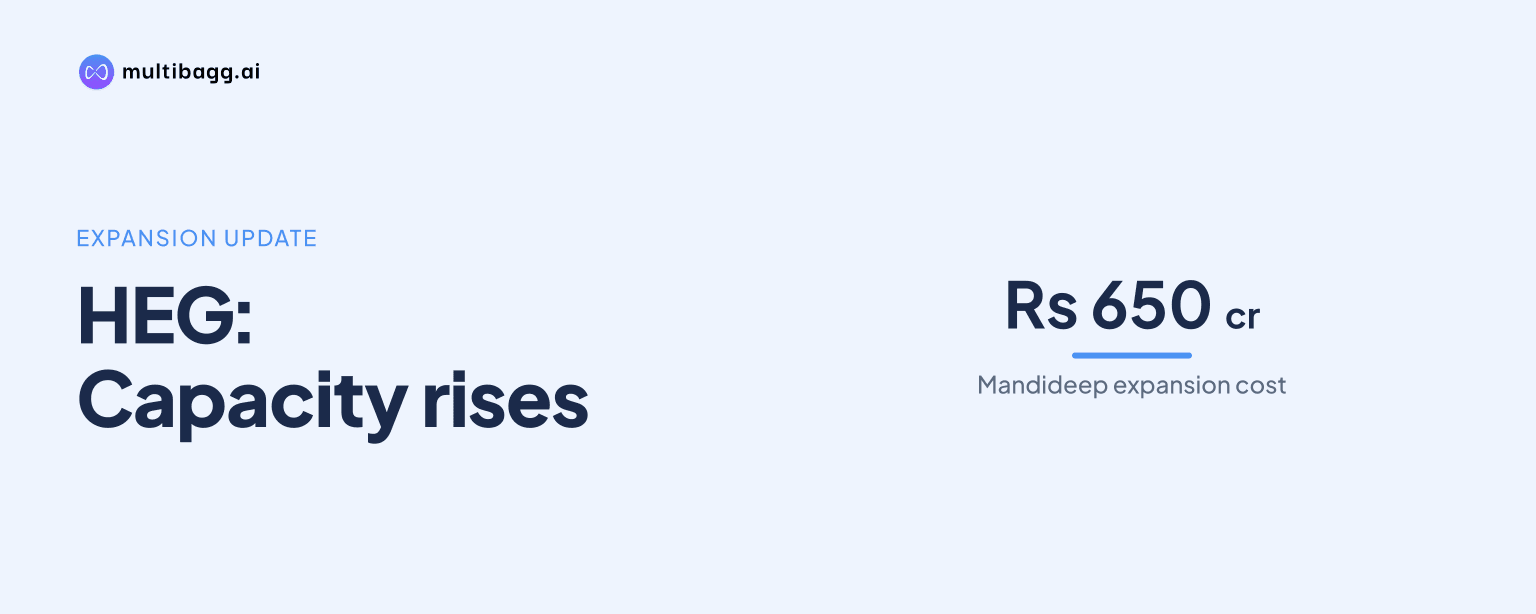
HEG Limited has approved a Rs 650 crore brownfield expansion at Mandideep that will raise annual Ultra High Power graphite-electrode capacity from 100,000 tonnes to 115,000 tonnes, a 15% increase, with production targeted in Q1 CY2028. The plan was announced on November 27, 2026, the day HEG listed separately on BSE and NSE.
Know HEG inside out
Results, valuation, peers and who's buying, in one view.
What capacity will HEG add at Mandideep?
HEG will add 15,000 tonnes per annum of graphite-electrode capacity at Mandideep, taking the site's annual capacity from 100,000 tonnes to 115,000 tonnes. The Board-approved project is a 15% increase over the existing capacity and is confined to HEG's current Mandideep facility in Madhya Pradesh.
The project covers Ultra High Power, or UHP, graphite electrodes used in electric arc furnace, or EAF, steelmaking. HEG describes Mandideep as the world's largest single-site UHP graphite-electrode manufacturing facility and says it has operated in the graphite-electrode industry since 1976.
The 115,000-tonne figure is a capacity target rather than a sales or production forecast. HEG has not disclosed expected plant utilisation, electrode prices, revenue from the added capacity or the volume that may be exported after commissioning.
When will HEG begin output from the expansion?
HEG is targeting production commencement from the Mandideep expansion in the first quarter of calendar year 2028. In its November 27, 2026 release, the company also described the expected start as early 2028, while specifying Q1 CY2028 as the production target.
The Rs 650 crore project is a brownfield development using existing Mandideep infrastructure. HEG said its capital intensity will be less than half that of a greenfield plant, but did not provide the project's cost per tonne or a comparable greenfield capital-cost estimate.
HEG has not set out construction stages, equipment-order dates, regulatory milestones or the date at which the facility is expected to operate at its full planned 115,000-tonne annual capacity. The disclosed operational milestone is the Q1 CY2028 production start.
Why is HEG expanding graphite-electrode capacity?
HEG cited planned growth in EAF steelmaking outside China as the main demand backdrop for its 15,000-tonne addition. The company said more than 100 million tonnes of new EAF steel capacity is scheduled to come on stream outside China by 2030, and graphite electrodes are an essential consumable in that route.
According to HEG, EAF steelmaking emits approximately one-fourth of the carbon of the blast-furnace route. Management identified economics, regulation and the requirement for lower-carbon steel as factors supporting wider EAF adoption, without providing an estimate of future electrode demand or HEG's expected market share.
HEG also contrasted planned EAF additions with the supply environment outside China, where it said no new company has entered the graphite-electrode industry since 1976. The company did not quantify a supply-demand gap, but said the Mandideep project is intended to meet the demand opportunity.
Got a follow-up? Ask IRIS
What operating base supports HEG's capacity plan?
HEG exports approximately 65% to 70% of its production to more than 35 countries, providing an existing international sales base ahead of the Q1 CY2028 capacity target. The company said it supplies many of the world's leading steel companies, though it did not identify customers or disclose country-level shipment volumes.
The Mandideep operation is supported by an 18 megawatt, or MW, captive hydro plant at Tawa and a 6 MW solar plant at Mandideep. HEG said the combined 24 MW of renewable power supplies clean and reliable energy for a manufacturing process it describes as highly energy intensive.
Management linked the site's scale, location and captive power assets to its ability to operate through business cycles. The November 2026 announcement does not disclose electricity consumption, power costs, the share of plant demand met by the 24 MW assets or operating margins.
How did HEG become a separately listed company?
HEG began trading as an independently listed company on BSE and NSE on November 27, 2026, after the demerger of the graphite-electrodes business. The National Company Law Tribunal, Indore Bench, sanctioned the Composite Scheme of Arrangement on August 13, 2026, and the scheme took effect on September 1, 2026.
Shareholders on the September 7, 2026 record date received one fully paid-up HEG equity share with a face value of Rs 2 for every one Rs 2 share held in HEG Advanced Materials Limited. HEG trades under scrip code 544896 on BSE and the HEGRAPHITE symbol on NSE.
Chairman, Managing Director and Chief Executive Officer Ravi Jhunjhunwala said the listed company contains the plant, people and customer relationships shareholders knew before the demerger. Vice-Chairman Riju Jhunjhunwala said the listing gives shareholders a direct stake in the graphite-electrode business and gives HEG its own capital priorities.
Conclusion
HEG's Rs 650 crore brownfield project combines a 15,000-tonne capacity addition with an existing 100,000-tonne Mandideep UHP facility, exports of about 65% to 70% of production and a customer presence in more than 35 countries. The plan comes as HEG cites more than 100 million tonnes of new EAF steel capacity scheduled outside China by 2030.
The next disclosed milestone is the targeted Q1 CY2028 production commencement. Progress toward that date, including whether the site reaches the planned 115,000-tonne annual capacity using its existing infrastructure, is the key item to watch under the announced plan.

