










Hexaware Q3 Revenue Rises 4.3% as Adjusted EBIT Margin Hits 13.8%
Key highlights
- Hexaware reported Q3 CY2026 revenue of INR 39,331 million, up 2.3% quarter on quarter and 12.9% year on year.
- Adjusted EBIT margin improved 17 basis points sequentially to 13.8%, while reported EBIT margin was 12.2%.
- Reported Q3 CY2026 profit was INR 4,294 million, up 16.1% from INR 3,699 million a year earlier.
- Basic EPS was INR 7.06, up 30.5% sequentially and 15.9% year on year.
powered by IRIS
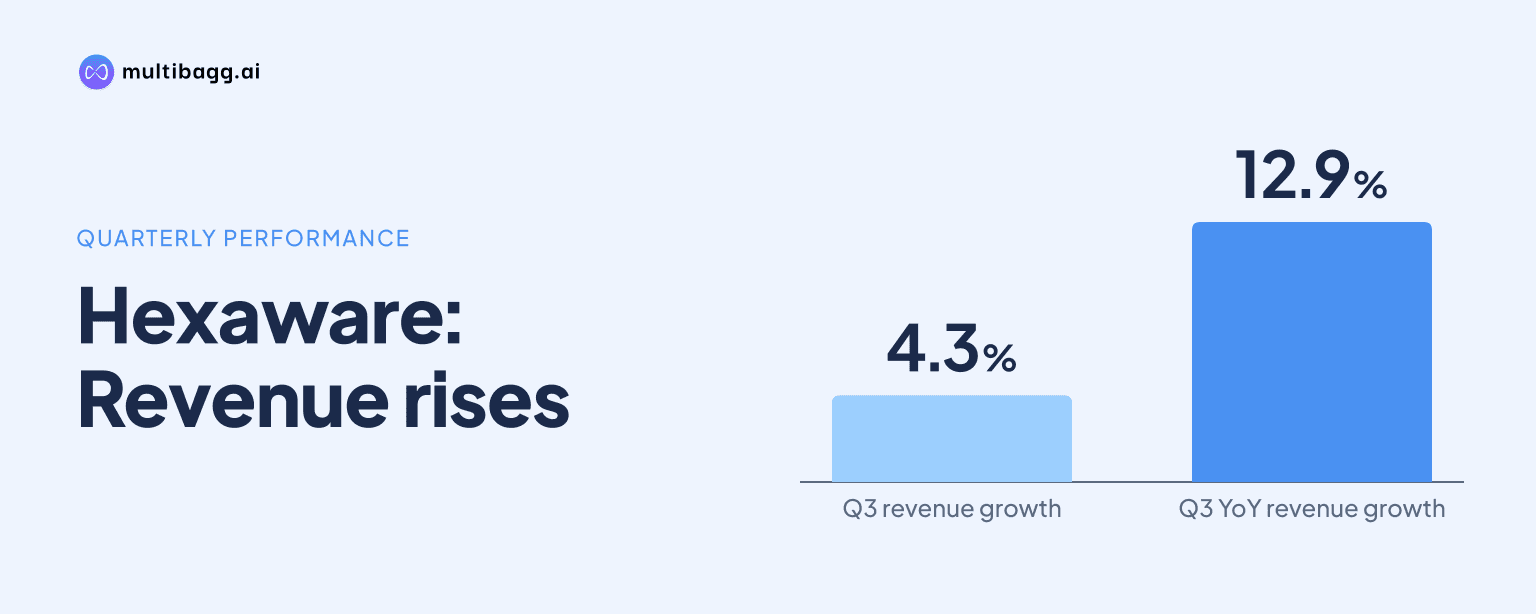
Hexaware Technologies Limited reported 4.3% year-on-year revenue growth in Q3 CY2026, while its adjusted EBIT margin reached 13.8%. Revenue was INR 39,331 million for the quarter ended September 30, 2026, but management said the outcome was below its expectations because of weakness at one global capability centre client and delayed progress in selected large deals.
Know Hexaware Technologies inside out
Results, valuation, peers and who's buying, in one view.
What did Hexaware report for Q3 CY2026?
Hexaware reported Q3 CY2026 revenue of INR 39,331 million, representing growth of 2.3% sequentially and 12.9% year on year in rupee terms. On a US dollar basis, revenue was reported at USD 411.9 million, up 1.6% from the preceding quarter and 4.3% from a year earlier.
Revenue growth in constant currency terms was 1.7% sequentially and 4.5% year on year. The company said a USD 7 million sequential increase in revenue was supported by volume growth and better seasonality, partly offset by lower licence revenue. Reported EBIT margin was 12.2%, while adjusted EBIT margin was 13.8% after excluding one-off costs related to the restructuring of Netherlands operations.
Why was Q3 revenue below management expectations?
Management said Q3 revenue fell below its internal expectations because one global capability centre client was soft and certain large deals advanced more slowly than anticipated. These factors restrained the quarter's growth despite sequential expansion across several parts of the business.
Chief Executive Officer Vivek Jetley said banking and the technology products and platforms, or TPP, business led growth among verticals. Europe and APAC were the principal geographical contributors. The company did not disclose the identity of the affected client or provide financial details of the delayed deals.
The update is important because it distinguishes between the company’s reported growth and the performance it had expected to deliver. Hexaware still recorded higher revenue in both sequential and annual comparisons, but the comments point to uneven demand across clients and the timing risk associated with larger engagements.
How did profitability change during the quarter?
Hexaware improved adjusted EBIT margin by 17 basis points sequentially to 13.8%, even as revenue growth was slower than expected. Adjusted EBIT was 2.9% higher sequentially in absolute terms, although it was 1.9% lower from a year earlier.
The adjusted margin was 88 basis points below the year-earlier level. Reported EBIT margin stood at 12.2%, reflecting the impact of one-off Netherlands restructuring costs that were excluded from the adjusted measure. The company separately reported profit of INR 4,294 million, compared with INR 3,699 million in Q3 CY2025.
Basic earnings per share rose to INR 7.06, up 30.5% sequentially and 15.9% year on year. The difference between the reported and adjusted EBIT measures is relevant for investors assessing operating performance, as the company specifically linked the adjustment to Netherlands restructuring costs.
Got a follow-up? Ask IRIS
What is Hexaware’s AI strategy and operating focus?
Hexaware is pursuing an AI strategy centred on three pillars, with one pillar focused on applying AI across the IT lifecycle. The company said it is embedding AI in technology services to support legacy-system modernisation, lower technical debt, software quality, cyber resilience, operations automation and application delivery.
Earlier in 2026, Hexaware launched Zero Friction Enterprise, which it described as an offering to help clients modernise legacy environments and automate operations. Management referred to earlier recognition of its capabilities as support for the AI-related work it has already developed, but did not quantify the revenue contribution from AI services in the Q3 disclosure.
Vivek Jetley led the earnings call as CEO for the first time. He acknowledged the contribution of Keech, his predecessor referenced in the call, while outlining the company’s operating priorities and AI approach.
What does the quarter mean for investors and industry operations?
The quarter shows that Hexaware maintained revenue growth and improved adjusted sequential profitability, but client-specific softness and slower deal conversion limited the pace of expansion. Banking, TPP, Europe and APAC provided growth support, while lower licence revenue partly offset volume and seasonal benefits.
For investors, the key disclosed indicators are the 12.9% increase in rupee revenue, the 16.1% rise in reported profit and the 13.8% adjusted EBIT margin. No share-price movement, revised guidance, deal value, client concentration figure or target for future growth was provided in the supplied results material.
For customers and employees, the stated focus remains delivery modernisation and AI-enabled services. The Netherlands restructuring charge indicates that operational changes were underway during the quarter, although the company did not provide further detail on the scope, cost or workforce effects of that restructuring.
Conclusion
Hexaware delivered higher Q3 CY2026 revenue and profit, with adjusted EBIT margin improving sequentially to 13.8%. However, the company said performance was below its expectations due to softness at one global capability centre client and slower progress in selected large deals, making the quality and timing of future demand central to the result.
Investors will watch whether the affected client environment improves, whether selected large deals progress, and whether banking, TPP, Europe and APAC continue to support growth. Management has also identified AI-enabled modernisation through Zero Friction Enterprise as a strategic focus, but the company has not disclosed a quantified revenue target or AI contribution for that initiative.