










Hikal expects Rs 50-75 crore annual sales from agro CDMO
Key highlights
- Hikal expects the agrochemical CDMO contract to reach Rs 50 crore to Rs 75 crore of annual peak sales by calendar 2029 or early 2030.
- Hikal plans commercial production toward the end of FY27, with realistic volumes expected in the following year.
- Hikal reported Crop Protection revenue of Rs 326 crore and an EBIT loss of Rs 8 crore in H1 FY27.
- Hikal reported Q2 FY27 revenue of Rs 434 crore, EBITDA of Rs 45 crore and a 10.3% EBITDA margin.
powered by IRIS
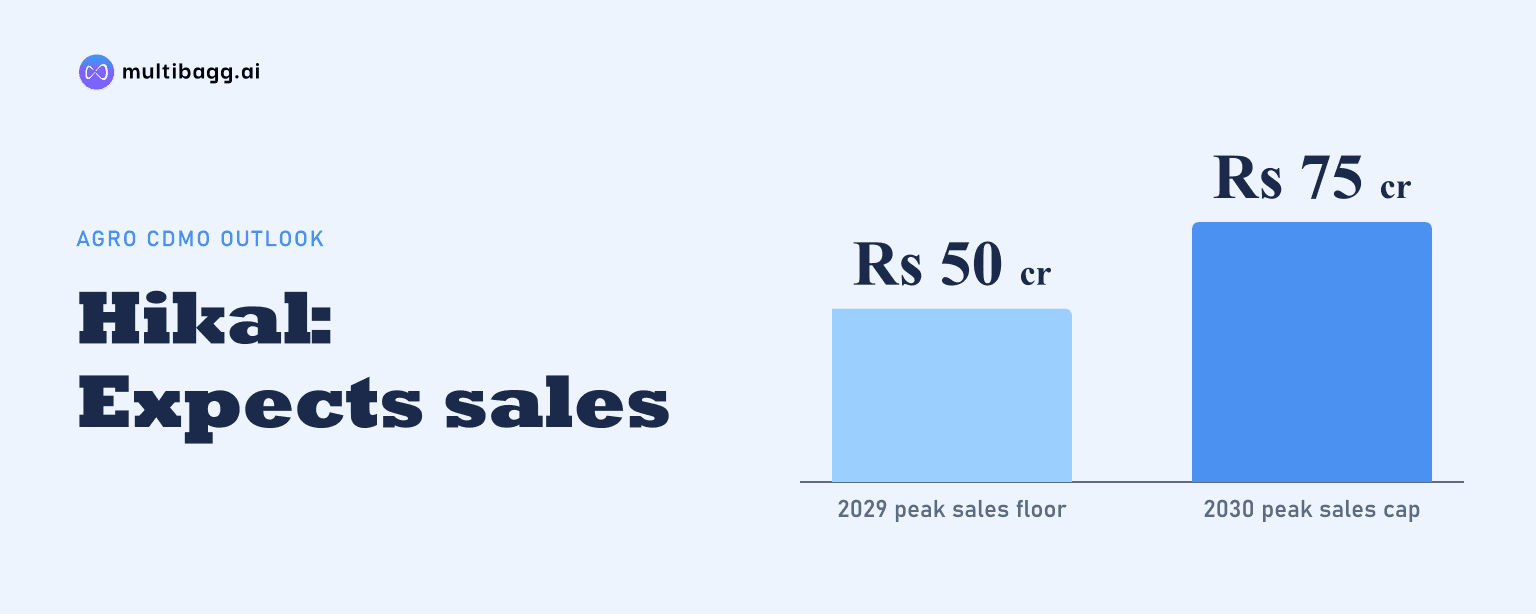
Hikal expects its new agrochemical contract development and manufacturing organization (CDMO) contract to generate Rs 50 crore to Rs 75 crore of annual revenue at peak by calendar 2029 or early 2030, following commercial production toward the end of fiscal year 2027 (FY27). Management said the niche molecule should have EBITDA margins above Hikal’s crop-protection and company-wide levels.
Know Hikal inside out
Results, valuation, peers and who's buying, in one view.
What does Hikal’s new agrochemical CDMO contract cover?
Hikal has signed a multiyear contract with a Europe-based global agrochemical company to supply a specialized active ingredient to worldwide markets. The customer is new to Hikal, and management described the arrangement as a long-term, typically evergreen contract that can continue for five, 10 or more years after regulatory approvals are obtained.
The product is a proprietary off-patent molecule, according to Hikal. Management said the patent has expired, but niche formulation technology and a specialized application limit competition. Hikal did not disclose the molecule’s name, capacity requirement or contract value, although it said most sales will be in regulated global markets, with some sales in India.
Hikal’s Crop Protection business reported second-quarter FY27 revenue of Rs 156 crore and an EBIT, or earnings before interest and tax, loss of Rs 2 crore, equal to a negative 1.5% EBIT margin. In the first half of FY27, the segment generated Rs 326 crore of revenue and a Rs 8 crore EBIT loss, or a negative 2.5% margin, amid elevated raw-material costs, pricing pressure and deferred CDMO demand.
When will Hikal start production and reach peak sales?
Hikal expects commercial production to start toward the end of FY27, while management expects realistic volumes in the following year. Peak revenue is projected for calendar 2029 or early 2030, which management characterized as roughly two to two-and-a-half years from launch rather than a long gestation period.
The timetable follows nearly three years of work with the customer. Hikal said it began with process development and chemistry work, provided samples, scaled up the molecule and supported registration-material filings. Regulatory approvals across markets will determine the pace of volume growth, making the Rs 50 crore to Rs 75 crore annual peak-sales estimate dependent on those approvals and the planned commercial ramp-up.
Management said the launch would occur toward the end of FY27, while the Crop Protection division said volumes would grow progressively as global approvals are secured. This differs from immediate spot demand because the contract is intended to add sales after launch, rather than materially alter the segment’s Rs 326 crore of H1 FY27 revenue.
Why does Hikal expect higher margins from this molecule?
Hikal said the contract should deliver a contribution margin well above that of its existing Crop Protection division and above the company’s overall contribution margin. Management also said EBITDA, or earnings before interest, tax, depreciation and amortization, from this CDMO molecule should be well above Hikal’s company-wide EBITDA margin, but did not quantify either molecule-specific measure.
A central mechanism is backward integration into the key starting material. Hikal said competitors source that input from Europe, whereas it plans to be fully self-sufficient in the supply chain. Management said this should keep cost of goods under control and support margins, alongside a customer-provided roadmap for future pricing incorporated into its projections.
The contrast with current crop-market conditions is material. Hikal said raw-material costs for key solvents and certain commodities had risen by more than 100%, while Chinese competition pressured global prices and customers bought only for immediate needs. The company said it is passing most price increases to customers, but these conditions contributed to the Crop Protection segment’s Rs 2 crore Q2 FY27 EBIT loss.
Got a follow-up? Ask IRIS
How does the contract fit Hikal’s crop-protection strategy?
Hikal said the contract reflects its strategy of entering customer projects early, from development through commercial supply. Its Pune technical center developed a scalable and cost-competitive process for the molecule, according to management, which said this capability helped it win the project after about three years of customer engagement.
The company’s broader crop strategy has two stated parts: raise capacity utilization, which management said has been depressed for the past couple of years, and replace lower-value commodity products with higher-margin CDMO work. Hikal said CDMO as a share of Crop Protection is increasing year on year, though it did not disclose the percentage or the division’s current utilization rate.
Management said its longer-term aim is for Crop Protection margins to move above 17% to 18% as the mix shifts toward CDMO. That is a management objective rather than reported guidance for a specified period, and depends on market conditions, product mix, customer approvals and the commercial timing of the new molecule.
What does the contract mean for Hikal’s FY27 outlook?
The contract is unlikely to be a major FY27 revenue contributor because production is planned only toward the end of FY27 and meaningful volumes are expected next year. Hikal nevertheless reiterated its full-year outlook for mid-teens revenue growth and a substantial improvement in profitability, with management expecting the second half of FY27 to be significantly better than the first half.
At group level, Hikal reported Q2 FY27 revenue of Rs 434 crore, EBITDA of Rs 45 crore and a 10.3% EBITDA margin, with a net loss of Rs 6 crore. H1 FY27 revenue was Rs 837 crore, EBITDA was Rs 82 crore and the EBITDA margin was 9.8%, with a net loss of Rs 14 crore. The company incurred Rs 81 crore of capital expenditure for debottlenecking, inventory, regulatory upgrades and selective capacity creation.
Management also cited an estimated annual Rs 20 crore operating cost from U.S. Food and Drug Administration remediation, which it said will remain elevated until the end of FY27. It said most raw-material cost increases in CDMO should be passed to customers over the next few quarters, while debt to equity stood at 0.52 as of September 30, 2026.
Conclusion
Hikal’s new agrochemical contract is a medium-term CDMO opportunity rather than an immediate sales catalyst. Its disclosed Rs 50 crore to Rs 75 crore annual peak-sales potential by calendar 2029 or early 2030 is material beside Crop Protection’s Rs 326 crore of H1 FY27 revenue, while management expects the molecule’s margins to exceed those of the existing crop business.
The next developments to watch are commercial production toward the end of FY27, regulatory approvals that permit volume expansion and the arrival of realistic volumes in the following year. Management’s plan also relies on backward integration into the key starting material and its stated move from lower-value commodity products toward higher-margin CDMO work.