










Hindustan Composites Limited Trust Takes Indirect Voting Rights
Key highlights
- Shashi Mody Family Trust received indirect voting-rights control on November 17, 2026 through an off-market transfer.
- Hindustan Composites Limited’s promoter and promoter-group holding remains 1,10,73,060 shares, or 74.98%.
- The company’s equity share capital remains 1,47,69,000 equity shares of ₹5 each.
- The Trust holds 78.07% in Pallawi Resources Pvt Ltd and 50.10% in Leaders Healthcare Pvt Ltd.
powered by IRIS
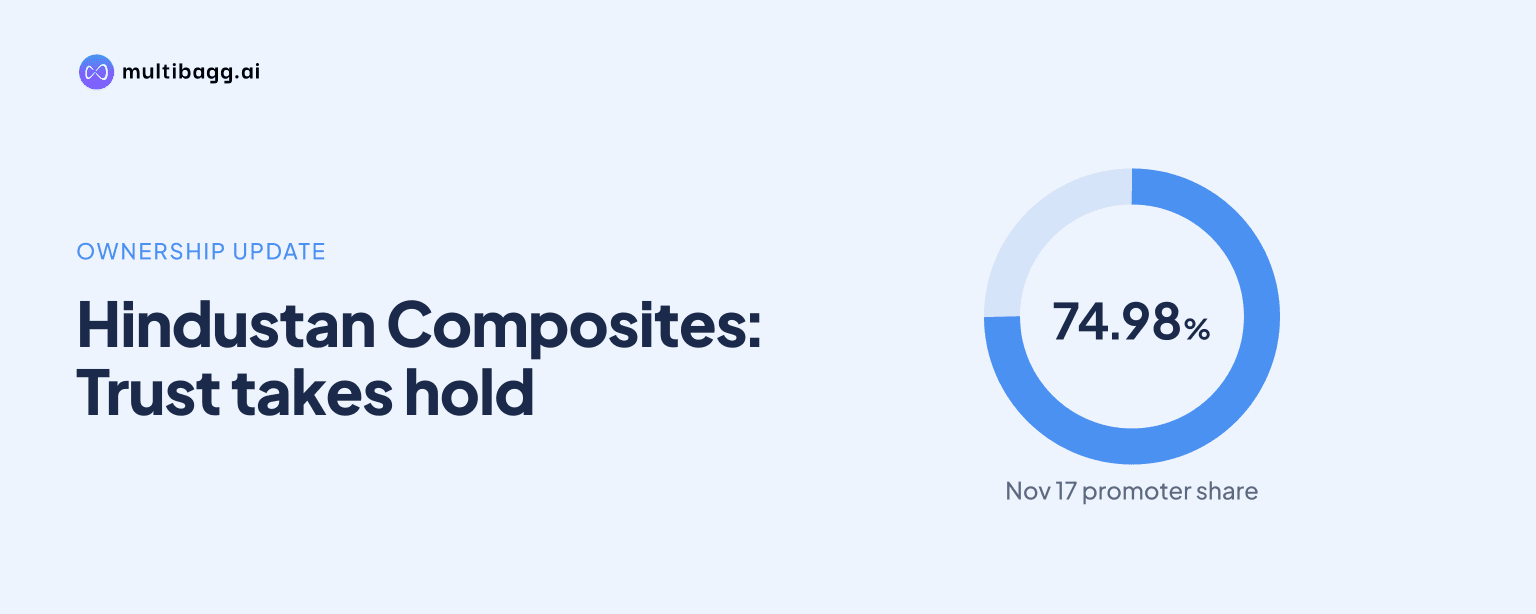
Hindustan Composites Limited disclosed on November 17, 2026 that Shashi Mody Family Trust acquired indirect voting rights through promoter-group holding entities, while the company’s total promoter shareholding remained unchanged at 74.98%. The off-market transaction followed a SEBI exemption order dated July 30, 2026 and does not alter the company’s equity share capital.
Know Hindustan Composites inside out
Results, valuation, peers and who's buying, in one view.
What did Shashi Mody Family Trust acquire?
Shashi Mody Family Trust acquired the power to direct voting rights in Hindustan Composites Limited that are held through six unlisted entities belonging to the promoter and promoter group. The arrangement was completed through an off-market, indirect transfer in which Shashi Mody contributed shares carrying voting rights in those entities to the Trust.
The disclosure was made under Regulation 29(2) of the SEBI (Substantial Acquisition of Shares and Takeovers) Regulations, 2011. The filing describes a reorganisation of indirect control within the promoter family structure, rather than a purchase of Hindustan Composites shares from public shareholders or an increase in the company’s total promoter stake.
Shashi Mody’s direct holding in Hindustan Composites remains negligible at 10 equity shares. However, the Trust has acquired control over voting rights associated with holdings in important promoter-group entities, including Pallawi Resources Pvt Ltd, in which it holds 78.07%, and Leaders Healthcare Pvt Ltd, in which it holds 50.10%.
Why was a SEBI exemption required for the transfer?
The transfer was undertaken under SEBI Exemption Order No. WTM/KCV/CFD/09/2026-27, issued under Regulation 11 of the Takeover Regulations. The order dated July 30, 2026 granted an exemption to the proposed acquirer trusts, including Shashi Mody Family Trust and Varunn Mody Family Trust, from specified obligations that otherwise apply to substantial acquisitions.
The trusts had sought the exemption for proposed transfers of interests in promoter and promoter-group companies that hold, directly or indirectly, shares and voting rights in Hindustan Composites. SEBI’s order records that the reorganisation was intended to streamline succession planning and promote the welfare of the promoter family.
The order also states that the trustees and beneficiaries through whom control is exercised are lineal descendants of the promoter and promoter group. Crucially, the pre-acquisition and post-acquisition shareholding of the promoter and promoter group in Hindustan Composites was stated to remain the same, with the existing promoter family continuing to exercise control.
What are the key figures in the disclosure?
The main figures show that the transaction changed the channel through which voting rights are directed, not the company’s issued capital or aggregate promoter ownership. Hindustan Composites continues to have 1,47,69,000 equity shares of face value ₹5 each.
The disclosure does not report a change in the total promoter shareholding of 1,10,73,060 shares, representing 74.98% of the company. It also does not state that any new outside investor has acquired a stake or that the public shareholding has changed as a result of this transaction.
Got a follow-up? Ask IRIS
How does this affect Hindustan Composites shareholders?
For shareholders, the reported effect is a consolidation of indirect voting control within the promoter family’s trust structure. Since the aggregate promoter and promoter-group holding remains unchanged, the filing does not indicate dilution for public shareholders or a fresh issuance of equity shares.
The transaction is nevertheless relevant because the Trust can now direct voting rights held through six promoter-group entities. Such voting authority can be important in shareholder resolutions and corporate governance decisions, even when the economic ownership remains within the same promoter family.
The company has recently completed a separate operational transaction. Hindustan Composites completed the ₹370 crore slump sale of its Friction Business Undertaking to Rane (Madras) Limited on August 20, 2026, after shareholders approved the sale through a postal ballot whose results were declared on August 11, 2026.
That business transfer included the COMPO brand, two manufacturing plants in Maharashtra, relevant assets, liabilities, contracts, employees and associated intellectual property. The promoter-trust transaction is distinct from the friction-business sale: one concerns internal control and succession arrangements, while the other involved the transfer of an operating business to Rane (Madras) Limited.
Why does the promoter structure matter after the friction business sale?
The promoter structure matters because Hindustan Composites remains closely held, with promoters and the promoter group owning 74.98% of its equity capital. A family-trust arrangement can formalise how voting rights are administered among family members while preserving the aggregate ownership and control position disclosed to the market.
The SEBI order specifically records that there would be no change in the overall promoter and promoter-group shareholding before and after the proposed acquisition. It also recognises the acquirer trusts as part of the promoter and promoter group, which distinguishes the exercise from a conventional takeover by an external acquirer.
Investors assessing the company can therefore separate two developments. The ₹370 crore friction-business slump sale changes the operating portfolio, while the November 17 indirect transfer changes the internal architecture through which promoter-held voting rights are exercised. The available disclosures do not provide a revised financial impact from the trust transfer itself.
Conclusion
Hindustan Composites Limited’s November 17 disclosure records an internal promoter-family consolidation of indirect voting rights in favour of Shashi Mody Family Trust. The transfer was completed under a SEBI exemption and leaves the company’s 1,47,69,000-share capital and aggregate promoter holding of 74.98% unchanged.
The key next disclosure for investors is how Hindustan Composites deploys or reports the effects of the ₹370 crore friction-business sale, which was completed on August 20, 2026. Investors can also monitor future shareholding-pattern filings for confirmation that promoter ownership and the Trust’s role within the promoter group remain as disclosed.