










HT Media print growth reflects share gains and government rates
Key highlights
- HT Media reported Q2 FY27 consolidated revenue of Rs 502 crore, up 5% year on year.
- Print operating revenue reached Rs 386 crore, up 8%, with English up 5% and Hindi up 11%.
- Consolidated print circulation revenue was flat at Rs 54 crore in Q2 FY27.
- Print operating EBITDA declined 6% as higher newsprint costs and a 20-day Diwali shift affected the quarter.
powered by IRIS
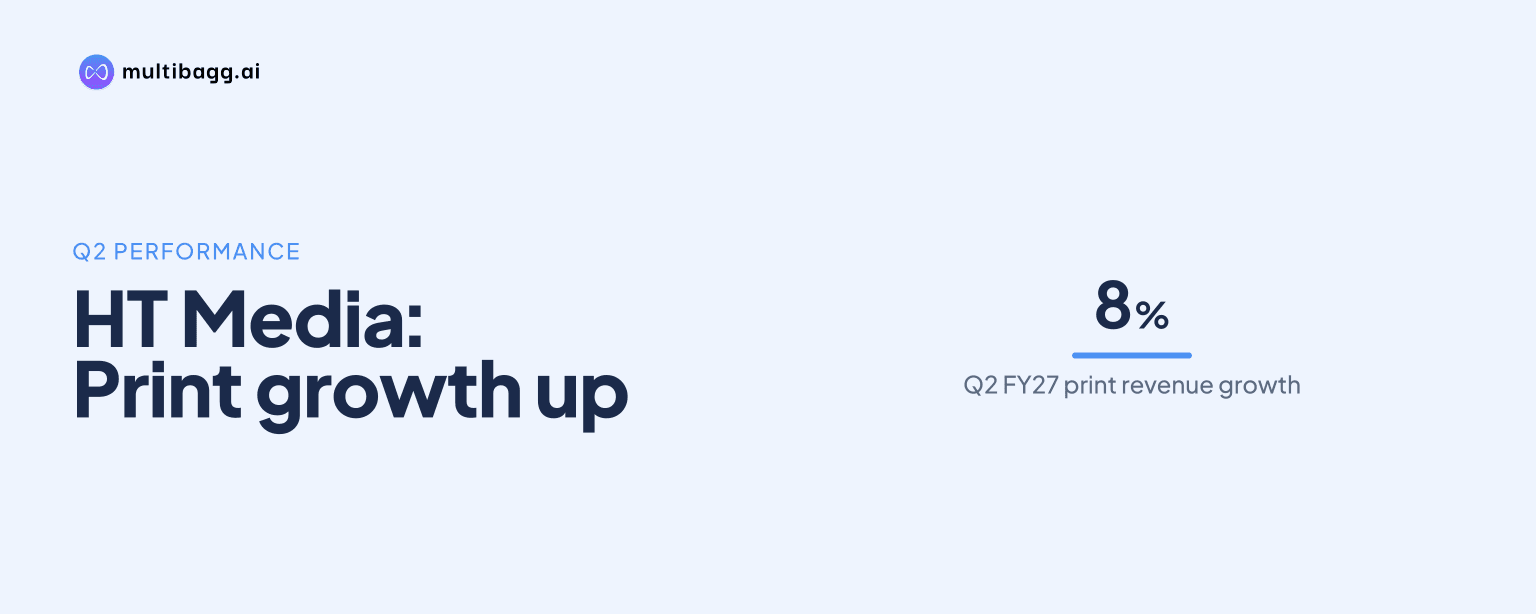
HT Media Limited said Q2 FY27 print operating revenue rose 8% year on year to Rs 386 crore, as advertising growth in its English and Hindi titles reflected market-share gains and higher government advertising rates despite Diwali shifting 20 days into the third quarter. Consolidated revenue rose 5% to Rs 502 crore.
Know H T Media inside out
Results, valuation, peers and who's buying, in one view.
Why did HT Media's print advertising grow in Q2 FY27?
HT Media said print advertising growth came from volume gains through holding or gaining market share in both English and Hindi markets, along with pricing support from government advertising. Group Chief Financial Officer Piyush Gupta told investors on November 5, 2026 that the industry had received a DAVP price increase in the previous year, contributing to government revenue in the quarter ended September 30, 2026.
HT Media said the same factors applied to both language segments when an analyst asked whether the drivers were common to English and Hindi titles. Management did not disclose an absolute advertising-revenue figure in the webinar, but reported total print operating revenue of Rs 386 crore, up 8% year on year, and identified advertising as the source of the increase.
How did HT Media's English and Hindi print revenue compare?
HT Media's Hindi print business grew faster than its English print business in Q2 FY27. English print operating revenue rose 5% year on year, while Hindi print operating revenue increased 11%, producing the combined 8% increase in print operating revenue to Rs 386 crore.
The Hindi growth rate was 6 percentage points above the English rate, even though management cited market-share consolidation and government-led pricing for both businesses. Circulation was not an additional growth engine in the quarter, as management said copies sold and consolidated print circulation revenue were primarily flat.
HT Media reported consolidated print circulation revenue of Rs 54 crore, exactly flat from the same quarter a year earlier. Hindi circulation revenue was also flat at Rs 39 crore, while management said the number of copies sold was primarily unchanged.
How did the Diwali shift affect HT Media's quarter?
HT Media said Q2 FY27 print growth would have been higher if Diwali had not shifted by 20 days into the third quarter. Gupta said the timing change moved part of the festive-period opportunity out of the quarter ended September 30, 2026, and said the effect would be captured in third-quarter results.
The festival shift also formed part of management's explanation for the gap between revenue growth and print profitability. Print operating revenue rose 8% to Rs 386 crore, but print operating earnings before interest, tax, depreciation and amortisation, or EBITDA, declined 6% year on year as shifted revenue and higher newsprint costs affected the business.
At the consolidated level, HT Media reported revenue of Rs 502 crore, up 5%, and EBITDA of Rs 88 crore, up 26%. EBITDA margin increased to 17% from 15% in the comparable prior-year period, while management said the results were delivered despite the 20-day Diwali timing shift.
Got a follow-up? Ask IRIS
Why did HT Media keep circulation flat?
HT Media said it did not plan to add copies merely to raise circulation because its market position was comfortable relative to competitors and newsprint prices remained elevated. Management said it would run schemes and add copies where needed, but it did not invest behind new copies in Q2 FY27 while copies and circulation revenue remained flat.
The approach was linked to direct variable costs, which management said were significantly higher because rates were above the prior-year level. Deputy Group Chief Financial Officer Anna Abraham described the growth as price-led, while saying the company was not investing behind new copies during a quarter in which consolidated print circulation revenue was Rs 54 crore.
Newsprint remained the main pressure on print margins. Gupta said prices had flattened at a certain level and management believed they had peaked, but he gave no date for a decline and cited currency conditions and global seafaring freight rates as variables that could affect future easing.
What else changed across HT Media's businesses?
HT Media's print growth contrasted with revenue declines in radio and digital operations in Q2 FY27. Radio operating revenue fell 23% to Rs 25 crore after the company surrendered certain stations under its network rationalisation, while digital operating revenue declined 30% to Rs 28 crore as management focused on a leaner portfolio.
Profitability improved in the smaller segments despite lower revenue. Radio operating EBITDA was positive at Rs 2 crore, with a 9% margin, after management said it had been negative for many quarters, while digital operating EBITDA was at break-even to a slight positive of Rs 1 crore.
HT Media reported profit after tax, or PAT, of Rs 39 crore and a PAT margin of 8%, compared with 4% a year earlier. Management also cited an indirect-cost rationalisation programme, including people costs, after an analyst noted consolidated employee expense of about Rs 95 crore in Q2 FY27 versus about Rs 99 crore in the previous quarter and about Rs 105 crore a year earlier.
Conclusion
HT Media's Q2 FY27 print outcome was driven by advertising rather than circulation: market-share gains and prior government pricing support lifted English revenue 5% and Hindi revenue 11%, while consolidated circulation revenue stayed at Rs 54 crore. The quarter also showed the cost pressure in print, with operating revenue rising 8% to Rs 386 crore while operating EBITDA declined 6%.
The next reported period to watch is Q3 FY27, when management said revenue linked to Diwali's 20-day shift should be captured. Management also identified newsprint costs, currency conditions and global seafaring freight rates as unresolved factors affecting whether print-cost pressure moderates after Q2 FY27.