










ideaForge Tests ZOLT Hybrid for 100-km ISR Missions in EW
Key highlights
- ideaForge completed Q2 FY27 testing of ZOLT Hybrid for 100-km, six-hour ISR missions in an EW environment.
- ideaForge launched a combat ZOLT variant in Q2 FY27 and plans field-trial readiness in H2 FY27.
- H1 FY27 revenue was Rs 103.9 crore, while the CEO reported PAT of negative Rs 3.9 crore.
- ideaForge signed for Rs 151 crore of Technology Development Board funding for the YETI logistics UAV.
powered by IRIS
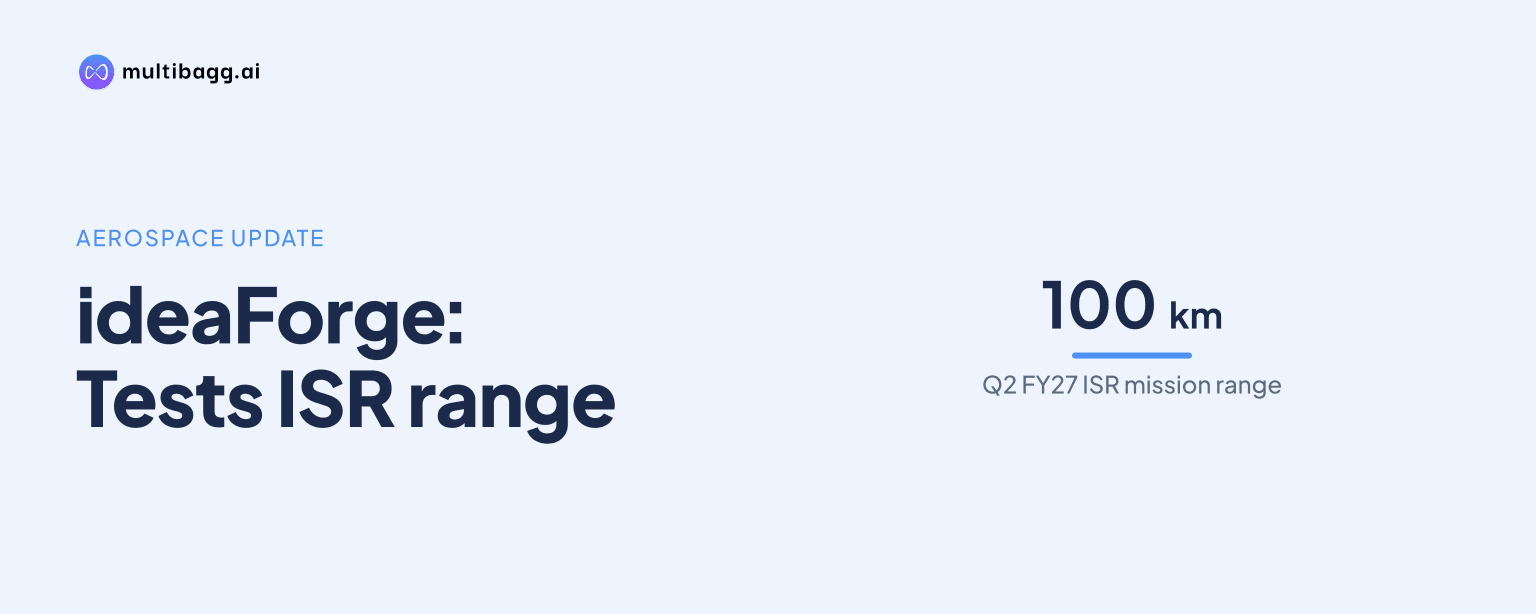
ideaForge Technology Limited said it completed Q2 FY27 field testing of its hybrid ZOLT unmanned aerial vehicle for a 100-km, six-hour intelligence, surveillance and reconnaissance mission in an electronic-warfare environment. ideaForge also launched a combat variant of the tactical platform and plans to prepare new technologies for field trials in H2 FY27.
Know Ideaforge Technology inside out
Results, valuation, peers and who's buying, in one view.
What did ideaForge test with the ZOLT Hybrid UAV?
ideaForge tested the ZOLT Hybrid UAV in Q2 FY27 for long-range intelligence, surveillance and reconnaissance, or ISR, with a stated 100-km range and six-hour endurance in an electronic-warffare, or EW, environment. Its Q2 FY27 business update describes the field testing as successfully completed.
The hybrid version incorporates an internal-combustion engine to extend range and endurance, according to the chief executive officer's Q2 FY27 comments. This differs from ZOLT electric, for which ideaForge reported completing a productization milestone during the same quarter.
ideaForge's technology update still describes development progress toward more than six hours of endurance and 100-km range for ZOLT. The presentation does not disclose payload capacity, flight speed, customer orders, production status or a commercial launch date for the hybrid aircraft.
How is ideaForge expanding ZOLT beyond ISR missions?
ideaForge said it launched a combat variant of ZOLT in Q2 FY27, alongside combat capabilities developed through partnerships and the in-house hybrid version of its tactical UAV. Management described these activities as an expansion from ISR into defence combat applications, rather than as confirmed customer deployments or procurement awards.
The Q2 FY27 CEO comments also cite experiments with Air Launched Effects, seeker technologies and loitering-munition platforms. The presentation does not define Air Launched Effects or provide test results, programme values, customer names or deployment details for these technologies.
Management's stated H2 FY27 objective is to make the new technologies and products ready for field trials and participation in Fast Track Procurement, or FTP, opportunities. That is a disclosed development plan, not a timetable for orders or revenue.
What navigation and product technologies are under development?
ideaForge reported Q2 FY27 work on resilient navigation and communications, including higher controlled reception pattern antenna, or CRPA, configurations intended to improve jamming rejection. It also cited the fusion of inertial navigation, visual simultaneous localisation and mapping, or SLAM, and satellite matching for greater resilience under interference.
In the Q2 FY27 multirotor and SWITCH programmes, ideaForge field-tested an internal next-generation multirotor prototype and pursued design changes to improve speed, endurance and wind resistance in the SWITCH family. The presentation gives no performance figures for the prototype or the revised SWITCH designs.
YETI, ideaForge's logistics UAV programme, continued testing and tuning of TDO in Q2 FY27, while indigenous development of key TDI propulsion-system elements began with partners. The presentation does not define TDO or TDI, but says ideaForge signed an agreement with the Technology Development Board for Rs 151 crore of research, development and innovation funding for YETI.
ideaForge also disclosed Q2 FY27 edge artificial-intelligence deployment for object detection, classification and tracking. Payload work included autofocus, image super-resolution and automated thermal calibration, although the presentation does not say which of these capabilities are installed on the tested 100-km ZOLT Hybrid aircraft.
Got a follow-up? Ask IRIS
What do Q2 FY27 execution and financial figures show?
ideaForge reported revenue from operations of Rs 91.3 crore and profit after tax, or PAT, of negative Rs 6.5 crore in Q2 FY27, according to the CEO's comments. For H1 FY27, the CEO reported Rs 103.9 crore of revenue, described as the company's highest-ever first-half revenue, and PAT of negative Rs 3.9 crore.
The company said it had executed more than 50% of its FY27 opening order book in H1 FY27. It also cited persistent global supply-chain constraints and some delays in customer approvals for deliveries while describing continued execution momentum.
The stated H1 FY27 revenue was Rs 12.6 crore above the stated Q2 FY27 revenue, but the presentation does not separately disclose Q1 FY27 revenue. Similarly, the H1 PAT loss was Rs 2.6 crore lower than the stated Q2 loss, without a quarter-by-quarter reconciliation.
A separate Q2 FY27 business-update slide says ideaForge completed more than 50% of the FY27 opening order book with positive PAT. The presentation does not reconcile that wording with the CEO comments reporting negative Q2 and H1 PAT figures.
Which procurement opportunities could affect the next stage?
Management identified an estimated Rs 20,000 crore opportunity under FTP across ISR and combat UAV categories, with the first request for proposal, or RFP, at an advanced stage of evaluation. This is a market opportunity cited by management, not an ideaForge order-book figure or awarded contract.
The Defence Acquisition Council has cleared defence-services proposals worth Rs 2,12,000 crore, according to the Q2 FY27 presentation. The listed programmes include Long Range UAS, Surveillance UAV, Integrated Surveillance and Strike Systems, and Long Range Kamikaze Drone Systems, with ideaForge expecting RFPs soon.
Management also pointed to enhanced financial powers delegated to field commanders under DFPDS 2026 as a potential driver of more consistent procurement activity. The company presents this as an expectation that could complement larger centralised programmes, not as recorded sales.
Conclusion
The Q2 FY27 disclosure places the tested 100-km, six-hour ZOLT Hybrid platform alongside a combat ZOLT variant, seeker and loitering-munition work, and navigation technologies intended to resist interference. At the same time, ideaForge reported H1 FY27 revenue of Rs 103.9 crore and execution of more than 50% of its FY27 opening order book, despite supply-chain and delivery-approval constraints.
The next disclosed milestones are ideaForge's H2 FY27 plan to prepare new products for field trials and FTP participation, as well as anticipated RFPs linked to cleared defence proposals. The progression of ZOLT from field testing to commercialisation, deployment of Rs 151 crore in YETI funding, and clarification of the differing Q2 PAT descriptions remain matters to watch in later disclosures.