










IFCI reports negative 18.42% capital ratio as NPAs hit 99.23%
Key highlights
- IFCI's CRAR was negative 18.42% at September 30, 2026, versus a 15% minimum requirement.
- Gross NPAs were Rs 3,566.40 crore and represented 99.23% of gross loan assets at September 30, 2026.
- The gross NPA ratio rose 3.44 percentage points from 95.79% at March 31, 2026.
- IFCI reported an impairment reserve of Rs 104.67 crore and standalone net profit after tax of Rs 20.85 crore.
powered by IRIS
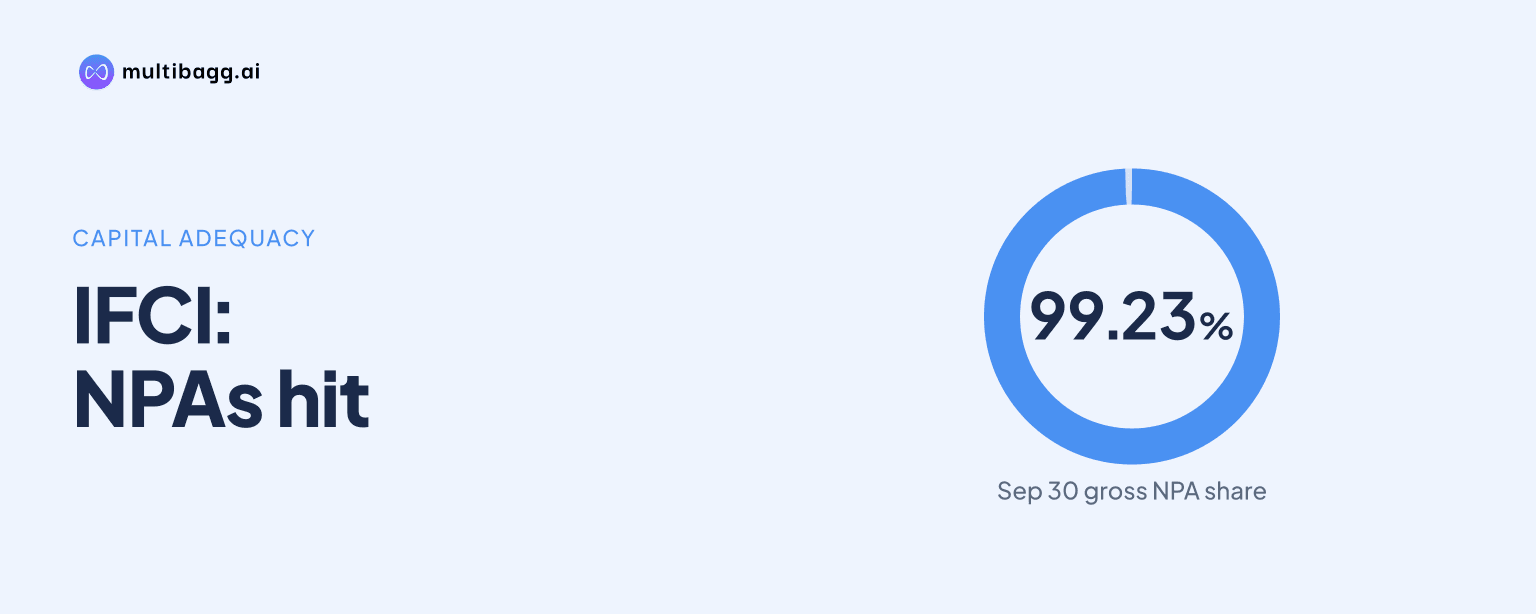
IFCI Limited reported a capital risk adequacy ratio of negative 18.42% at September 30, 2026, 33.42 percentage points below the 15% regulatory minimum, while gross credit-impaired assets were 99.23% of gross loan assets. The standalone disclosures show balance-sheet stress despite Rs 20.85 crore net profit after tax for the period.
Know IFCI inside out
Results, valuation, peers and who's buying, in one view.
Why is IFCI's capital adequacy negative?
IFCI's Capital Risk Adequacy Ratio, or CRAR, was negative 18.42% on September 30, 2026, against the 15% minimum prescribed under the Reserve Bank of India’s 2025 capital-adequacy directions. CRAR measures adjusted net worth against risk-weighted assets, as defined in IFCI’s disclosure. The reported ratio was therefore 33.42 percentage points below the stated regulatory threshold, placing the capital measure below zero as well as below the minimum requirement.
The standalone Annexure B reported net worth of Rs 1,809.20 crore, a debt-equity ratio of 1.71 times and total debts to total assets of 0.48 times at September 30, 2026. These are separate measures from CRAR: IFCI defines debt-equity as debt divided by net worth, while CRAR uses adjusted net worth and risk-weighted assets under Reserve Bank of India guidelines. The filing does not disclose a capital-restoration amount or timetable.
The statutory auditor highlighted the negative CRAR in an emphasis-of-matter section of its November 12, 2026 review report. The auditor also noted that its review conclusion was not modified for that matter. A review provides moderate assurance and is narrower in scope than an audit, according to the report, so the emphasis identifies the reported capital position without changing the review conclusion.
How impaired is IFCI's loan book?
IFCI reported gross non-performing assets, or gross NPAs, of Rs 3,566.40 crore and a gross NPA ratio of 99.23% at September 30, 2026. Annexure B separately labels the same 99.23% measure as the gross credit-impaired assets ratio, defined as gross credit-impaired assets divided by gross loan assets. Its net credit-impaired assets ratio was 95.55%, showing that the disclosed impairment issue extended across almost the entire loan-asset base.
The comparison shows that gross NPAs declined by Rs 23.57 crore between March 31, 2026 and September 30, 2026, but the associated ratio increased by 3.44 percentage points. In other words, the percentage of the loan book classified as impaired rose even though the reported rupee stock of gross NPAs was lower. IFCI attributes this movement to the contraction of standard loan accounts rather than to fresh lending growth.
The 95.55% net credit-impaired assets ratio was 3.68 percentage points below the 99.23% gross ratio at September 30, 2026. IFCI defines the net ratio as net credit-impaired assets divided by net loan assets. The filing does not provide a prior-period net credit-impaired ratio in Annexure B, so a like-for-like trend for that measure cannot be calculated from the disclosed figures.
Got a follow-up? Ask IRIS
What caused IFCI's gross NPA ratio to rise?
IFCI says the gross NPA ratio rose because it has not been taking fresh loan exposure, reducing standard loan accounts and increasing the NPA share of the remaining loan book. This explanation appears alongside the September 30, 2026 gross NPA disclosure of Rs 3,566.40 crore. The stated mechanism is therefore denominator-led: standard accounts declined, causing impaired assets to represent a larger proportion of gross loans.
The filing also records no loan-acquisition consideration paid from lenders or asset reconstruction companies, or ARCs, for the period ended September 30, 2026. Its stressed-loan transfer disclosure contains no reported aggregate consideration, net book value, gain or loss for transfers to ARCs, permitted transferees or other parties. Separately, IFCI said there were no cases in the period where a COVID-19-related stress resolution plan was implemented under the Reserve Bank of India’s August 2020 framework.
IFCI reported interest income of Rs 19.72 crore on stage 3 assets during the quarter ended September 30, 2026, excluding assets that remain standard under income-recognition and asset-classification norms. It wrote off the same Rs 19.72 crore as bad debts in that quarter because it said recovery was not expected. IFCI said the matching recognition and write-off had no impact on net profit or loss for the period.
What do IFCI's profit and provisions show?
IFCI reported Rs 20.85 crore of standalone net profit after tax for the period ended September 30, 2026, but that result does not change the separately reported negative CRAR or 99.23% gross credit-impaired assets ratio. The same Annexure B showed an operating margin of 0.55% and a net profit margin of 8.71%. These disclosed profitability measures sit alongside, rather than replace, the capital and asset-quality metrics.
Under Reserve Bank of India prudential norms, IFCI said required provisioning, including standard-asset provisioning, exceeded its impairment allowance under Indian Accounting Standard 109 by Rs 90.49 crore at September 30, 2026. However, it held an existing impairment reserve of Rs 104.67 crore. IFCI therefore said it did not create an additional impairment reserve, and it said the existing reserve could not be withdrawn without prior approval from the Reserve Bank of India’s Department of Supervision.
The auditor also drew attention to the use of subsidiary financial statements for the period ended June 30, 2026 when assessing impairment of investments in subsidiaries, instead of September 30, 2026 statements. This was listed with the Rs 104.67 crore impairment reserve, the stage 3 interest write-off and the negative CRAR as emphasis-of-matter items. The auditor’s review conclusion remained unmodified despite those highlighted disclosures.
Conclusion
IFCI’s September 30, 2026 standalone disclosures present two linked balance-sheet pressures: a CRAR below the 15% minimum and a gross impaired-loan ratio that increased to 99.23% from 95.79% at March 31, 2026. Although gross NPAs fell by Rs 23.57 crore, IFCI’s explanation that standard loan accounts have reduced shows why the impaired share of gross loans continued to rise.
The next disclosed strategic item to watch is the proposed consolidation of the IFCI group. The Department of Financial Services gave in-principle approval on November 22, 2024, and IFCI’s board also gave in-principle approval on that date to begin the process under applicable rules; the company said its stock-exchange disclosure was updated on July 14, 2025. The filing gives no completion date, while the Rs 104.67 crore impairment reserve remains subject to restrictions on withdrawal.