










IIFL Capital operational PBT rises almost 40% despite BSE loss
Key highlights
- IIFL Capital’s Q2 FY27 operational PBT was Rs 206 crore, up almost 40% sequentially.
- IIFL Capital recorded a Rs 32 crore Q2 FY27 mark-to-market loss from BSE share-price movement.
- IIFL Capital’s Q2 FY27 operational revenue was Rs 722 crore, up 14% sequentially and 22% year on year.
- IIFL Capital’s distribution income rose 27% sequentially to Rs 159 crore in Q2 FY27.
powered by IRIS
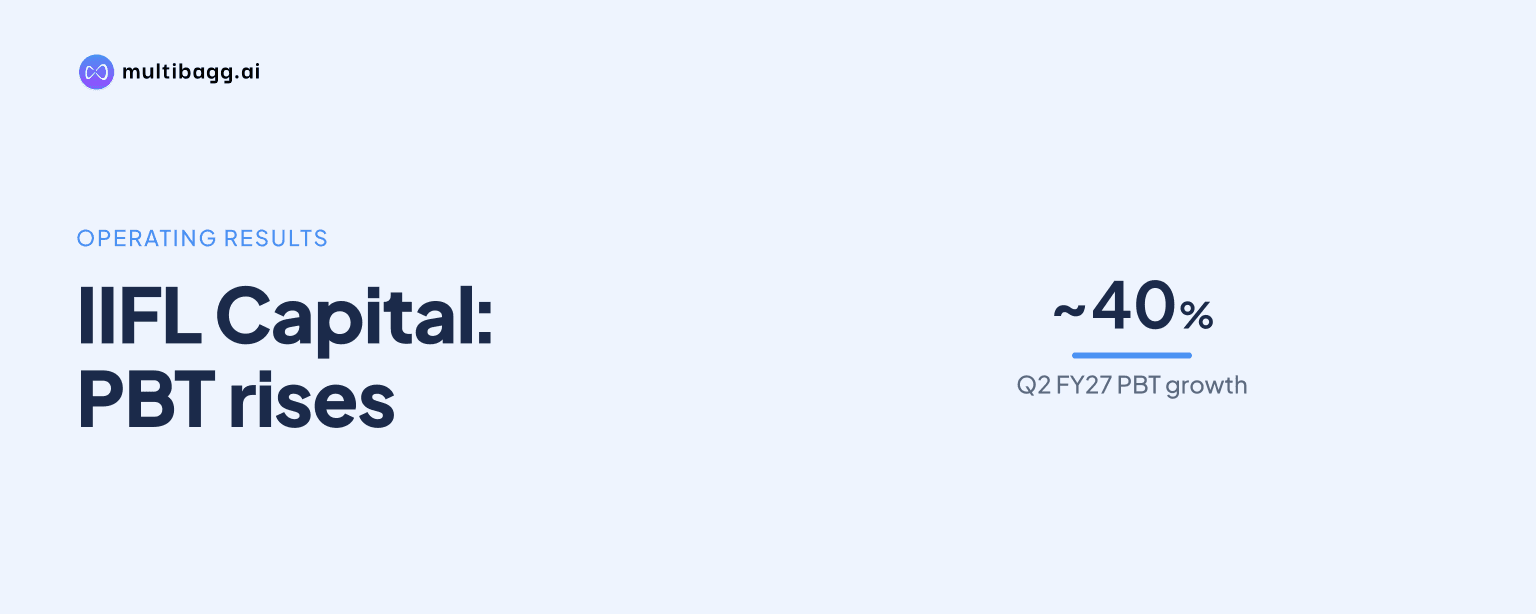
IIFL Capital Services Limited reported operational profit before tax of Rs 206 crore in Q2 FY27, up almost 40% sequentially, but adverse BSE share-price movement caused a Rs 32 crore mark-to-market loss. Operational revenue rose 14% from Q1 FY27 to Rs 722 crore, led by institutional and banking activity and distribution income.
Know IIFL Capital Services inside out
Results, valuation, peers and who's buying, in one view.
Why did IIFL Capital’s operational PBT rise in Q2 FY27?
IIFL Capital’s operational PBT rose to Rs 206 crore in Q2 FY27 because revenue growth across retail equities, institutional and banking operations, and distribution outpaced the reported increase in costs. Management said the Rs 206 crore measure was before the BSE shareholding’s mark-to-market effect and was almost 40% above Q1 FY27.
The same operating measure was about 25% higher than Q2 FY26, indicating that the improvement extended beyond the sequential comparison. For H1 FY27, operational PBT was Rs 355 crore, up 8% from H1 FY26, a slower rate than the quarterly increase because the first-half result includes both Q1 and Q2.
Which businesses drove IIFL Capital’s revenue growth?
IIFL Capital’s consolidated operational revenue was Rs 722 crore in Q2 FY27, up 14% from Q1 FY27 and 22% from Q2 FY26. Retail-equities income contributed Rs 316 crore, rising 6% sequentially and nearly 17% year on year, while institutional and banking revenue reached Rs 245 crore, up 18% from Rs 207 crore in Q1 FY27.
Distribution income was Rs 159 crore in Q2 FY27, up 27% from Rs 125 crore in Q1 FY27 and nearly 23% from Rs 130 crore a year earlier. Management said the quarter’s distribution growth reflected recurring income from assets under management rather than insurance, which underperformed; alternative investment funds, portfolio management services and mutual funds contributed to the increase.
The H1 FY27 figures show different growth rates among the businesses. Retail-equities income increased 15% to Rs 613 crore, while institutional-equities income rose 16% to Rs 451 crore from Rs 390 crore. Distribution income was nearly flat at Rs 285 crore versus Rs 275 crore because H1 FY26 included exceptional upfront transaction income in its first quarter.
How did costs change at IIFL Capital in Q2 FY27?
IIFL Capital’s employee cost increased 8% sequentially to Rs 194 crore in Q2 FY27, reflecting headcount additions and bonus provisions. Management said additions of wealth relationship managers were marginal and in single digits, while some hiring occurred in the wealth asset-management business; it also cited an overall headcount increase of roughly 5% year on year.
Finance cost climbed 25% sequentially to Rs 75 crore as borrowings increased, and it was 40% higher year on year for the same reason. Depreciation rose 6% sequentially to Rs 18 crore, while administration expense increased 9% to Rs 96 crore, mainly due to technology investment. Fees and commissions declined 4% sequentially to Rs 134 crore from Rs 139 crore, partly offsetting cost growth.
On a year-on-year basis, employee cost rose 26% to Rs 194 crore, including fixed-pay increases, variable pay and wage inflation, according to management. Depreciation grew 16% because of branch and technology investments, fees and commissions increased 13%, and administration expense rose 11%, again led by technology spending.
Got a follow-up? Ask IRIS
How did the BSE shareholding affect IIFL Capital’s earnings?
IIFL Capital recorded a Rs 32 crore mark-to-market loss in Q2 FY27 because of an adverse movement in BSE’s share price. This was outside the Rs 206 crore operational PBT measure, so the operating result and the valuation effect of the legacy listed-share investment moved in opposite directions during the quarter.
Management said the BSE holding is a legacy investment and that IIFL Capital continues to own about 5.95 lakh BSE shares. It also said Q1 FY27 had included mark-to-market gains on BSE shares, meaning the valuation impact shifted from a gain in the prior quarter to a loss in Q2 FY27 because of price movement rather than broking, banking or distribution activity.
Trading activity provided a mixed market backdrop in Q2 FY27. Average daily turnover was Rs 3,05,073 crore, including Rs 3,01,785 crore in futures and options and Rs 3,288 crore in cash equities, down roughly 3% sequentially. Management said IIFL Capital performed reasonably against the market-volume decline, while average daily turnover was 16% above Rs 2,63,568 crore in Q2 FY26.
What is IIFL Capital planning after Q2 FY27?
IIFL Capital expects the Fairfax transaction to close during November 2026, after Fairfax Mauritius Investments received the stated regulatory and shareholder approvals for acquiring 51% through a preferential allotment, open offer and other arrangements. Management said Fairfax would join the promoter group alongside the existing promoters when the arrangements are completed.
Management said the broad uses of the Fairfax funds would include repayment of borrowings and expansion of the margin-funding book. Separately, IIFL Capital proposes to incorporate a wholly owned non-banking financial company, subject to Reserve Bank of India approval, to develop lending and credit solutions for high-net-worth clients.
The board has also approved Vasudev Jagannath’s appointment as additional director and whole-time director for three years, subject to required approvals. Management said he is scheduled to become managing director on January 1, 2027, while R. Venkataraman will remain on the board; Jagannath has nearly three decades of capital-markets experience, including almost two decades with IIFL Capital.
Conclusion
IIFL Capital’s Q2 FY27 result combined a Rs 722 crore operational-revenue base with Rs 206 crore of operational PBT, as institutional and banking revenue and distribution income grew faster than retail equities. The Rs 32 crore BSE mark-to-market loss, however, shows that the legacy holding of 5.95 lakh BSE shares can materially change earnings after the operating result.
The next disclosed milestones are the expected November 2026 completion of the Fairfax transaction, the planned use of funds for borrowing repayment and margin funding, and regulatory consideration of the proposed non-banking financial company. Management also expects insurance income to improve over the next two quarters and has scheduled the managing-director transition for January 1, 2027.