










IKIO non-lighting businesses grew 47% in H1 FY27 results
Key highlights
- IKIO’s other business segments grew 47% year on year to Rs 289 crore in H1 FY27.
- IKIO reported H1 FY27 revenue from operations of Rs 378 crore, up 27% year on year.
- H1 FY27 EBITDA rose 71% year on year to Rs 51 crore, while EBITDA margin reached 13.4%.
- Block 2 generated about Rs 20 crore to Rs 22 crore of Q2 FY27 revenue, mainly from hearables and wearables.
powered by IRIS
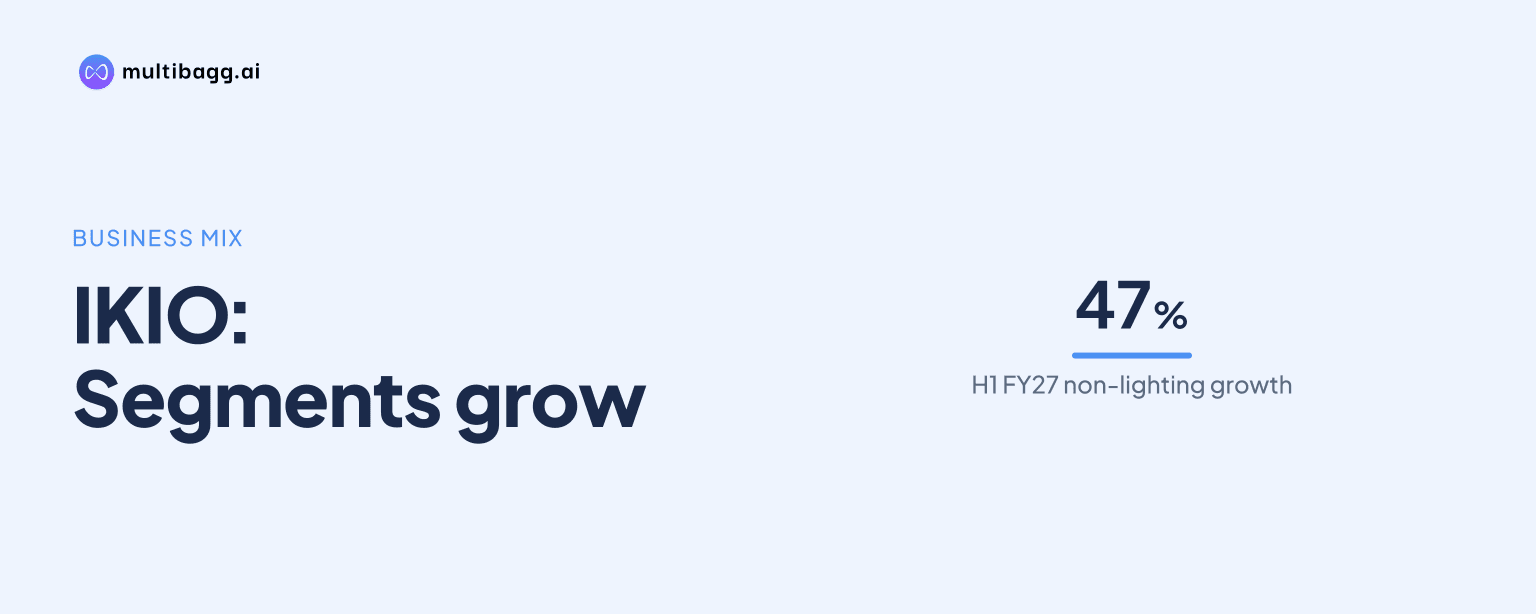
IKIO Technologies Limited’s non-lighting businesses grew 47% year on year to Rs 289 crore in H1 FY27 ended September 30, 2026, indicating that automotive lighting, hearables, wearables, solar energy solutions and advanced electronics are becoming more material as management works to reduce reliance on traditional home-lighting original design manufacturing (ODM).
Know IKIO Technologies inside out
Results, valuation, peers and who's buying, in one view.
How fast did IKIO’s non-lighting business grow?
IKIO’s other business segments increased 47% year on year to Rs 289 crore in H1 FY27, according to management. The company identified automotive lighting, hearables, wearables, solar energy solutions and advanced electronics as the businesses behind that increase, rather than its traditional home-lighting ODM operations.
The Rs 289 crore other-business figure equalled roughly 76% of IKIO’s reported H1 FY27 revenue from operations of Rs 378 crore, based on the two figures disclosed on the call. This calculation indicates the scale of the changing mix, although IKIO did not disclose separate H1 revenue for traditional home lighting or a full revenue split among the newer categories.
Management described its strategy as a systematic effort to lower dependence on traditional home-lighting ODM. IKIO said it is building a diversified manufacturing platform across technology-led categories, supported by an integrated model spanning design, tooling, component manufacturing, assembly and testing for more than 3,000 stock-keeping units, or SKUs.
Which products are changing IKIO’s revenue mix?
IKIO said hearables, wearables, automotive lighting, solar energy solutions and advanced electronics are the principal categories changing its H1 FY27 revenue mix. Those businesses form the company’s other business segments, which generated Rs 289 crore during the half year and grew 47% year on year.
The product expansion is supported by a research and development team of more than 50 people and by backward integration, management said. IKIO stated that these capabilities allow it to pursue work across design and production stages, including component manufacturing, assembly and testing, instead of only assembling finished lighting products.
Automotive lighting remains one of IKIO’s diversification categories even though it is lighting-related, while hearables, wearables, solar products and advanced electronics extend the portfolio beyond home lighting. The distinction is therefore between dependence on traditional home-lighting ODM and a broader product base, rather than a complete exit from lighting.
How did IKIO’s H1 FY27 financial performance compare?
IKIO reported H1 FY27 revenue from operations of Rs 378 crore, up 27% year on year, and earnings before interest, tax, depreciation and amortisation, or EBITDA, of Rs 51 crore, up 71%. In Q2 FY27, revenue reached Rs 209 crore, up 33% year on year and 23% quarter on quarter, while EBITDA rose 52% year on year and 22% quarter on quarter to Rs 28 crore.
The margin trend improved alongside the revenue mix change, although IKIO did not quantify profitability by non-lighting category. Q2 FY27 EBITDA margin was 13.4%, compared with 11.2% a year earlier, an expansion of 220 basis points. H1 FY27 EBITDA margin was 13.4%, compared with 10.4% in H1 FY26, while H1 PAT rose 80% year on year to Rs 24 crore.
The 47% expansion in other businesses exceeded IKIO’s 27% H1 revenue growth, although the call did not provide comparable category-level revenue for H1 FY26. The reported figures show that the diversification programme coincided with higher revenue, EBITDA growth of 71% and a 3-percentage-point year-on-year improvement in H1 EBITDA margin.
Got a follow-up? Ask IRIS
What capacity is supporting IKIO’s newer businesses?
IKIO is expanding its Noida manufacturing complex to support exports, backward integration and next-generation product lines, with Blocks 2 and 3 expected to add about 3 lakh square feet of space. Block 1, at about 2 lakh square feet, was fully operational, while Block 2, also about 2 lakh square feet, was partially commercialised in Q2 FY27 and Block 3 remained under construction.
Block 2 generated about Rs 20 crore to Rs 22 crore of revenue in Q2 FY27, primarily from hearables and wearables, management said. The area then in use was not operating at full capacity because orders were being transferred from a previous location, creating operational challenges during the transition.
Management estimated Block 2 could generate annual revenue of about Rs 150 crore to Rs 200 crore once the entire space is utilised. It said full commercialisation could occur by Q4 FY27 or Q1 of the following year, but added that utilisation would take longer and gave no timeline for reaching full output.
IKIO said customer additions in hearables, wearables, other ODM products and electronics manufacturing services, or EMS, were a continuing effort. Management did not disclose customer names, order values or category-specific revenue targets, but said new verticals were being developed as it added customers and production capacity.
Conclusion
IKIO’s H1 FY27 results show a measurable business-mix shift: other business segments rose 47% to Rs 289 crore while total revenue from operations reached Rs 378 crore and EBITDA was Rs 51 crore. IKIO is not presenting diversification as an abandonment of lighting, but as a way to reduce dependence on traditional home-lighting ODM through technology-oriented categories and automotive lighting.
The next disclosed milestone is Block 2’s expected full commercialisation by Q4 FY27 or Q1 of the following year, followed by the pace of its utilisation. Management’s Rs 150 crore to Rs 200 crore annual revenue estimate for Block 2 depends on full use of the facility, while Block 3 construction and customer additions in newer categories remain relevant to the planned capacity ramp-up.