








India GDP Growth at 7.8% Does Not Guarantee Stock Gains
MAX Plan at ₹4,999/yr

Find your next multibaggerBe a Pro Investor
Research stocks and track your picks on the go. Download the app.
Key highlights
- India’s real GDP grew 7.8% year-on-year in the April-June quarter of FY2026-27.
- The 7.8% GDP reading exceeded the RBI’s 7% forecast and the 7.1% consensus estimate.
- S&P raised its FY2026-27 India growth forecast to 7% from 6.6%.
- The Nifty 50 closed at 22,363.35 on October 12, 2026, around 11.35% below its October 13, 2025 close.
powered by IRIS
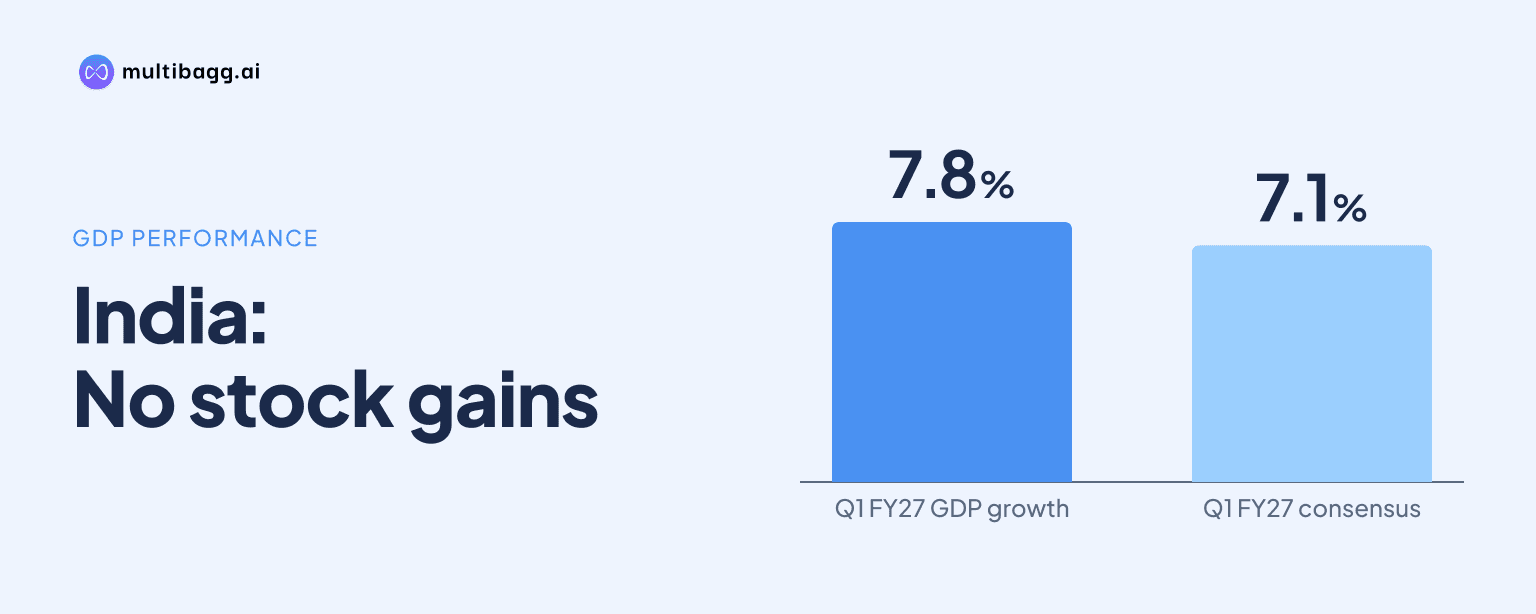
India’s real GDP grew 7.8% year-on-year in the April-June quarter of FY2026-27, above the RBI’s 7% forecast, but the reading did not guarantee higher equity prices as foreign selling, valuations, oil prices and global bond yields continued to weigh on market sentiment.
Why did India’s 7.8% GDP growth not lift stocks?
India’s 7.8% GDP growth did not automatically lift stocks because equity prices reflect expected future corporate earnings, valuations, capital flows and global financial conditions, not economic activity alone. The June-quarter number signalled stronger domestic activity, with investment, manufacturing, services, domestic demand and exports cited as contributors. It also exceeded the 7.1% consensus estimate mentioned in the discussion.
The market response nevertheless remained cautious. Indian benchmark indices ended lower in September despite the GDP data, while rising US Treasury yields and oil prices weighed on sentiment. Foreign investor selling, a weaker rupee, elevated crude prices and uncertainty in international markets were also identified as pressures. These factors can affect how much investors are willing to pay for future earnings, even when the domestic economy is expanding quickly.
What are the latest growth forecasts for India?
India is projected to grow about 7% in FY2026-27 by both S&P and the IMF, although their forecasts and reasons differ. S&P raised its estimate to 7% from 6.6% for the fiscal year ending March 31, 2027. The IMF raised its FY2026-27 projection to 7% from 6.4%, citing stronger domestic demand and services activity.
The forecasts point to continued expansion after the strong April-June quarter, but they do not imply uninterrupted momentum. S&P said growth could moderate in the second half as the effects of General Sales Tax rationalisation and income-tax cuts diminish. The context also notes that India is expected to post one of Asia’s highest growth rates, second only to Vietnam, while macroeconomic risks remain tilted to the upside.
Why can India’s GDP and Nifty move in different directions?
India’s GDP and the Nifty can move in different directions because GDP is a backward-looking measure of economy-wide output, while the Nifty prices expected profits and risks for listed companies. A strong quarterly growth number can improve the broad economic backdrop without immediately producing a similar improvement in earnings across companies. The timing and scale of profit conversion matter for shareholders.
The available market data illustrates that distinction. The Nifty 50 closed at 22,363.35 on October 12, 2026, around 11.35% below its October 13, 2025 close, even as the IMF upgraded its growth outlook. Reports also described a sharp rebound in November 2026 after several months of pressure. Comparing a past index level mechanically with a forecast for the full fiscal year can be misleading, since both measures capture different periods and drivers.
Got a follow-up? Ask IRIS
Which sectors could benefit from stronger Indian growth?
India’s domestic-facing sectors could benefit if growth translates into stronger rural demand and consumer spending. A favourable La Niña phase, if it follows the El Niño-related risks mentioned by S&P, could support rainfall, reservoir levels, agricultural production and rural incomes. That outcome could have implications beyond farming.
Two-wheelers, tractors, fast-moving consumer goods, consumer durables and building-material companies were identified as potential beneficiaries of a rural-demand recovery. However, sector outcomes will not be uniform. Domestic-oriented businesses may respond differently from export-oriented companies if foreign demand weakens, and higher input costs or interest rates can absorb part of the benefit from faster economic activity.
What should India stock market investors track after the GDP data?
India stock market investors should track corporate earnings, valuations, foreign flows, crude oil prices and global interest-rate expectations after the GDP release. The next earnings season is particularly important because it can show whether stronger activity is becoming sustainable profit growth for listed companies. GDP is a useful macroeconomic signal, but it is not a direct short-term forecast for the Nifty.
Investors also have weather and policy factors to monitor. El Niño could raise food-price pressures, while a favourable La Niña outcome could improve rural conditions. Higher bond yields may have only a modest near-term effect on the public debt-to-GDP ratio, according to the context, but can limit the government’s medium-term room to support growth. A growth shock can have a more immediate impact on debt dynamics because nominal GDP changes immediately, whereas borrowing costs adjust as debt is refinanced.
Conclusion
India’s 7.8% April-June GDP growth confirms strong economic activity and supports the broader domestic backdrop, but it does not resolve the factors determining equity returns. Stock prices still depend on earnings delivery, starting valuations, foreign investment flows, crude prices, bond yields and global risk appetite. The divergence between the growth reading and market weakness is therefore not inherently contradictory.
The next focus is whether the projected 7% FY2026-27 growth rate is supported by sustained demand and corporate profit growth. Investors will watch the next earnings season, movements in US Treasury yields and oil prices, foreign flows, and the impact of weather conditions on food prices and rural demand.

