










India Power Corporation Ltd Q2 Profit Rises 164% Under CIRP
Key highlights
- India Power Corporation Ltd reported Q2 FY27 consolidated net profit of ₹9.98 crore, up 164.02% year-on-year.
- Q2 FY27 consolidated revenue declined 1.64% year-on-year to ₹194.70 crore.
- Operating profit rose 193.66% year-on-year to ₹19.91 crore in Q2 FY27.
- Standalone H1 FY27 net profit was ₹16.97 crore, compared with a loss of ₹237.69 crore in H1 FY26.
powered by IRIS
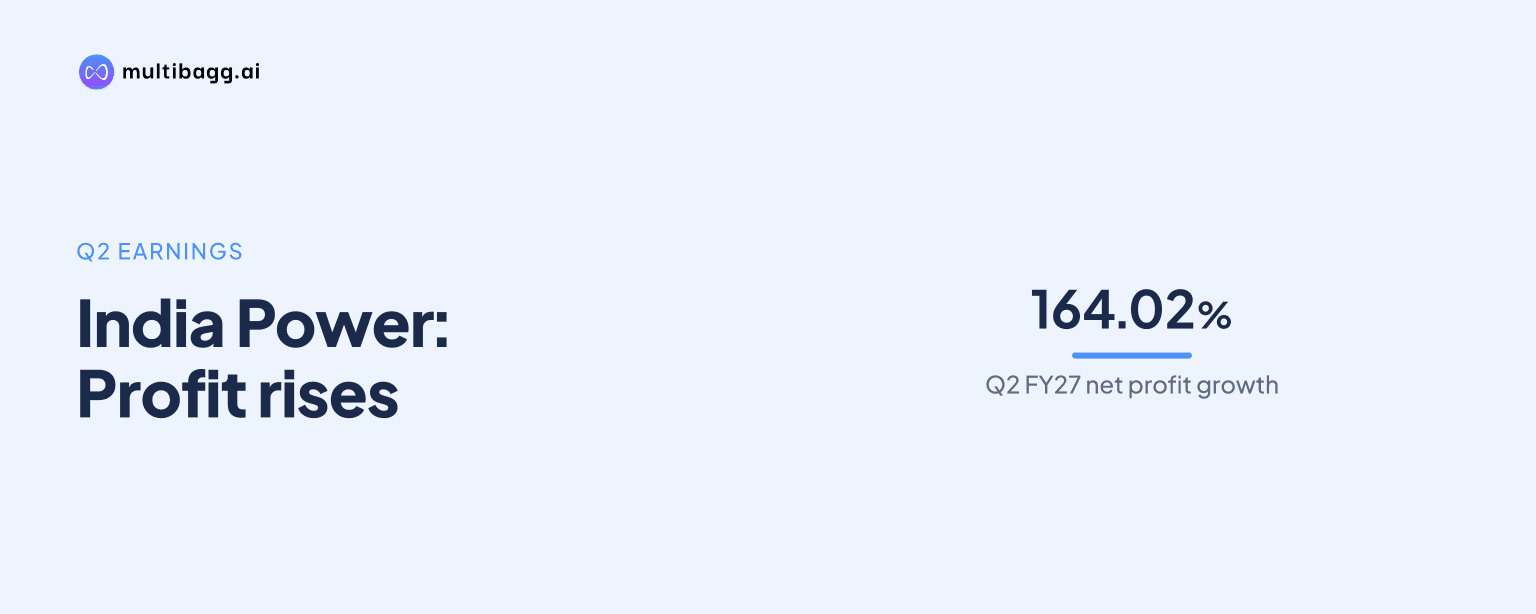
India Power Corporation Ltd reported a 164.02% year-on-year rise in consolidated Q2 FY27 net profit to ₹9.98 crore, despite revenue declining 1.64% to ₹194.70 crore. The results, announced on 13 November 2026, were released while the company remains under the corporate insolvency resolution process, or CIRP.
Know India Power Corporation inside out
Results, valuation, peers and who's buying, in one view.
What did India Power Corporation report for Q2 FY27?
India Power Corporation reported consolidated revenue from operations of ₹194.70 crore for the quarter ended 30 September 2026, compared with ₹197.94 crore in Q2 FY26. The 1.64% year-on-year decline in revenue came alongside a substantial increase in profitability from the prior-year quarter.
Consolidated net profit rose to ₹9.98 crore from ₹3.78 crore a year earlier. Operating profit increased to ₹19.91 crore from ₹6.78 crore, representing year-on-year growth of 193.66%. Consolidated total income for the quarter stood at ₹196.17 crore, according to the financial results released after the Resolution Professional Management Committee meeting.
Why did profit rise while revenue declined?
India Power Corporation's reported figures show that profit and operating profit improved even though revenue was marginally lower than the comparable quarter. The company disclosed the movement in reported financial metrics but did not provide a detailed breakdown in the supplied information attributing the consolidated profit increase to particular cost, tariff, or other operating factors.
On a standalone basis, revenue from operations was ₹186.98 crore in Q2 FY27, against ₹187.45 crore in Q2 FY26, a decline of about 0.2%. Standalone net profit increased to ₹10.36 crore from ₹3.76 crore. Standalone earnings per share were ₹0.07, compared with ₹0.02 in the corresponding quarter of the previous financial year.
The standalone results also recorded net regulatory income of ₹2.68 crore for the quarter. This amount was based on orders of the West Bengal Electricity Regulatory Commission and tariff adjustments. The filing identifies this regulatory income, but the supplied information does not specify its precise contribution to the consolidated profit movement.
What did the filing say about CIRP and audit opinion?
India Power Corporation said its results were issued under CIRP following a Resolution Professional Management Committee meeting. The status is material because the financial statements carry an adverse opinion related to the treatment of admitted claims.
According to the disclosure, the financial statements were not prepared in accordance with Indian Accounting Standards, or Ind AS, due to non-provisioning of admitted claims. This accounting matter means that readers of the reported figures need to consider the insolvency-process context alongside the revenue and profit trends.
The announcement was described as the outcome of the Resolution Professional Management Committee meeting and included unaudited financial results for the quarter and half year ended 30 September 2026. No resolution plan, completion timeline, or further outcome of the CIRP was disclosed in the supplied material.
Got a follow-up? Ask IRIS
How did standalone and half-year results compare?
India Power Corporation's standalone half-year results showed revenue growth and a return to profit compared with the prior-year period. Revenue from operations for the six months ended 30 September 2026 was ₹363.54 crore, up 5.1% from ₹345.84 crore in H1 FY26.
Standalone net profit for H1 FY27 was ₹16.97 crore, compared with a loss of ₹237.69 crore in H1 FY26. Standalone total income for the half year was ₹366.06 crore, while earnings per share were ₹0.11, against a loss per share of ₹1.51 in the previous year's first half.
On a consolidated basis, India Power Corporation reported H1 FY27 revenue from operations of ₹381.63 crore and total income of ₹384.40 crore. Consolidated net profit for the six-month period was ₹14.19 crore, with earnings per share of ₹0.09.
What does the result mean for investors and operations?
India Power Corporation's quarterly report presents improved reported profitability alongside broadly stable revenue, but it also retains a significant accounting and insolvency-process qualification. The adverse opinion on the financial statements is an important consideration when comparing the company with power-sector peers reporting results under regular corporate governance arrangements.
For investors, the main reported operating indicators are the 1.64% revenue decline, the ₹19.91 crore operating profit, and the ₹9.98 crore consolidated net profit. The half-year standalone shift from a substantial loss to a profit is also notable, although the supplied disclosure does not set out a complete explanation for the change.
The filing also shows that regulatory orders and tariff adjustments remained relevant to the standalone results through ₹2.68 crore of net regulatory income in the quarter. For customers and operations, the data indicates continued revenue-generating activity during the quarter, while the CIRP status and treatment of admitted claims remain unresolved issues in the financial reporting.
Conclusion
India Power Corporation reported a sharp year-on-year increase in Q2 FY27 consolidated profit to ₹9.98 crore and operating profit to ₹19.91 crore, even as revenue eased to ₹194.70 crore. The numbers point to better reported quarterly profitability, while the standalone half-year figures showed a return to profit from a large loss in H1 FY26.
The next key development is any disclosure from the Resolution Professional Management Committee on the CIRP and the non-provisioning of admitted claims that led to the adverse opinion. Investors will also watch subsequent financial filings for whether revenue, regulatory income, and reported profitability are sustained.