










Indian Toners reports Rs 1.77 crore first-half operating cash flow
Key highlights
- Indian Toners’ net cash inflow from operating activities was Rs 1.77 crore for the half year ended September 30, 2026.
- Inventories and trade receivables absorbed Rs 7.52 crore of cash, comprising Rs 4.28 crore from inventories and Rs 3.24 crore from receivables.
- Net profit fell to Rs 11.67 crore from Rs 13.23 crore in the corresponding prior-year half, while revenue from operations declined to Rs 77.33 crore from Rs 77.96 crore.
- Total assets increased to Rs 274.72 crore at September 30, 2026, from Rs 261.07 crore at March 31, 2026, while cash and cash equivalents rose to Rs 9.32 crore.
powered by IRIS
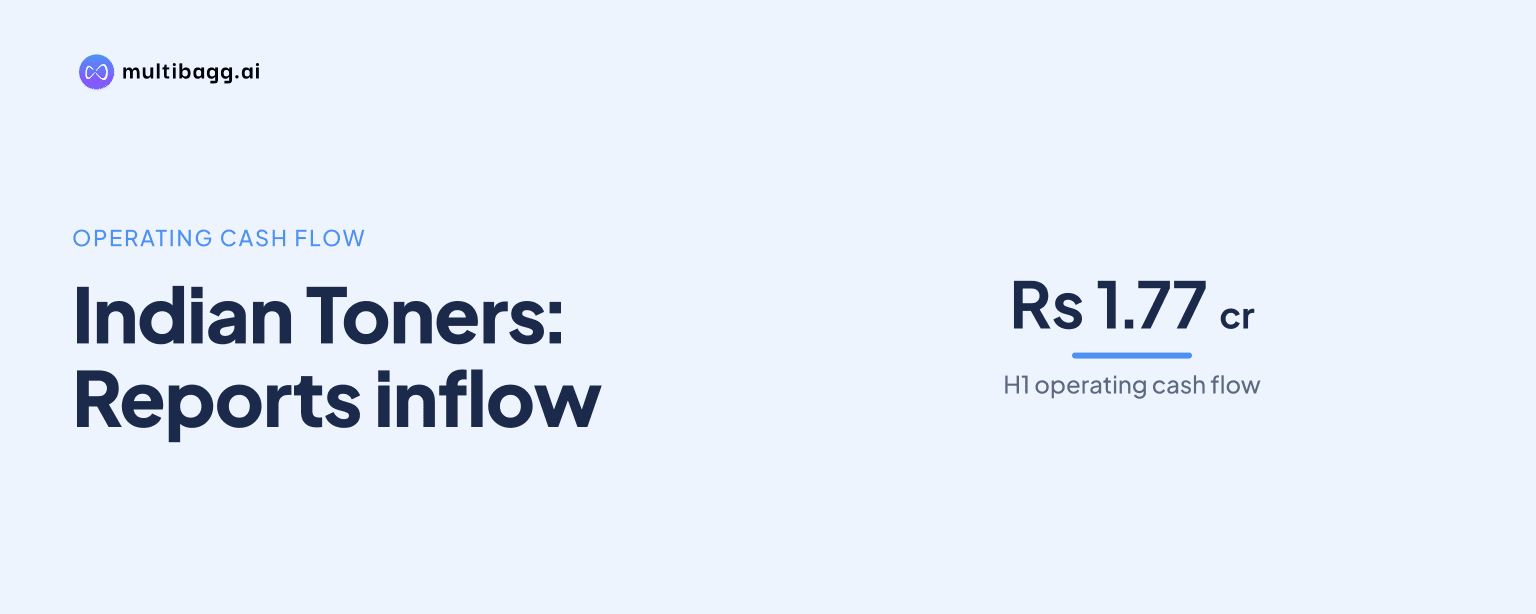
Indian Toners and Developers Limited reported net cash inflow from operating activities of Rs 1.77 crore for the half year ended September 30, 2026. Indian Toners generated Rs 14.55 crore of operating profit before working-capital changes, but higher inventories and trade receivables absorbed Rs 7.52 crore while net direct taxes paid totalled Rs 3.30 crore.
Know Indian Toners & Developers inside out
Results, valuation, peers and who's buying, in one view.
Why was Indian Toners’ operating cash flow Rs 1.77 crore?
Indian Toners’ operating cash inflow was Rs 1.77 crore because Rs 5.07 crore of cash generated from operations was reduced by Rs 3.30 crore of net direct taxes paid. The company prepared its cash-flow statement under the indirect method in Indian Accounting Standard 7, beginning with profit before tax of Rs 15.54 crore for the half year.
The largest reconciling adjustment was a Rs 3.01 crore gain on mark-to-market investments, which reduced the cash-flow starting profit. Depreciation and amortisation added back Rs 2.67 crore, interest income deducted Rs 63.48 lakh, finance cost added Rs 8.02 lakh, and loss on sale of property, plant and equipment added Rs 13.29 lakh.
The filing presents the previous comparator as the year ended March 31, 2026 rather than the corresponding 2025 half year. On that disclosed basis, cash generated from operations was Rs 5.07 crore in the latest half year, compared with Rs 44.27 crore in the prior full year, while operating profit before working-capital changes was Rs 14.55 crore versus Rs 34.89 crore.
How did inventories and receivables affect Indian Toners’ cash?
Indian Toners used Rs 7.52 crore of cash through increases in inventories and trade receivables during the half year ended September 30, 2026. Inventory absorbed Rs 4.28 crore and trade receivables absorbed Rs 3.24 crore, together accounting for a substantial part of the movement from Rs 14.55 crore of operating profit before working-capital changes to Rs 5.07 crore of cash generated from operations.
The balance sheet recorded inventories of Rs 24.17 crore at September 30, 2026, up from Rs 19.89 crore at March 31, 2026. Trade receivables rose to Rs 30.43 crore from Rs 27.19 crore over the same six-month period, consistent with the two working-capital cash outflows shown in the cash-flow statement.
Loans and other assets created an additional cash outflow of Rs 3.70 crore in the half year. This was partly offset by a Rs 1.74 crore increase in trade and other payables, leaving the disclosed inventory, receivable, loans and other-assets movements as the main constraints on cash generated from operations.
Got a follow-up? Ask IRIS
What changed in Indian Toners’ profit and operating expenses?
Indian Toners reported profit before tax of Rs 15.54 crore in the half year ended September 30, 2026, down from Rs 16.00 crore in the corresponding half year ended September 30, 2025. Net profit was Rs 11.67 crore, compared with Rs 13.23 crore a year earlier, while revenue from operations declined to Rs 77.33 crore from Rs 77.96 crore.
Total income nevertheless increased to Rs 81.22 crore from Rs 80.78 crore because other income rose to Rs 3.89 crore from Rs 2.82 crore. Total expenses increased to Rs 65.68 crore from Rs 64.78 crore, as cost of materials consumed rose to Rs 39.16 crore from Rs 35.71 crore and other expenses rose to Rs 9.50 crore from Rs 8.83 crore.
Changes in inventories of finished goods, work-in-progress and stock-in-trade produced a negative Rs 3.82 crore expense adjustment in the latest half year, compared with a negative Rs 60.68 lakh adjustment a year earlier. This income-statement movement differs from the Rs 4.28 crore cash outflow for higher inventory in the cash-flow statement, which records the balance-sheet working-capital change.
What does Indian Toners’ September balance sheet show?
Indian Toners reported total assets of Rs 274.72 crore at September 30, 2026, compared with Rs 261.07 crore at March 31, 2026. Current assets increased to Rs 176.79 crore from Rs 165.06 crore, led by higher inventories, receivables and current investments, which rose to Rs 104.38 crore from Rs 98.89 crore.
Cash and cash equivalents increased to Rs 9.32 crore from Rs 8.62 crore, a gain of Rs 69.99 lakh that agrees with the cash-flow statement’s net increase in cash and cash equivalents. Other bank balances declined to Rs 3.06 crore from Rs 6.30 crore, while non-current investments rose to Rs 5.28 crore from Rs 3.17 crore.
Total equity rose to Rs 244.03 crore at September 30 from Rs 232.27 crore at March 31, comprising other equity of Rs 233.64 crore and equity capital of Rs 10.39 crore. Total current liabilities increased to Rs 17.56 crore from Rs 15.94 crore, including other current liabilities of Rs 8.69 crore compared with Rs 4.98 crore.
Conclusion
Indian Toners converted Rs 15.54 crore of half-year profit before tax into Rs 1.77 crore of operating cash inflow after working-capital movements and taxes. The Rs 7.52 crore use of cash from higher inventories and receivables, together with Rs 3.70 crore absorbed by loans and other assets, explains the difference between operating profit and cash generation.
The next matter to watch is the effect of supply arrangements for trading in writing instruments and stationery products, which Indian Toners entered into during the quarter ended September 30, 2026. The company also said it continues to monitor central and state rules under the new labour codes for further obligations after recording a Rs 35.84 lakh non-recurring impact in the year ended March 31, 2026.