










Indo Tech H1 FY27 sales rose 34%, while PAT gained 18%
Key highlights
- Indo Tech’s H1 FY27 sales were Rs 466.4 crore, up 34% year on year.
- H1 FY27 PAT increased 18% to Rs 51.8 crore, while PBT rose 19% to Rs 69.6 crore.
- Q2 FY27 sales rose 30% year on year to Rs 238.5 crore, while PAT grew 5% to Rs 26.1 crore.
- Indo Tech disclosed a Rs 1,453 crore executable order book and a 50,000 MVA FY29 capacity target.
powered by IRIS
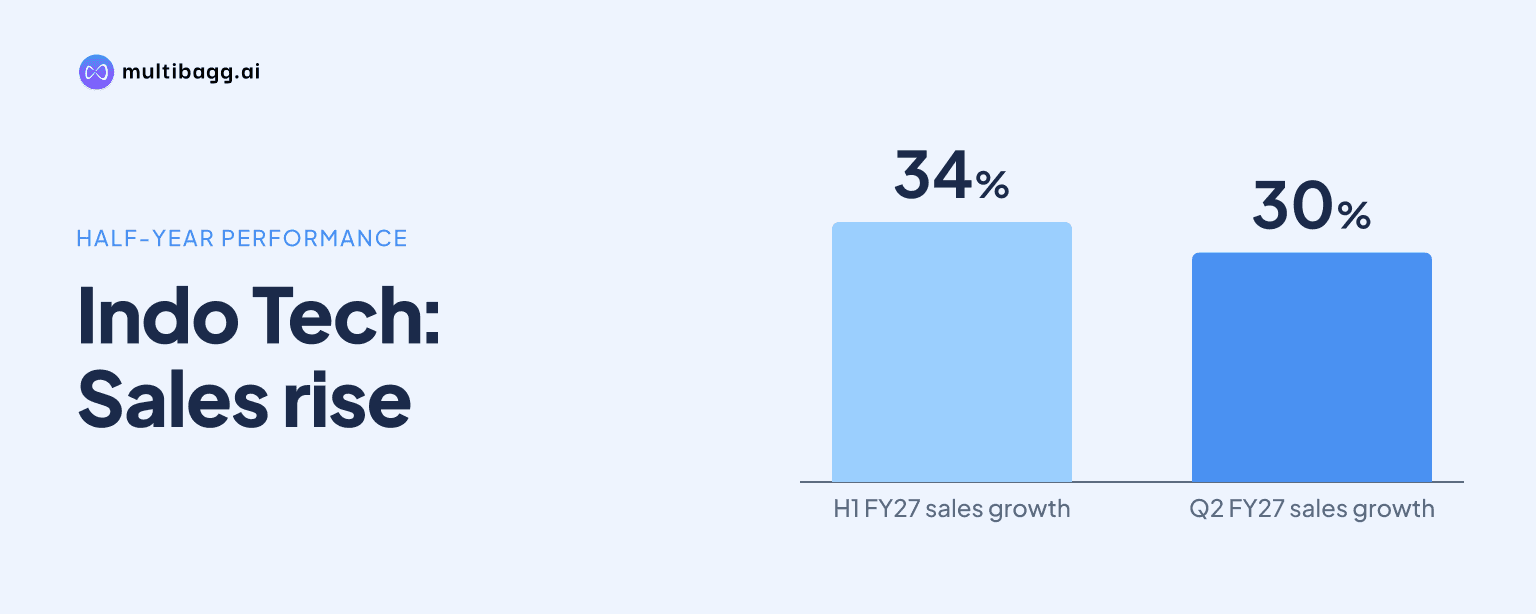
Indo Tech Transformers Limited reported standalone unaudited H1 FY27 sales of Rs 466.4 crore for the half year ended 30 September 2026, up 34% year on year, while profit after tax rose 18% to Rs 51.8 crore. The result marked a wider gap between sales and profit growth than in audited FY26.
Know Indo Tech Transformers inside out
Results, valuation, peers and who's buying, in one view.
How did Indo Tech perform in H1 FY27?
Indo Tech’s H1 FY27 sales increased by Rs 119.6 crore to Rs 466.4 crore from Rs 346.8 crore in H1 FY26, while profit after tax, or PAT, increased by Rs 7.8 crore to Rs 51.8 crore from Rs 44.0 crore. Profit before tax, or PBT, was Rs 69.6 crore, up 19% from Rs 58.3 crore. The company labels the half-year figures as standalone and unaudited.
The reported growth rates show revenue expanding faster than profits in the six months to 30 September 2026. Sales rose 34%, compared with 19% growth in PBT and 18% growth in PAT. The presentation does not provide a half-year breakdown for costs, product mix, pricing, finance costs or tax that would explain the difference between sales and profit growth.
Why did Indo Tech’s profit grow more slowly than sales?
Indo Tech has not disclosed a specific cause for H1 FY27 PAT growth of 18% trailing the 34% rise in sales. The presentation quantifies the result, including a Rs 119.6 crore increase in sales and a Rs 7.8 crore increase in PAT, but does not disclose material-cost, employee-expense, project-margin or tax-rate detail for the half year.
The reported pattern differs from audited FY26, although FY26 is a full-year period and therefore not directly comparable with H1 FY27. In FY26, revenue from operations rose 28% to Rs 782 crore from Rs 612 crore in FY25, while PAT increased 45% to Rs 93 crore from Rs 64 crore. PAT margin expanded by 150 basis points, or 1.5 percentage points, to 12% from 10%.
FY26 PBT increased 44% to Rs 124 crore from Rs 86 crore, broadly in line with the 45% PAT increase in that audited year. In contrast, H1 FY27 PBT grew 19% and PAT grew 18%, against 34% sales growth. The available data establish the change in growth rates, but not the operational or financial reasons behind it.
How did Indo Tech’s second quarter compare with the first?
Indo Tech reported Q2 FY27 sales of Rs 238.5 crore, up 30% year on year and Rs 10.6 crore above Q1 FY27 sales of Rs 227.9 crore. Q2 FY27 PBT was Rs 35.2 crore, compared with Rs 34.4 crore in Q1 FY27, while PAT was Rs 26.1 crore against Rs 25.7 crore. Both FY27 quarterly periods are described as standalone unaudited results.
Compared with Q2 FY26, sales rose from Rs 182.9 crore to Rs 238.5 crore, while PBT increased from Rs 33.3 crore to Rs 35.2 crore and PAT rose from Rs 24.8 crore to Rs 26.1 crore. This equated to reported year-on-year growth of 30% in sales, 6% in PBT and 5% in PAT. Sequentially, Q2 sales rose by Rs 10.6 crore, PBT by 80 lakh and PAT by 40 lakh from Q1 FY27.
Got a follow-up? Ask IRIS
What order visibility and capacity plans support Indo Tech’s growth?
Indo Tech reported an executable order book of Rs 1,453 crore, pipeline opportunities exceeding Rs 10,000 crore and capacity utilisation of 80% to 90%. Management says high utilisation and the executable order book support the case for phased capacity additions. The company also reported FY26 revenue of Rs 782 crore and more than 67,000 transformers manufactured over its operating history.
Indo Tech’s stated expansion programme targets manufacturing capacity of 50,000 megavolt-amperes, or MVA, by FY29, from a 14,000 MVA base in 2026. The planned capital expenditure totals Rs 495 crore, comprising Rs 75 crore for phase 1 to reach 16,000 MVA, Rs 25 crore for phase 2 to reach 20,000 MVA, Rs 35 crore for phase 3 to reach 25,000 MVA and Rs 360 crore for phase 4 to reach 50,000 MVA.
The company says its product capability extends to 315 MVA and 400 kilovolt-class transformers, with applications in distribution, power, large power, renewable and special-application segments. Management describes the capacity programme as intended to increase manufacturing scale and strengthen participation in higher-value applications. The presentation does not disclose a revenue, margin or profit target linked to the Rs 495 crore programme.
What financial position does Indo Tech report for expansion?
Indo Tech reported cash and bank balances of Rs 114 crore in FY26, up from Rs 93 crore in FY25, and total equity of Rs 374 crore, compared with Rs 281 crore a year earlier. The presentation describes net debt as near zero and reports a debt-to-equity ratio of 0.03 times. FY26 borrowings comprised Rs 2.25 crore of long-term debt and Rs 2.95 crore of short-term debt.
The company also reported debtor days of 56 in FY26, improving from 76 in FY25. Its FY26 return on capital employed was 38% and return on equity was 28%. These balance-sheet and collection figures accompany the phased plan to increase capacity from 14,000 MVA in 2026 to 50,000 MVA by FY29, though the presentation does not specify the financing mix for the planned Rs 495 crore capital expenditure.
Conclusion
Indo Tech’s H1 FY27 outcome combines 34% sales growth to Rs 466.4 crore with 18% PAT growth to Rs 51.8 crore. Q2 FY27 showed a similar pattern, with sales increasing 30% year on year to Rs 238.5 crore while PAT rose 5% to Rs 26.1 crore. The presentation reports the gap in growth rates but does not identify the cost, mix or tax factors that produced it.
The next disclosed items to watch are execution of the Rs 1,453 crore order book and progress on the Rs 495 crore phased capacity programme targeting 50,000 MVA by FY29. Management has linked the expansion case to utilisation of 80% to 90% and pipeline opportunities above Rs 10,000 crore, while the presentation leaves the programme’s funding mix and profit targets undisclosed.