








Innova Captab targets 70%-75% Jammu utilisation within six years

Find your next multibaggerBe a Pro Investor
Research stocks and track your picks on the go. Download the app.
Key highlights
- Innova Captab targets 70%-75% utilisation at Jammu within five to six years, from 5%-10% in FY26.
- Innova Captab reports more than ₹480 crore of total capital investment in the Jammu greenfield project.
- The Jammu plant has four independent blocks: Cephalosporin, Penem, Penicillin and General.
- The GST-linked incentive can total up to 300% of eligible plant-and-machinery investment over 10 years.
powered by IRIS
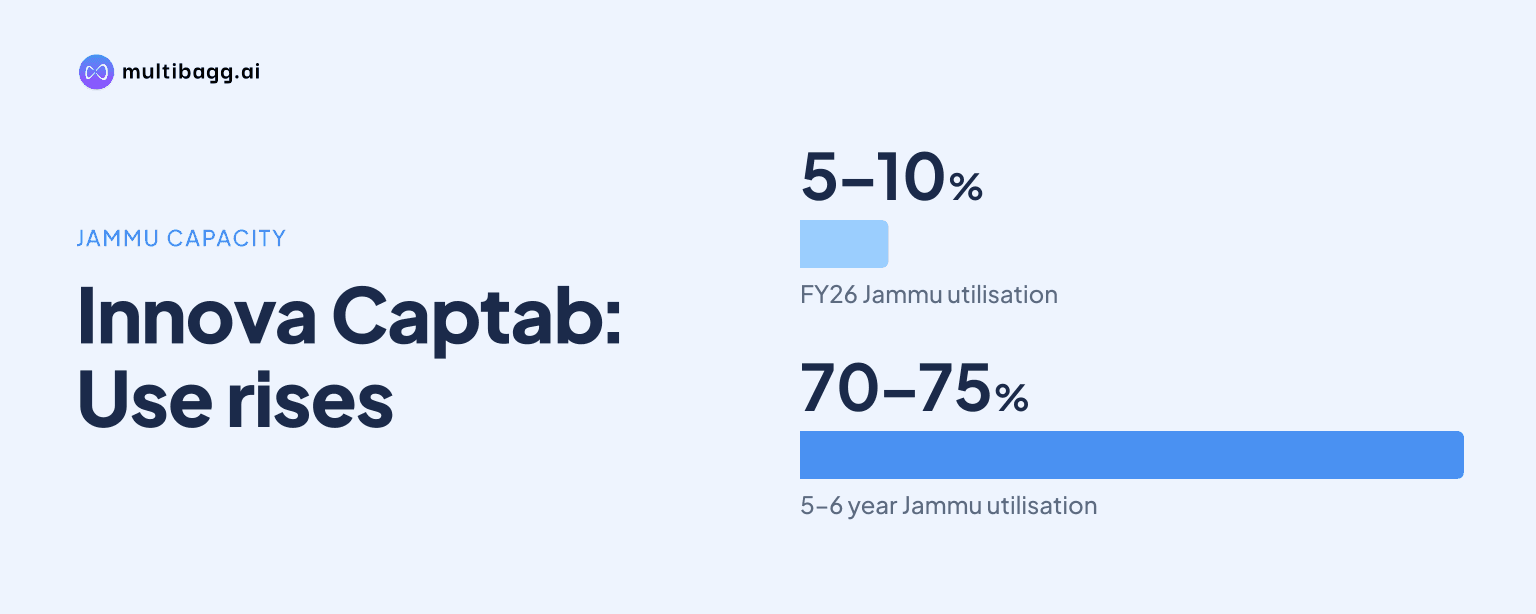
Innova Captab targets 70%-75% utilisation at its ₹480+ crore Kathua, Jammu plant within five to six years, compared with 5%-10% in FY26. The four-block greenfield facility was commercialised in January 2025 and is eligible for incentives under the Central Government’s New Central Sector Scheme.
Know Innova Captab inside out
Results, valuation, peers and who's buying, in one view.
What is Innova Captab’s Jammu plant utilisation target?
Innova Captab’s stated optimum utilisation target for the Kathua, Jammu plant is 70%-75% in five to six years. The company places FY26 utilisation at 5%-10%, indicating that the facility remains in an early commercial ramp-up phase after its January 2025 commercialisation.
The pathway disclosed by Innova Captab has two intermediate steps. It expects utilisation to reach 40%-50% in two to three years, followed by a further 10%-15% ramp-up before the site reaches its 70%-75% optimum range. These stages set out management’s operating plan rather than a reported achieved utilisation level beyond FY26.
The disclosed end-state would represent an increase of 60-70 percentage points from the 5%-10% FY26 range. Innova Captab also says the Jammu facility has completed its first full year and is ramping up, with multiple marquee-client audits successfully completed, although the presentation does not identify those clients or quantify orders from them.
What has Innova Captab invested in the Jammu facility?
Innova Captab reports total capital investment of more than ₹480 crore for the Jammu expansion. The site is a new greenfield project, rather than an acquired facility, and the company identifies it as part of manufacturing-capability expansion from 2025 onwards.
The Jammu plant comprises four independent blocks: Cephalosporin, Penem, Penicillin and General. The separation of these blocks is a stated feature of the ₹480+ crore project, while the presentation does not provide individual block capacities, capital allocations or utilisation figures.
Innova Captab lists five dosage categories for the facility: dry syrup, oral solid dosages, large and small volume parenterals, respiratory respule products and dry powder injectables. Blow Fill Seal, or BFS, capability is included for large and small volume parenterals and respules, expanding the facility beyond the tablets and capsules formats shown for several of its other plants.
The January 2025 commercialisation date distinguishes Jammu from Innova Captab’s older Baddi operations, which date from 2006 onwards, and from its Dehradun and Taloja expansion. The latter followed the acquisition of Sharon Bio Medicine Ltd on June 30, 2023, whereas Jammu represents internally developed greenfield capacity.
Which government incentives can apply to the Jammu project?
Innova Captab says the Jammu project is eligible for benefits under the Central Government’s New Central Sector Scheme, including a Goods and Services Tax, or GST, linked incentive of up to 300% of investment in eligible plant and machinery over 10 years. Eligibility does not establish the amount that will ultimately be received, because the presentation gives no claimed or realised incentive figure.
The company also lists capital subvention of 6% per annum on loans against eligible capital expenditure, as well as interest subvention of 6% per annum on loans against eligible capital expenditure. These mechanisms are linked to qualifying project spending and borrowing, not to the full ₹480+ crore investment automatically.
The incentive period of 10 years is longer than Innova Captab’s five-to-six-year operating-utilisation target. That timing means the plant’s planned ramp-up to 70%-75% falls within the stated duration for the GST-linked incentive, but the presentation does not disclose expected annual incentive accruals, eligible-capex amounts, loan balances or project returns.
The stated policy support is therefore relevant to the eventual economics of the Jammu project, while the disclosed operational benchmark remains utilisation. The presentation distinguishes between FY26 use of 5%-10%, management’s intermediate 40%-50% target in two to three years, and benefits available subject to the scheme’s eligibility conditions.
Got a follow-up? Ask IRIS
How does the Jammu ramp-up compare with Innova Captab’s other plants?
Innova Captab’s Jammu site has the lowest utilisation among the three manufacturing groups shown for FY26. Baddi is reported at 55%-60%, while the Dehradun and Taloja plants are at 60%-70%; Jammu is at 5%-10%, reflecting its January 2025 commercialisation and earlier position in the production cycle.
Baddi has 10%-15% unutilised capacity and a stated optimum range of 70%-75% in coming years. Innova Captab expects its current Baddi capacity to meet ongoing demand while overall utilisation rises, but it does not give a date for attaining that range.
Dehradun and Taloja also have 10%-15% unutilised capacity, with an optimum target of 70%-80%. Innova Captab says Sharon’s manufacturing units are nearing optimal utilisation and aims to create long-term synergies through additional formulation and active pharmaceutical ingredient, or API, offerings; the presentation does not quantify those prospective synergies.
What supports Innova Captab’s Jammu ramp-up?
Innova Captab links the Jammu ramp-up to progressively using capacity across four independent blocks and five listed dosage categories, including dry powder injectables, respiratory respules and oral solid dosages. The company also reports successful completion of multiple marquee-client audits alongside its statement that the facility is ramping up well.
The company’s broader contract development and manufacturing organisation, or CDMO, platform serves more than 350 customers and offers more than 4,200 products. Those figures describe the group’s overall commercial base, but the presentation does not say how many of those customers or products have been assigned to Jammu.
Innova Captab also reports branded-generics reach of more than 2,50,000 touchpoints in India and exports to more than 60 countries. The presentation does not specify whether Jammu will serve domestic branded generics, exports, CDMO customers, or a particular combination of these channels, so the revenue mix supporting the five-to-six-year target remains undisclosed.
The company’s research and development organisation has more than 60 scientists and engineers and is located in Baddi, Himachal Pradesh. Its stated development work includes immediate-release products, super-bioavailability capsules, nano-size formulations, modified-release products, sustained-release products and tablets in capsules, but no pipeline allocation to Jammu is provided.
Conclusion
Innova Captab’s presentation sets out a long utilisation build-out for its ₹480+ crore Jammu facility: 5%-10% in FY26, 40%-50% in two to three years and 70%-75% in five to six years. The site differs from the more utilised Baddi and Dehradun-Taloja operations because it was commercialised only in January 2025 and combines four independent manufacturing blocks with several dosage categories.
The next disclosed operating milestone is the 40%-50% utilisation target in two to three years, followed by the 70%-75% range in five to six years. Innova Captab also identifies GST-linked incentives available for up to 10 years and 6% annual capital and interest subventions on loans against eligible capital expenditure, but it has not disclosed the amount of benefits realised.

