










INOX India net cash rises to Rs 384 crore in September 2026
Key highlights
- INOX India reported Rs 384 crore of net cash at September 2026-end, up from Rs 257 crore at March 2026-end.
- INOX India reported nil gross debt at September 2026-end, June 2026-end and March 2026-end.
- INOX India’s total inventory rose 12% to Rs 535 crore as backlog increased to Rs 2,268 crore.
- Combined trade receivables and net contract assets declined to Rs 619 crore from Rs 667 crore between March and September 2026.
powered by IRIS
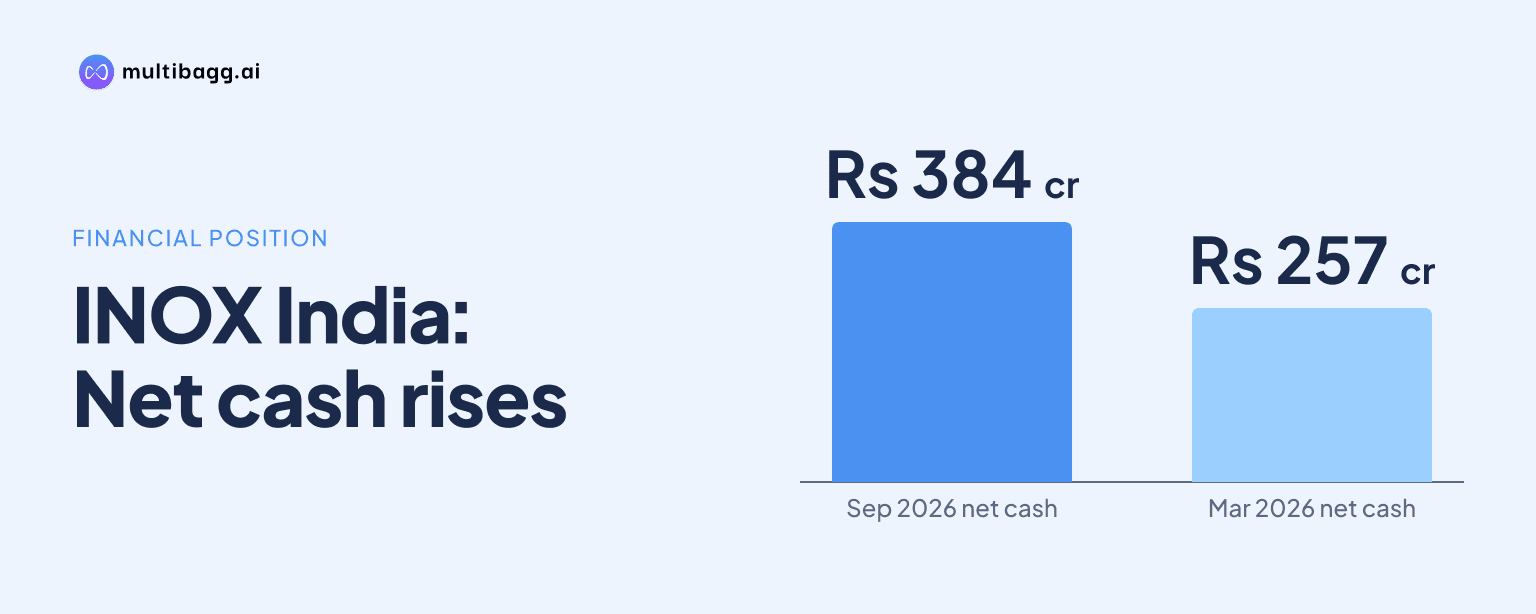
INOX India reported net cash of Rs 384 crore at September 2026-end, up Rs 127 crore from Rs 257 crore at March 2026-end, despite inventory increasing 12% to Rs 535 crore and additions of Rs 47 crore. The consolidated balance sheet showed nil gross debt in all three reported periods.
Know Inox India inside out
Results, valuation, peers and who's buying, in one view.
How did INOX India’s cash position change?
INOX India’s net cash, bank balances, mutual funds and fixed-deposit receipts rose to Rs 384 crore at September 2026-end from Rs 331 crore at June 2026-end and Rs 257 crore at March 2026-end. The increase was Rs 53 crore over the quarter and Rs 127 crore over six months. Gross debt was shown as nil at each of the three reporting dates.
INOX India’s net debt-to-equity ratio was negative 0.31 at September 2026-end, compared with negative 0.29 at June 2026-end and negative 0.23 at March 2026-end. The presentation defines net debt as gross debt, including short-term debt, less cash and bank balances, fixed-deposit receipts and mutual funds. Total equity increased to Rs 1,228 crore in September from Rs 1,118 crore in March.
What funded higher cash despite INOX India’s inventory increase?
INOX India said net cash was higher than in March 2026 despite the inventory increase and Rs 30 crore of real fixed-asset additions. The presentation excludes Rs 17 crore of lease land at Kandla port from that real fixed-asset figure because it was accounted for under Indian Accounting Standards. It attributes the cash increase to higher customer advances and realisation of contract assets.
Customer advances and deposits were Rs 518 crore at September 2026-end, Rs 41 crore above Rs 477 crore at March 2026-end, although Rs 8 crore below the June 2026 level of Rs 526 crore. Total current liabilities increased to Rs 811 crore from Rs 774 crore over the six months, while customer advances remained the largest component of those liabilities.
Inventory rose by Rs 57 crore to Rs 535 crore from Rs 478 crore between March and September 2026. Raw materials, including stores and spares, increased to Rs 324 crore from Rs 298 crore, while work in progress and finished goods increased to Rs 211 crore from Rs 180 crore. The inventory build therefore covered both production inputs and goods under manufacture or completed.
How does INOX India’s order backlog explain inventory growth?
INOX India linked the 12% inventory increase to a 50% rise in order backlog, from Rs 1,514 crore in March 2026 to Rs 2,268 crore in September 2026. The backlog was Rs 1,686 crore at June 2026-end, meaning it increased by Rs 582 crore during the September quarter. This is the company’s stated context for the rise in working capital tied up in inventory.
Export orders represented Rs 1,628 crore, or 72%, of the September 2026 backlog, while domestic orders accounted for Rs 640 crore, or 28%. At September 2025-end, total backlog was Rs 1,485 crore, including exports of Rs 934 crore, or 63%. The total backlog was therefore Rs 783 crore higher year on year, while exports gained 9 percentage points of the mix.
INOX India describes its products as cryogenic tanks and systems for industrial gases, equipment for liquefied natural gas storage, distribution and transportation, and cryogenic scientific equipment. The presentation also says the company executes large turnkey projects and manufactures non-cryogenic equipment. These disclosed activities provide the operating context for holdings of Rs 324 crore in raw materials and Rs 211 crore in work in progress and finished goods.
Got a follow-up? Ask IRIS
What happened to INOX India’s receivables and contract assets?
INOX India’s trade receivables rose to Rs 349 crore at September 2026-end from Rs 313 crore at March 2026-end, while net contract assets declined to Rs 270 crore from Rs 354 crore. Together, these balances fell to Rs 619 crore from Rs 667 crore, a reduction of Rs 48 crore. The presentation identifies this as an overall reduction despite the increase in receivables considered separately.
The presentation says some contract assets became trade receivables after final dispatch of the related goods and that the receivables would be realised in the coming quarter. Contract assets are reported net of contract liabilities, so the Rs 270 crore September figure is not a gross contract-assets balance. The movement from Rs 354 crore of net contract assets in March to higher receivables in September is linked to the stated dispatch and billing process.
Total current assets were Rs 1,596 crore at September 2026-end, compared with Rs 1,460 crore at March 2026-end. Current liabilities increased by Rs 37 crore to Rs 811 crore, less than the Rs 136 crore increase in current assets, lifting net current assets to Rs 785 crore from Rs 686 crore. Trade payables, including expenses payable, rose to Rs 169 crore from Rs 156 crore, while other current liabilities fell to Rs 124 crore from Rs 141 crore.
How did INOX India’s equity and fixed assets move?
INOX India’s total equity increased to Rs 1,228 crore at September 2026-end from Rs 1,118 crore at March 2026-end. Share capital remained Rs 18 crore, while other equity increased to Rs 1,210 crore from Rs 1,099 crore. In Q2 FY27, INOX India reported profit after tax of Rs 66 crore on total income of Rs 467 crore, although the presentation does not separately reconcile the full movement in other equity.
Net fixed assets rose to Rs 476 crore at September 2026-end from Rs 448 crore in March. Additions were Rs 47 crore at September-end, compared with Rs 25 crore at June-end and Rs 103 crore in FY26. Other non-current assets were Rs 6 crore, bringing total non-current assets to Rs 483 crore, while total sources and applications of funds both stood at Rs 1,267 crore.
INOX India reported annualised return on equity of 20.67% at September 2026-end, compared with 23.08% at March 2026-end. Annualised return on capital employed was 26.36%, versus 30.77% in March. The presentation defines return on equity as profit after tax divided by net worth and return on capital employed as earnings before interest and tax divided by capital employed.
Conclusion
INOX India’s September 2026 balance sheet showed Rs 384 crore of net cash, nil reported gross debt and a Rs 99 crore increase in net current assets since March 2026. Higher customer advances and the reduction in combined receivables and net contract assets helped fund a Rs 57 crore inventory increase and additions to fixed assets while the order backlog expanded to Rs 2,268 crore.
The next reported balance sheet should show whether trade receivables created by final dispatches are realised, as the presentation expects in the coming quarter. Investors can also track whether customer advances remain above the March 2026 level of Rs 477 crore and whether inventory continues to move with the Rs 2,268 crore backlog, including its Rs 1,628 crore export component.