










BCSSL Gets 85%-91% of Steel-Coil Purchases From JSWSCPL
Key highlights
- JSWSCPL supplied 85.13% of BCSSL’s steel-coil purchases in the three months ended June 30, 2026.
- BCSSL’s total steel-coil purchases increased from Rs 659.678 crore in Fiscal 2024 to Rs 1,193.570 crore in Fiscal 2026.
- BCSSL reported Fiscal 2026 revenue of Rs 1,266.818 crore, with home and commercial appliances contributing 86.54%.
- As of June 30, 2026, BCSSL had quarterly processing capacity of 123,153 metric tonnes across four facilities; slitting utilisation was 63.84% and cut-to-length utilisation was 59.66%.
powered by IRIS
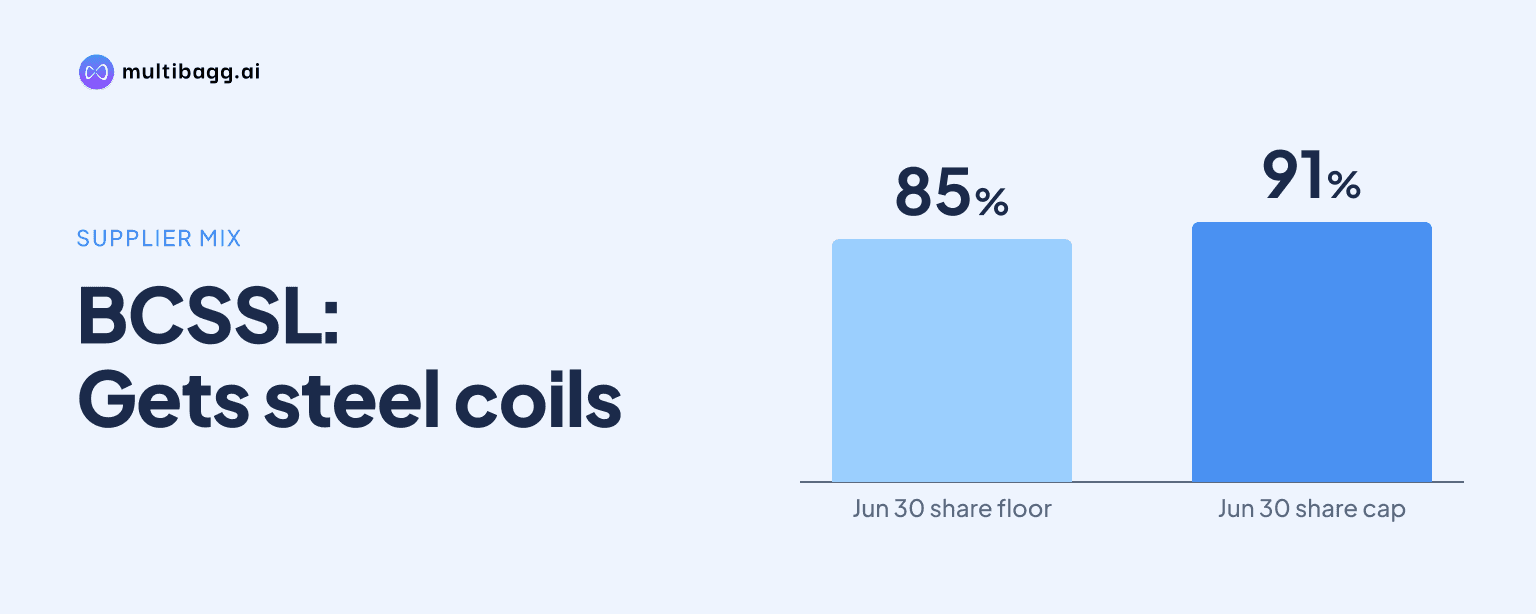
BCSSL sourced 85.13% to 90.61% of its steel-coil purchases from JSW Steel Coated Products Limited and/or its holding company (JSWSCPL) from Fiscal 2024 through the three months ended June 30, 2026. The 2021 authorised-service-partner arrangement provides regular supply, technical assistance and quality procedures, while concentrating BCSSL's principal raw-material procurement with JSWSCPL.
How concentrated are BCSSL's steel-coil purchases from JSWSCPL?
BCSSL's steel-coil purchases are concentrated with JSWSCPL because the supplier accounted for more than 84% of purchases in every disclosed period. JSWSCPL supplied Rs 869.182 crore of coils in Fiscal 2025, equal to 90.61% of BCSSL's Rs 959.276 crore total steel-coil purchases, the highest share across the four reported periods.
BCSSL's total coil purchases increased from Rs 659.678 crore in Fiscal 2024 to Rs 1,193.570 crore in Fiscal 2026, while purchases from other suppliers rose from Rs 101.734 crore to Rs 159.363 crore. However, the alternative-supplier increase did not materially alter the mix: JSWSCPL's Fiscal 2026 share was 2.07 percentage points above its Fiscal 2024 share. The June 30, 2026 figures cover three months and are not annualised, so they show a partial-period procurement mix rather than a full-year level.
What does BCSSL's authorised-service-partner arrangement with JSWSCPL provide?
BCSSL has been an authorised service partner of JSWSCPL since 2021 under an agreement for the regular supply of steel coils. JSWSCPL supplies galvanised plain, colour-coated and galvalume coils, which BCSSL processes into processed steel products through slitting, cut-to-length, shearing and embossing operations at four facilities.
The arrangement also provides technical assistance for prescribed product specifications and performance requirements when BCSSL processes blanks and sheets. BCSSL states that quality-control procedures jointly established with JSWSCPL, and aligned with JSWSCPL benchmarks, are used across operations for consistency, traceability and adherence to applicable industry standards. The disclosed model therefore combines the coil supply with technical inputs and specified quality procedures.
BCSSL also has sourcing arrangements with other steel suppliers, which the company says support regular procurement and consistency in input quality. Yet those suppliers represented 13.35% of coil purchases in Fiscal 2026 and 14.87% in the three months ended June 30, 2026. The source does not identify the other suppliers, their individual supply values or the product categories they provide.
Why does BCSSL need continuity in its steel-coil supply chain?
BCSSL needs regular coil availability because its facilities process supplied coils into customer-specific products across four process types. As of June 30, 2026, BCSSL reported aggregate installed processing capacity of 123,153 metric tonnes, computed on a quarterly basis, at Wada and Bhiwandi in Maharashtra, Ghiloth in Rajasthan and Sri City in Andhra Pradesh.
Slitting had the largest June 2026 period capacity at 59,505 metric tonnes, followed by cut-to-length at 50,481 metric tonnes. Actual production was 37,989 metric tonnes for slitting and 30,116 metric tonnes for cut-to-length, producing utilisation of 63.84% and 59.66%, respectively. Feedstock availability therefore affects the process capacity used to fulfil orders for processed steel products.
BCSSL states that it aligns procurement and processing schedules with customer demand forecasts and order pipelines. Each facility has storage infrastructure for bulk coils and processed products, while buffer stocks and steady production planning are intended to mitigate supply-chain disruptions and steel-availability volatility. These mechanisms operate alongside a June 2026 procurement mix in which JSWSCPL supplied Rs 239.774 crore of BCSSL's Rs 281.664 crore total coil purchases.
Got a follow-up? Ask IRIS
Which customers and end markets are linked to the JSWSCPL arrangement?
The JSWSCPL arrangement supports BCSSL's business with original equipment manufacturers (OEMs) and original design manufacturers (ODMs), particularly where customers require customised processing of JSWSCPL-manufactured coated steel coils. BCSSL identifies home and commercial appliances and general engineering as the sectors relevant to this authorised-service-partner model.
BCSSL reported revenue from operations of Rs 1,266.818 crore in Fiscal 2026, compared with Rs 1,055.707 crore in Fiscal 2025 and Rs 755.259 crore in Fiscal 2024. ODMs accounted for Rs 708.394 crore, or 55.92%, of Fiscal 2026 revenue, while OEMs accounted for Rs 548.278 crore, or 43.28%. Together, these two customer categories represented 99.20% of Fiscal 2026 revenue from operations.
Home and commercial appliances produced Rs 1,096.289 crore, or 86.54%, of Fiscal 2026 revenue, compared with Rs 170.529 crore, or 13.46%, from general engineering. Air-conditioner applications alone generated Rs 593.488 crore, equal to 46.85% of Fiscal 2026 revenue. BCSSL says customers with specific coated-steel requirements are serviced through the JSWSCPL arrangement, linking supply continuity to those processing requirements.
What must hold for BCSSL's concentrated supply model to continue?
BCSSL's current procurement model depends on the continued availability of its 2021 authorised-service-partner arrangement for regular steel-coil supplies and on JSWSCPL continuing to provide the required coated materials. The source does not disclose the agreement's duration, minimum volumes, exclusive-purchasing obligations or pricing terms, so those terms cannot be assessed from the disclosed purchase table.
The supplier mix has moved within a relatively narrow band rather than toward broadly distributed procurement. JSWSCPL's share increased from 84.58% in Fiscal 2024 to 90.61% in Fiscal 2025, then declined to 86.65% in Fiscal 2026 and 85.13% in the three months ended June 30, 2026. A further reduction in concentration would require other suppliers to account for a larger share of total steel-coil purchases; BCSSL has disclosed neither a supplier-diversification plan nor individual alternative-supplier commitments.
Conclusion
BCSSL combines a 2021 authorised-service-partner relationship, technical assistance and jointly established quality procedures with substantial steel-coil purchasing reliance on JSWSCPL. Although JSWSCPL's share declined from 90.61% in Fiscal 2025 to 85.13% in the three months ended June 30, 2026, it remained the source of more than five-sixths of BCSSL's steel-coil purchases.
The next reported purchasing mix will show whether purchases from other suppliers rise beyond the Rs 41.890 crore recorded in the June 2026 quarter. Capacity use also remains relevant because June 2026 utilisation was 63.84% in slitting and 59.66% in cut-to-length, while the disclosed material does not set out volume commitments or the duration of the JSWSCPL arrangement.