










BIS enforcement aids organised cable share gain to 74–80% by FY26
Key highlights
- India’s organised wires-and-cables market share is estimated to rise from roughly 70% in FY22 to 74–80% by FY26.
- The Cables (Quality Control) Order, 2020 requires specified cable products to meet Indian Standards and carry the BIS Standard Mark.
- Polycab India holds an estimated 25–27% of the organised market in FY2025–FY26, while KEI Industries holds about 13%.
- India’s wires-and-cables market is projected to grow at a 7.94% compound annual growth rate from 2025 to 2032.
powered by IRIS
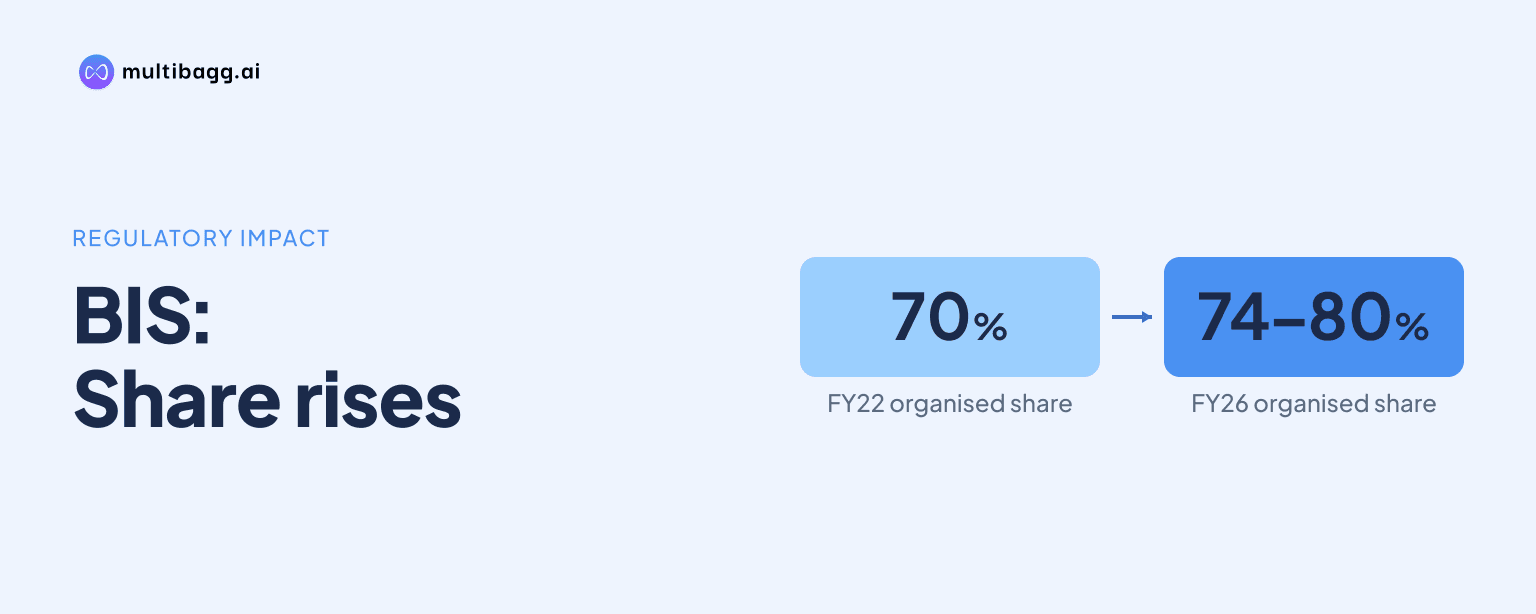
BIS enforcement has helped increase the organised share of India’s wires-and-cables market from roughly 70% in FY22 to an estimated 74–80% by FY26. The shift follows mandatory certification under the Cables (Quality Control) Order, 2020, which requires specified products to meet Indian Standards and carry the BIS Standard Mark.
How has BIS enforcement changed the wires-and-cables market?
BIS enforcement has shifted market share towards organised manufacturers by making certification compulsory for specified cable products. The industry disclosure estimates that organised players increased their share by 4 to 10 percentage points, from about 70% in FY22 to 74–80% in FY26, while the overall market remains fragmented.
The mechanism is the Cables (Quality Control) Order, 2020, issued by the Department for Promotion of Industry and Internal Trade, or DPIIT. Effective from August 1, 2020, the order requires covered cable products to conform to applicable Indian Standards and bear the BIS Standard Mark under Scheme-I of the BIS Conformity Assessment Regulations, 2018. Scheme-I is the conformity-assessment route specified in the disclosure for the mandatory mark.
The gain in organised share is not presented as a demand-cycle result alone. The disclosure identifies tightening quality-control enforcement and rising quality consciousness among institutional buyers as the two stated factors. Certification can raise compliance costs and lead times for smaller and unorganised manufacturers, creating a structural advantage for companies that can maintain certified production and distribution at scale.
What does mandatory cable certification require?
Mandatory cable certification requires specified cables sold in India to meet applicable Indian Standards and carry the BIS Standard Mark. The 2020 quality-control order therefore moves compliance from a voluntary product-positioning issue to a condition for selling products within the covered categories.
The requirement matters because the wires-and-cables market spans low, medium, high and extra-high voltage products, with varying uses and technical requirements. Low-voltage cables accounted for 56.07% of the India market in 2024, according to the industry data. Their extensive use in residential and commercial buildings means that compliance in this category reaches a large part of market demand.
The certification perimeter is also expanding beyond cables. BIS amendments notified for cable trunking and ducting systems make certification mandatory from January 2026, according to the regulatory disclosure. Cable trunking and ducting systems are adjacent electrical-accessory categories used to route and protect cable installations, widening the compliance framework around electrical infrastructure.
A broader Machinery and Electrical Equipment Safety (Omnibus Technical Regulations) Order, 2024, described as BIS Scheme X in the disclosure, has compliance timelines extended to September 2026. The disclosed expectation is that further categories of electrical equipment will come under mandatory certification. The organised-share trend would depend partly on how these requirements are implemented across the newly covered categories.
Which organised manufacturers hold the largest positions?
BIS enforcement has not produced a single dominant manufacturer, because no player holds more than roughly one quarter of the organised market. Polycab India is identified as the largest listed participant, with an estimated 25–27% organised-market share in FY2025–FY26, while KEI Industries is estimated at about 13% of the organised segment.
Polycab India’s estimated share rose from 25–26% in FY24 to about 27% in FY2025–FY26, aided by capacity expansion funded through capital expenditure. Its position is linked in the disclosure to an extensive dealer and distribution network. This illustrates that certification is one condition of participation, while manufacturing capacity and route-to-market determine how much of the compliant market a producer can serve.
KEI Industries is described as the second-largest listed player, with about 9% of the overall wires-and-cables market and around 13% of the organised segment. Its stated area of strength is extra-high-voltage and turnkey project cables, where a turnkey project combines supply and execution responsibilities. Havells India, RR Kabel and Finolex Cables are each described as having high-single-digit to low-double-digit organised-market shares.
The disclosed distribution of shares shows that organised-market expansion has been spread across several manufacturers rather than concentrated in one company. Brand, distribution reach and product focus, including house wires and fast-moving electrical goods cross-selling, remain relevant competitive factors. The certification regime can support compliant operators, but it does not remove competition between certified suppliers.
Got a follow-up? Ask IRIS
What demand base supports compliant cable production?
BIS enforcement is operating alongside a market projected to grow at a 7.94% compound annual growth rate from 2025 to 2032. A compound annual growth rate measures the annualised rate that links a starting market value to an ending value over a specified period; the disclosed forecast is therefore separate from the estimated 74–80% organised-share outcome in FY26.
Power-network investment is one named demand driver. The Revamped Distribution Sector Scheme has an outlay of Rs 3.03 lakh crore for five years from 2021–22 to 2025–26, providing financial support to power distribution companies for modernising and strengthening distribution infrastructure. The scheme aims to improve power-supply quality, reliability and affordability, all of which require distribution equipment and associated cables.
Solar deployment adds another quantified cable requirement. Industry standards cited in the disclosure indicate that a 1-megawatt solar project uses about 50 kilometres of solar cable, while the government target is 500 gigawatts of non-fossil capacity by 2030. Solar cable demand will depend on the eventual technology mix, project build-out and the share of solar within that 500-gigawatt target.
Transmission needs provide a second infrastructure channel. India’s network of 220 kilovolt and above transmission lines exceeds 500,000 circuit kilometres, and the National Electricity Plan (Transmission) 2022–32 estimates that more than 114,000 circuit kilometres of additional lines will be needed by 2032. These figures indicate the scale of grid investment occurring alongside the compliance changes in the cable market.
Will new entrants limit the effect of BIS enforcement?
BIS enforcement may continue to favour compliant production, but new capacity means that its benefits will be contested among a larger set of organised competitors. In 2025, Adani Enterprises, through Kutch Copper Limited, formed Praneetha Ecocables with Praneetha Ventures to manufacture wires and cables.
UltraTech Cement has separately announced a Rs 1,800 crore greenfield wires-and-cables plant at Bharuch, Gujarat, with commissioning targeted by December 2026. The project is a disclosed capacity plan rather than evidence of current output or market share. Its timing is relevant because it overlaps with the September 2026 extended compliance timeline for BIS Scheme X.
Upstream capacity support is another element in the disclosed policy setting. Production-linked incentive schemes for specialty steel and related input categories have supported investment among suppliers of wire rod and conductor inputs. Such support can aid the broader value chain, but the source does not quantify its direct effect on finished-cable prices, certified capacity or the 74–80% organised-market estimate.
Conclusion
BIS enforcement has coincided with a measurable change in India’s wires-and-cables market structure: organised manufacturers’ estimated share rose from roughly 70% in FY22 to 74–80% by FY26. The Cables (Quality Control) Order, 2020 supplies the direct mechanism by requiring specified products to meet Indian Standards and bear the BIS Standard Mark, while scale, distribution and capacity investment determine which compliant producers capture demand.
The next disclosed milestones are mandatory certification for cable trunking and ducting systems from January 2026, the September 2026 BIS Scheme X compliance timeline, and UltraTech Cement’s target to commission its Bharuch plant by December 2026. These developments will show whether the wider certification perimeter sustains organised-market gains as new manufacturing capacity enters the sector.