










Bombay Coated and Special Steels IPO: ₹183.06 crore fresh issue opens October 29, 2026
Key highlights
- Bombay Coated and Special Steels’ ₹183.06 crore mainboard IPO opens on October 29, 2026, and is entirely a fresh issue with no OFS.
- The company reported revenue of ₹1,266.82 crore and PAT of ₹30.54 crore in FY2026, while its PAT margin declined to 2.41% from 2.80% in FY2024.
- The company plans to use ₹125 crore of the IPO proceeds for repayment or prepayment of certain borrowings and ₹15.77 crore for capital equipment under a Siemens Financial Services lease arrangement.
- About 85%–97% of the company’s steel coils come from one supplier, while its debt-to-equity ratio stands at 2.00 times.
powered by IRIS
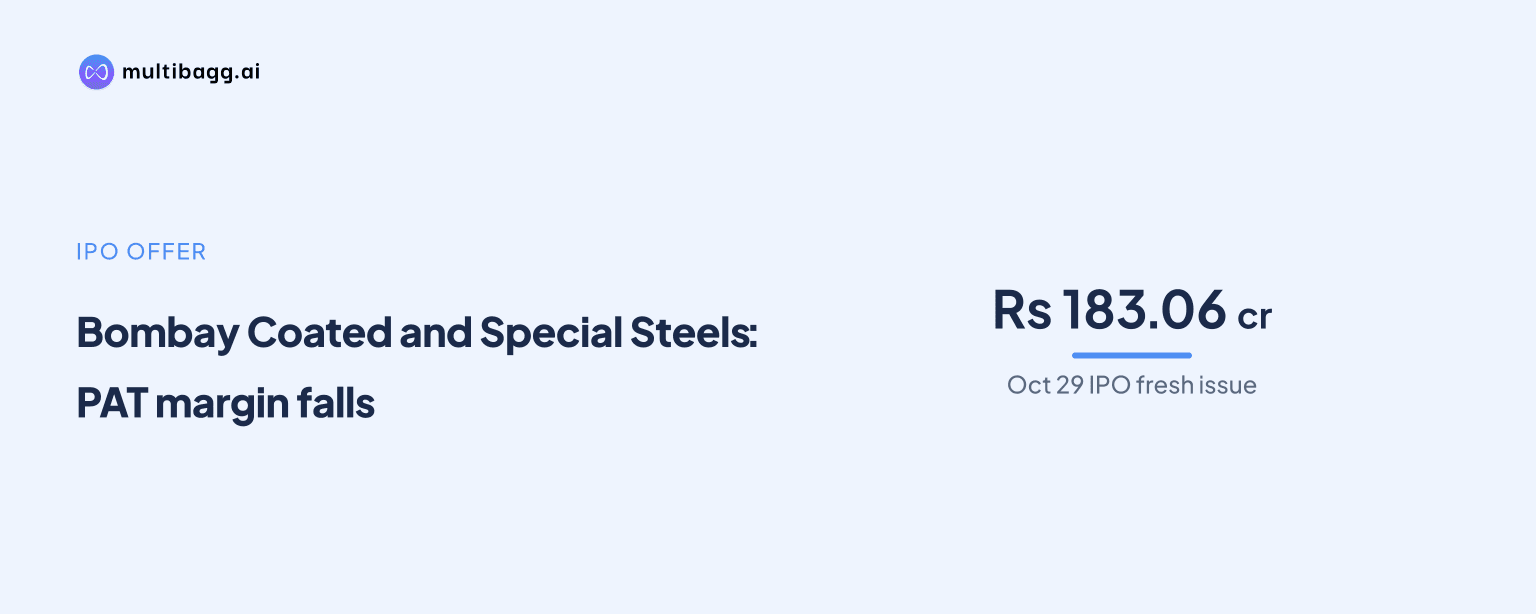
Bombay Coated and Special Steels Limited (Bombay Coated and Special Steels IPO) is scheduled to open for subscription on October 29, 2026 and close on November 2, 2026, with listing planned for November 5, 2026. The mainboard IPO is sized at ₹183.06 crore and is entirely a fresh issue, with no offer for sale (OFS). The price band and lot size were not available at the time of this snapshot.
Because the issue is a fresh issue, the proceeds (net of issue expenses) are proposed to accrue to the company. As stated in the offer documents, the proposed objects include repayment or prepayment of certain borrowings, funding the acquisition of capital equipment under an existing lease arrangement with Siemens Financial Services Private Limited, and general corporate purposes.
What Bombay Coated and Special Steels does
Bombay Coated and Special Steels is a steel processing centre that converts coated and non-coated steel coils into value-added processed steel products. Its processed outputs include slit coils, blanks/sheets, embossed products and sheared blanks.
Operationally, the company provides precision slitting, cut-to-length (CTL), embossing and shearing services to original equipment manufacturers (OEMs) and original design manufacturers (ODMs). In a processing-centre model, these activities sit between primary steel makers and end manufacturers, with the company positioned to supply customised, ready-to-use steel inputs aligned to customer specifications.
The company’s disclosed end-use exposure is led by home and commercial appliances, particularly air conditioners and refrigeration. It also supplies processed steel for applications across general engineering, including automotive, electrical equipment, ventilation and related segments.
Footprint, facilities, and key operating linkages
Bombay Coated and Special Steels operates a multi-location network with facilities in Maharashtra (Wada and Bhiwandi), Rajasthan (Ghiloth) and Andhra Pradesh (Sri City). The company links this footprint to servicing customer clusters and supporting just-in-time deliveries, which are often relevant for OEM/ODM procurement and inventory planning.
A central operating linkage in the disclosed business model is the company’s authorised service partner relationship with JSW Steel Coated Products Limited (JSWSCPL). The company also sources a significant share of raw material through this relationship. The disclosed risk framing indicates a high supplier concentration, with about 85%–97% of steel coils coming from one supplier.
The company’s milestones outline how the current footprint was built over time. The legacy Bhiwandi steel processing facility was established in 2012. The company became an authorised service partner for JSWSCPL in 2018. It was incorporated as Bombay Coated and Special Steels Private Limited in 2019 and acquired the running business of M/s Bombay Steels through a business transfer agreement in 2021, consolidating legacy operations. The Wada facility in Maharashtra was established in 2021, followed by the Ghiloth facility in Rajasthan in 2022, and the Sri City facility in Andhra Pradesh in 2024. The company also disclosed installed capacity increases at Ghiloth and Wada in 2024. In 2025, it converted into a public limited company and was renamed Bombay Coated and Special Steels Limited.
IPO structure, investor allocation, and proposed use of proceeds
The issue is structured as a ₹183.06 crore fresh issue and carries no OFS component. This distinction matters for cash-flow mapping because fresh issue proceeds go to the company, while OFS proceeds (if any) go to selling shareholders.
The stated objects of the issue focus on (1) repayment or prepayment, in full or in part, of certain borrowings availed by the company, (2) financing the cost towards acquisition of capital equipment under existing lease arrangements with Siemens Financial Services Private Limited, and (3) general corporate purposes. Within the disclosed proposed allocation, the largest stated portion is earmarked for borrowings, while a smaller stated portion is towards the equipment acquisition under the lease arrangement. The amount for general corporate purposes is not specified as a fixed figure in the provided context.
On reservation, the disclosed split is 50% for qualified institutional buyers (QIBs), 15% for non-institutional investors (NIIs), and 35% for retail individual investors (RIIs). The context also outlines an anchor framework: up to 60% of the QIB portion may be allocated to anchor investors, with 33.33% of the anchor portion reserved for domestic mutual funds.
As of the snapshot date, the IPO was marked as upcoming, and the subscription window had not yet opened.
Financial performance and profitability trajectory
Across FY2024 to FY2026, the company reported rising total revenue and profit after tax (PAT), alongside year-on-year growth in total assets. Over the same period, the PAT margin shown in the financial table moved from 2.80% in FY2024 to 2.41% in FY2026.
The company has also disclosed key performance indicators (KPIs) that help frame operating and return metrics at the snapshot date. These include an EBITDA margin of 8.10% (EBITDA presented as a margin percentage), return on equity (ROE) of 11.65%, return on net worth (RoNW) of 11.03%, and return on capital employed (ROCE) of 7.01%. Earnings per share (EPS) is disclosed at ₹7.54, and the company has disclosed a PAT margin KPI of 3.80%.
The balance-sheet and cash-flow context is relevant because the stated use of proceeds includes debt repayment. The disclosed debt-to-equity ratio is 2.00 times, and the risk disclosures also reference negative cash flows from investing and financing, indicating heavy cash needs.
Got a follow-up? Ask IRIS
Valuation context and what typically changes once the price band is known
At the time of this snapshot, the price band and lot size were not available. The pre-IPO price-to-earnings (P/E) and price-to-book (P/B) values in the supplied data are shown as 0, which is consistent with valuation multiples not being computable without an offer price.
Once the company announces the price band, investors typically use the disclosed EPS, net worth-linked ratios (such as ROE/RoNW), and margin metrics (including the EBITDA margin) to map implied multiples at the offer price. For Bombay Coated and Special Steels, the stated proceeds deployment towards borrowings and leased equipment is also a key monitoring item because it can change reported leverage and finance-cost sensitivity after the issue, depending on execution.
Monitoring points to track around allotment (November 3, 2026) and listing (November 5, 2026) based on the disclosed business model and offer objectives include:
Post-issue debt reduction in line with the stated object of repayment or prepayment of certain borrowings.
Continuity and commercial terms in the key raw material sourcing relationship, given the disclosed concentration of coil purchases with one supplier.
Facility-level execution and integration across Wada, Bhiwandi, Ghiloth and Sri City as the operating footprint scales.
Revenue mix and volume sensitivity to the appliances segment, given the disclosed skew towards air conditioners and refrigeration.
Key risks and dependencies highlighted in disclosures
Supplier concentration is a central dependency in the disclosures. With about 85%–97% of steel coils stated to come from one supplier, any supply disruption, dispute, or change in terms could affect production continuity, costs, and customer delivery schedules.
Customer concentration is also highlighted, with the top 10 customers contributing a large share of revenue. In processing businesses where utilisation and throughput matter, concentration can translate into higher sensitivity to order changes from a limited set of buyers.
End-market seasonality is explicitly flagged for air conditioner and refrigeration demand, which can result in uneven volumes and utilisation across periods.
The disclosures also point to competition from other steel processors and from steel producers that operate processing units, which can affect pricing and terms.
Regulatory and compliance requirements across environment, labour and safety can increase costs and operational risk. Separately, the company notes past Registrar of Companies (ROC) filing lapses and statutory delays, which can lead to penalties or scrutiny and may require management attention.