










Carver Roboweld derives 100% of revenue from forging customers
Key highlights
- Forging customers supplied 100.00% of Carver Roboweld’s revenue in Fiscal 2024, Fiscal 2025, Fiscal 2026 and the period ended June 30, 2026.
- Revenue from operations increased from Rs 21.6729 crore in Fiscal 2024 to Rs 27.022 crore in Fiscal 2026 without changing the industry mix.
- Raw-material consumption represented 58.91% of Fiscal 2026 revenue and 91.45% of revenue for the period ended June 30, 2026.
- Karnataka, Maharashtra and Tamil Nadu contributed Rs 22.2599 crore, or 82.33%, of Fiscal 2026 revenue.
powered by IRIS
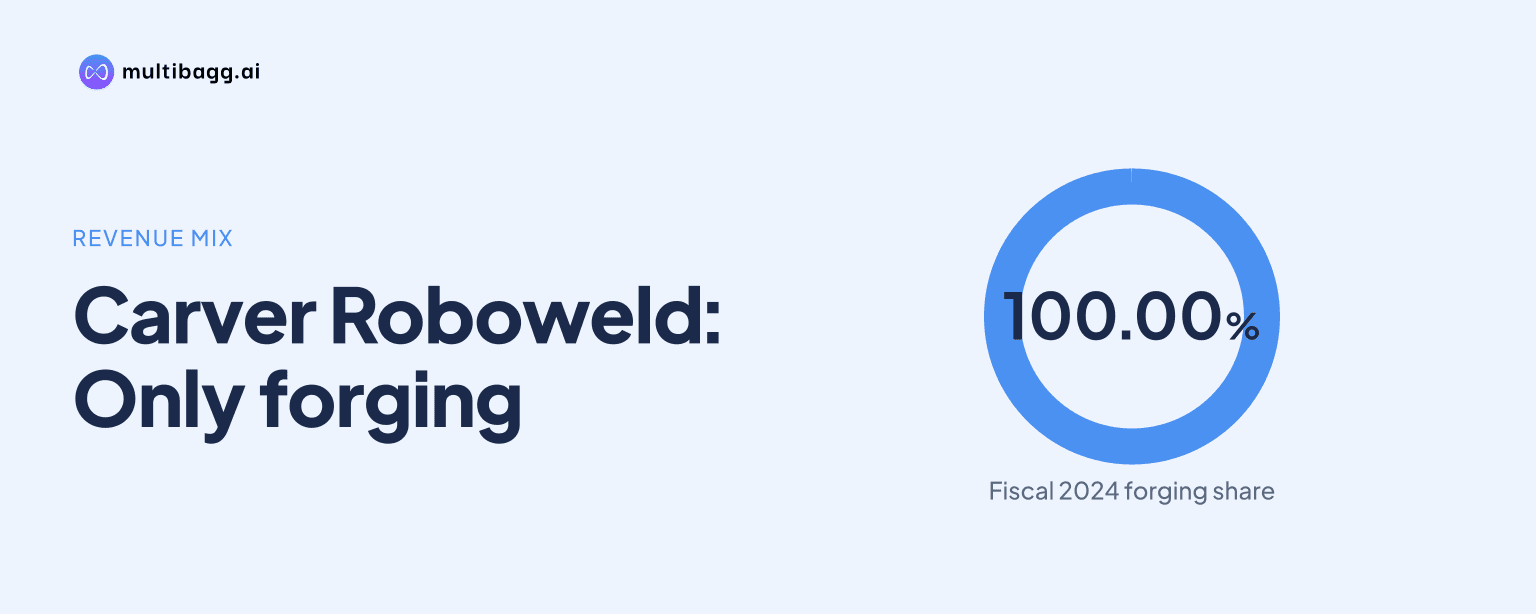
Carver Roboweld Limited derives 100.00% of its revenue from operations from forging-industry customers, leaving it without current industry diversification. Forging customers supplied 100.00% of revenue in Fiscal 2024, Fiscal 2025, Fiscal 2026 and the period ended June 30, 2026, when revenue was Rs 7.7104 crore.
What does Carver Roboweld's 100% forging revenue mean?
Carver Roboweld's 100% forging revenue means every reported rupee of operating revenue during the disclosed periods depended on customers operating in one industry. Carver Roboweld reported forging-industry revenue of Rs 7.7104 crore for the period ended June 30, 2026, Rs 27.022 crore in Fiscal 2026, Rs 24.8598 crore in Fiscal 2025 and Rs 21.6729 crore in Fiscal 2024. Each amount represented 100.00% of revenue from operations.
This is industry concentration rather than only concentration in individual accounts. Carver Roboweld manufactures welding rods, gouging electrodes and metal cored wire, and also supplies welding spare parts and accessories. Its disclosure identifies welding consumables, welding spare parts, forging die manufacturing and regeneration services, and welding robot rental services as offerings for which demand could fall if forging customers reduce procurement.
The concentration persists because the customer base, rather than merely one product line, is defined by the forging sector. A fall in forged-product demand, production levels, capacity utilisation or capital expenditure by forging customers could therefore affect several of Carver Roboweld's product and service categories at once. Revenue diversification would require acquiring customers outside forging, expanding offerings or successfully executing the stated plan to broaden end-user segments.
How did revenue change while forging concentration remained total?
Carver Roboweld increased revenue from operations from Rs 21.6729 crore in Fiscal 2024 to Rs 27.022 crore in Fiscal 2026, while the forging-industry share remained unchanged at 100.00%. Revenue rose by Rs 3.1869 crore in Fiscal 2025 and by a further Rs 2.1622 crore in Fiscal 2026. The increase in revenue did not introduce another industry source.
Carver Roboweld also has customer concentration within its industry exposure. Carver Roboweld said it depends significantly on a limited number of key customers and expects that dependence to continue for the foreseeable future. As of June 30, 2026, some top-10 customer relationships had existed for more than seven to eight years, but Carver Roboweld did not disclose customer names because consent was not received.
Carver Roboweld reported no material loss of key customers over the preceding three financial years. That historical outcome does not alter the disclosed risk that contracts may be terminated or not renewed, commercial terms may not be agreed, or customers may reduce or delay demand. A loss of one or more customers could have a disproportionate effect because account concentration operates alongside complete exposure to the forging industry.
Got a follow-up? Ask IRIS
Which forging conditions can affect Carver Roboweld?
Carver Roboweld's revenue depends on forging-industry conditions because its customers' production and spending determine their need for welding products and services. Carver Roboweld identifies demand for forged products, production levels, capacity utilisation, capital expenditure and customers' operating and financial conditions as factors that can affect procurement. Project delays or cancellations and deterioration in a customer's financial condition could directly reduce revenue and profitability.
The forging sector is itself affected by general economic conditions, industrial production, capital-expenditure cycles, financing availability and raw-material prices. Carver Roboweld also identifies automotive, infrastructure, engineering and other industrial sectors as end-user industries whose demand can affect forging activity. For the 100.00% concentration to persist without a revenue decline, forging customers must continue operating, spending and procuring products and services at levels sufficient to support orders.
Input costs add a separate exposure to this model. Raw materials consumed were Rs 15.9195 crore, or 58.91% of Fiscal 2026 revenue from operations of Rs 27.022 crore, compared with Rs 17.1755 crore, or 69.09%, in Fiscal 2025. In the period ended June 30, 2026, raw-material consumption was Rs 7.051 crore, equal to 91.45% of revenue from operations, showing that changes in material prices or supply can matter even where customer demand is maintained.
Carver Roboweld lists ferro molybdenum, cold-rolled steel strips, ferro tungsten powder, nickel metal powder, chromium metal powder and packaging materials among its required inputs. A raw-material price increase without a corresponding increase in revenue may affect margins, while supply disruption, equipment failure, power interruption or deviations in formulation may cause downtime, rework or product rejection. These operational risks could coincide with a forging-industry slowdown rather than offset it.
Can product and location breadth reduce forging dependence?
Carver Roboweld's four operating locations provide geographic coverage but do not currently reduce its forging-industry dependence. Carver Roboweld operates one manufacturing facility at Bamnabore, Rajkot, Gujarat, and service units in Pune, Maharashtra; Ludhiana, Punjab; and Hosur, Tamil Nadu. All Rs 27.022 crore of Fiscal 2026 revenue remained attributable to forging-industry customers despite this footprint.
In Fiscal 2026, the Bamnabore manufacturing unit generated Rs 11.11 crore, or 41.11% of revenue, while the Pune, Hosur and Ludhiana service units generated Rs 5.2251 crore, Rs 8.0282 crore and Rs 2.6588 crore respectively. The four locations support production, robotic welding systems, automation, repair, maintenance and customer service, but their revenue sources remain within the same industry.
Geographic sales are also concentrated. Karnataka, Maharashtra and Tamil Nadu together accounted for Rs 22.2599 crore, or 82.33%, of Fiscal 2026 revenue, compared with Rs 21.4275 crore, or 86.20%, in Fiscal 2025. Karnataka alone contributed Rs 13.2102 crore, or 48.86%, in Fiscal 2026. Geographic presence across 14 states therefore did not remove concentration in either the forging sector or the three largest states.
Carver Roboweld states that it intends to expand its customer base and diversify across industries and end-user segments. The disclosure does not give a target date, revenue target or identified non-forging customer base for that plan. Its success depends on acquiring customers in other industries, expanding products and services, and implementing its business strategies, and Carver Roboweld states there is no assurance that it will reduce industry concentration.
Conclusion
Carver Roboweld's revenue grew from Rs 21.6729 crore in Fiscal 2024 to Rs 27.022 crore in Fiscal 2026, but its industry mix did not change: forging customers supplied 100.00% in every reported period through June 30, 2026. Product breadth, four operational locations and sales across 14 states provide operating coverage, yet none currently supplies an industry-level counterweight to forging demand.
The next point to watch is execution of Carver Roboweld's stated plan to acquire customers from other industries and broaden end-user segments. Until Carver Roboweld reports revenue from non-forging customers, its results will remain dependent on forging production, capital expenditure, customer procurement requirements and the operating conditions of a limited group of customers.