










Carver Roboweld Limited IPO: dates, business model, financials, and use of proceeds
Key highlights
- Carver Roboweld’s SME IPO is scheduled to open on 28 October 2026, close on 30 October 2026 and list on 4 November 2026.
- The company manufactures welding consumables and combines product sales with forging die regeneration, welding robot rentals and related services.
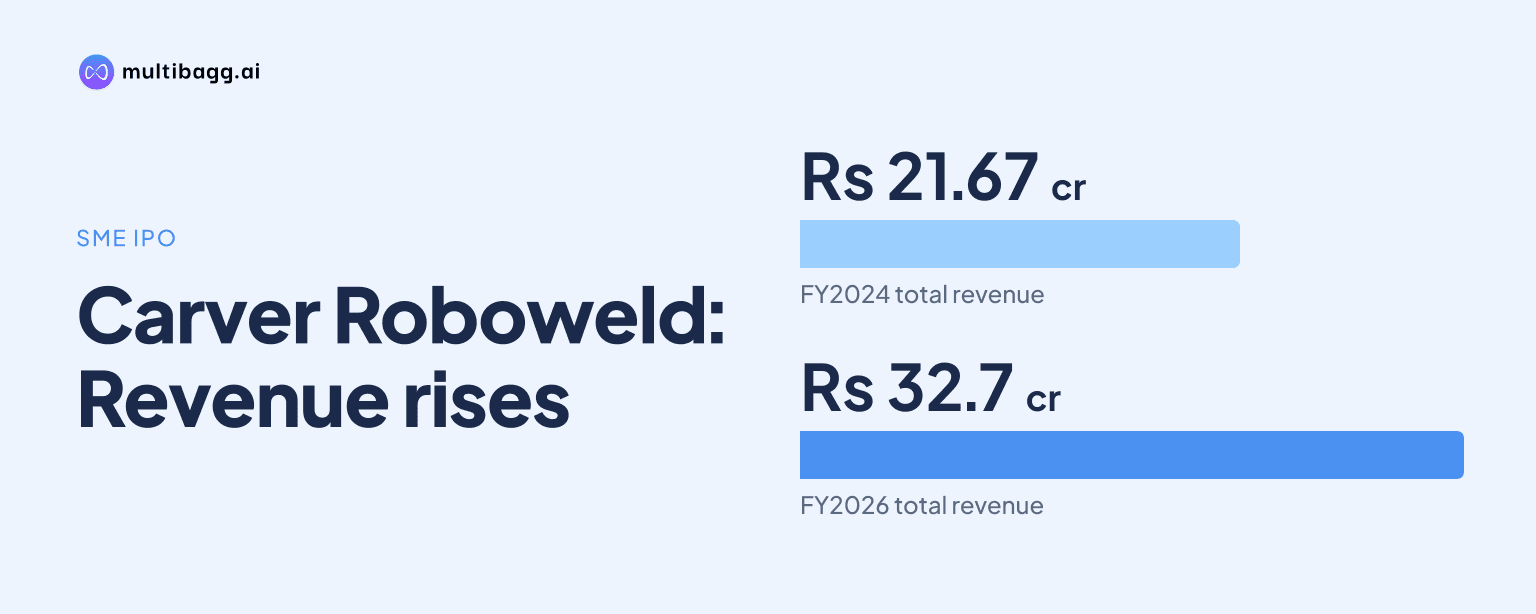
- Total revenue increased from ₹21.67 crore in FY2024 to ₹32.7 crore in FY2026, while PAT rose from ₹1.01 crore to ₹5.34 crore.
- The company proposes to allocate ₹11.99 crore toward welding robots and ₹8.60 crore toward repayment or prepayment of borrowings.
powered by IRIS
Carver Roboweld Limited is set to launch an SME initial public offering (IPO) that opens on 28 October 2026 and closes on 30 October 2026, with a proposed listing on 4 November 2026. As of the latest available details, the price band, lot size and total issue size were not available. The issue details in the provided context indicate no offer for sale (OFS) component, while the fresh issue amount was not available at the snapshot. The company’s stated objects include capital expenditure for purchasing additional industrial welding robots, repayment and/or prepayment of certain borrowings, and general corporate purposes.
What Carver Roboweld does and how it earns
Carver Roboweld Limited operates across welding consumables and allied engineering services aimed at industrial customers, with a specific emphasis on the forging ecosystem. The company manufactures welding consumables including metal cored wires, welding rods and gouging electrodes. It also supplies welding spares and accessories, which typically complement consumables usage at customer sites.
Alongside manufactured products, the company provides value-added engineering services, including forging die regeneration. This services layer positions the business beyond product supply alone, with a model that includes on-site or near-site support through its service units.
A key element highlighted in the company’s IPO positioning is its welding robot rental offering. The model is described as linking robot rentals with ongoing consumables supply, resulting in a revenue mix that includes recurring rental income tied to continued consumables purchases. This “consumables-plus-services” platform is central to how the company describes its route to customer retention and repeat business.
Operating footprint and service reach
Carver Roboweld’s main manufacturing facility is located at Bamanbore in Rajkot, Gujarat. In addition to the plant, the company operates service units in Pune (Maharashtra), Hosur (Tamil Nadu) and Ludhiana (Punjab). Across these locations, the company serves customers in multiple Indian states.
The presence of service units is relevant for an offering that includes engineering services and robot rentals, where installation, maintenance, response time and availability of spares can affect customer operations. The company also highlights that a portion of its business mix is tied to robot rentals, reinforcing the relevance of after-sales servicing capability.
Key milestones and capability build-out
Carver Roboweld was incorporated in 2009 as Carver Welding Private Limited. In the same year, it set up a manufacturing unit at Kothariya, Rajkot. Over time, the company expanded its service presence, setting up a unit at Hosur in 2019, followed by Pune in 2020 and Ludhiana in 2023.
In 2021, the company leased its first welding robot to a customer, marking a milestone connected to the rental-led services element of its model.
The year 2025 contains several changes and capacity-related developments. The company shifted its manufacturing unit from Kothariya to Bamanbore, Rajkot for expansion. It also changed its name to Carver Roboweld Private Limited, converted into a public limited company, and adopted the name Carver Roboweld Limited.
On certifications and industry linkages, the company received ISO 9001:2015 certification in 2025 for manufacturing welding electrodes and metal cored wires, and for sales of welding consumables. It also became a Sustaining Corporate Member of the American Welding Society (AWS) in 2025.
In group structure developments, Carver Roboweld acquired shares of Carver Engineering Private Limited through a share sale and transfer agreement dated 26 September 2025, described as a subsidiary acquisition. It also installed one new metal cored wire production line in 2025.
Financial performance and reported profitability trend
Over FY2024 to FY2026, the company reported growth in total revenue alongside a sharper rise in profit after tax (PAT), with total assets also increasing over the same period. The reported PAT margin moved up across the three financial years presented, and the asset base expanded materially by FY2026.
In the KPI set provided with the IPO context, the company reports an EBITDA margin of 30.94% and a reported PAT margin of 12.87%. Return ratios disclosed include return on equity (ROE) of 33.63%, return on capital employed (ROCE) of 21.64% and return on net worth (RoNW) of 21.57%, along with earnings per share (EPS) of ₹3.64.
Leverage is reflected in a reported debt-to-equity ratio of 0.97 times. This metric is particularly relevant because one of the stated IPO objects is repayment and/or prepayment of certain outstanding borrowings.
The provided valuation fields show pre-IPO price-to-earnings (P/E) and price-to-book as 0 at the snapshot, indicating these valuation multiples were not available in the supplied data at the time.
Got a follow-up? Ask IRIS
IPO timeline, issue structure, and stated objects
The IPO is classified as an SME issue and is marked as upcoming. The offer opens on 28 October 2026 and closes on 30 October 2026. The timeline provided indicates allotment and refunds on 2 November 2026, followed by a proposed listing on 4 November 2026.
At the snapshot time, the price band, lot size and total issue size were not available. The issue details in the supplied context indicate an OFS amount of nil; the fresh issue amount was not available in the snapshot values.
The stated objects for utilisation of net proceeds are:
-
Funding capital expenditure requirements towards the purchase of welding robots.
-
Repayment and/or prepayment, in full or in part, of certain outstanding borrowings availed from banks and financial institutions.
-
General corporate purposes.
The disclosed proposed deployment amounts include ₹11.99 crore toward the purchase of welding robots and ₹8.60 crore toward repayment and/or prepayment of borrowings, while general corporate purposes are listed without a specified allocation in the provided details.
For category allocation, the reservation mix provided indicates 50% for qualified institutional buyers (QIB), 15% for non-institutional investors (NII) and 35% for retail individual investors (RII). The context also provides anchor allocation parameters, stating that 60% of the QIB portion is earmarked for anchor investors, with 33.33% reserved for domestic mutual funds within the anchor book.
Key risks from the disclosed profile, and what to monitor
The company’s disclosed risk framing places emphasis on concentration and input-side sensitivities.
Customer concentration is highlighted as a key consideration, with the company flagging that revenue dependence on a small set of customers could affect revenue and cash inflows if a large customer is lost. This is particularly relevant for an operating model that combines consumables supply with services and robot rentals.
On the supply side, the company flags high supplier concentration and raw material price volatility, including steel wire and alloys. The disclosed weaknesses also note exposure to imported inputs and accessories, including sourcing from China, the United States and the Netherlands, which can add supply chain and foreign-exchange sensitivity.
The threat set also includes competition from low-cost imported welding consumables, a shortage of skilled welders and specialised welding talent that may affect adoption of higher-specification solutions, and logistics or infrastructure bottlenecks that can affect delivery costs and service levels across regions.
Monitoring points to track as disclosures evolve and periodic results are reported:
- Movement in customer concentration, including whether dependence on a small set of customers reduces over time.
- Execution against the stated robot fleet expansion objective, including additions and utilisation of welding robots in the rental model.
- Changes in leverage indicators following any repayment or prepayment of borrowings funded from IPO proceeds.
- Stability of margins and working-capital needs as the company scales consumables, services and rentals across its multi-location footprint.