










Carver Roboweld Limited rentals tie robots to wire sales
Key highlights
- CRL owned 12 welding robots as of the prospectus date, and lessees are required to use CRL-manufactured consumables.
- Welding robot rental revenue rose to Rs 2.47 crore in Fiscal 2026 from Rs 77.18 lakh in Fiscal 2024.
- Metal-cored wires generated Rs 18.39 crore, or 68.04%, of Fiscal 2026 operating revenue.
- CRL’s top 10 customers contributed 80.78% of Fiscal 2026 operating revenue, while its largest customer contributed 31.50%.
powered by IRIS
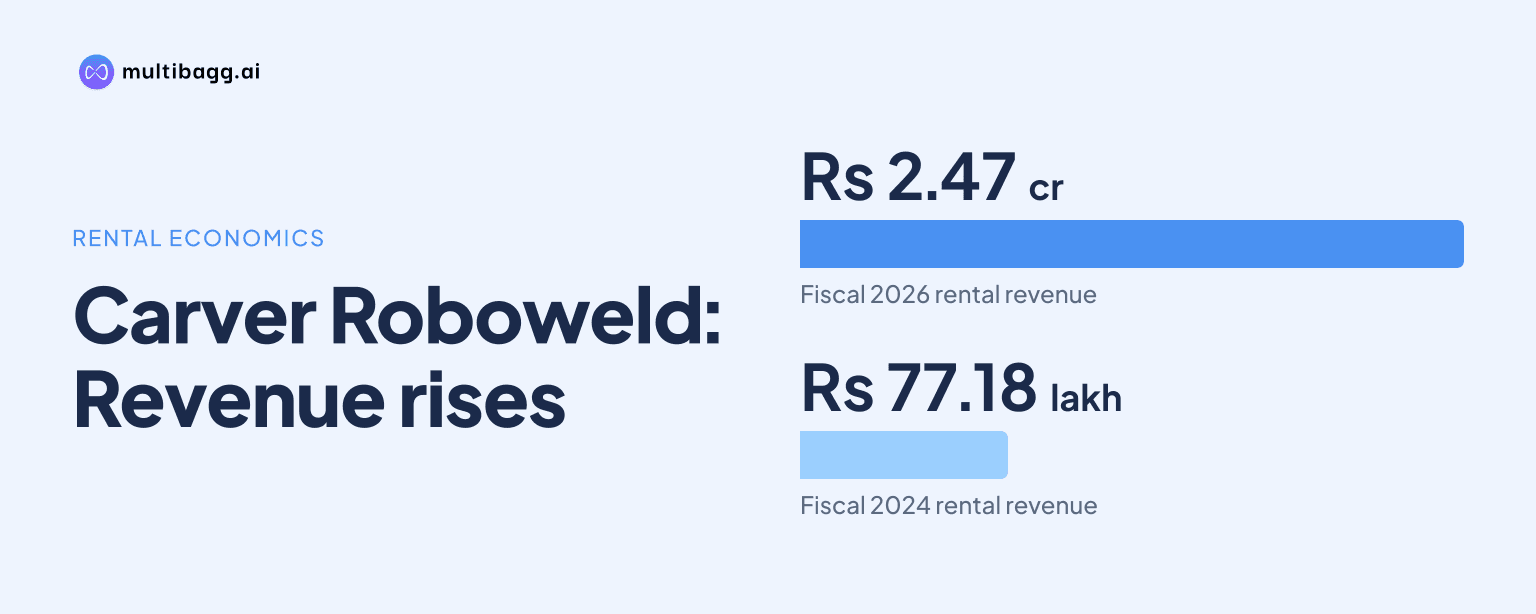
Carver Roboweld Limited operates a 12-robot rental fleet whose lessees must use its metal-cored wires, linking rental agreements to consumable sales. Welding robot rental revenue rose from Rs 77.18 lakh in Fiscal 2024 to Rs 2.47 crore in Fiscal 2026, while metal-cored wires supplied 68.04% of Fiscal 2026 operating revenue.
How do CRL robot rentals tie robots to wire sales?
CRL states that customers leasing its welding robots are required to use welding consumables manufactured by CRL, including metal-cored wires. The arrangement means robots operate exclusively with CRL inputs, making the lessee dependent on CRL’s supply of metal-cored wires for the lease tenure rather than merely paying a rental charge for equipment.
CRL owned 12 welding robots as of the prospectus date. The company deploys the robots at customer manufacturing facilities for welding components and forging dies, while its engineers provide installation, programming, commissioning and operational support under terms determined by the project, robot configuration, utilisation period and service scope.
The mechanism combines an asset-rental service with a continuing product requirement. CRL describes robot leases as long-term arrangements and says this provides predictable and stable revenue during agreements, strengthens retention and ensures consistent demand for consumables. That outcome depends on the customer continuing the rental arrangement and CRL maintaining supply of the specified metal-cored wires.
Metal-cored wire is a tubular welding wire filled with metallic powders, rather than a traditional solid or flux-cored wire. CRL says its wires are designed for robotic welding systems and are used in welding steel structures, vehicles, ships and heavy machinery; it operates three metal-cored-wire manufacturing lines after commissioning an additional line.
How quickly has CRL’s robot-rental revenue grown?
CRL’s welding robot rental service revenue increased in each reported full fiscal year, reaching Rs 2.47 crore in Fiscal 2026 from Rs 1.61 crore in Fiscal 2025 and Rs 77.18 lakh in Fiscal 2024. Its share of total operating revenue rose from 3.56% in Fiscal 2024 to 6.46% in Fiscal 2025 and 9.16% in Fiscal 2026, before reaching 10.10% in the period ended June 30, 2026.
The increase in rental-service revenue was accompanied by a larger product contribution from metal-cored wires. Metal-cored-wire revenue increased from Rs 13.67 crore in Fiscal 2024 to Rs 18.39 crore in Fiscal 2026, lifting its operating-revenue share from 63.09% to 68.04%; in the period ended June 30, 2026, it represented 72.28% of Rs 7.71 crore of operating revenue.
The disclosure does not separate consumable revenue generated specifically by robot lessees from wire revenue generated by other customers. It therefore supports the contractual link between rented robots and CRL wire usage, and reports growth in both categories, but does not quantify how much of the Rs 18.39 crore Fiscal 2026 wire revenue came from the 12-robot fleet.
Got a follow-up? Ask IRIS
Why does the model matter to CRL’s wider revenue mix?
CRL’s model matters because it joins a recurring service agreement to its largest product category. Product revenue was Rs 20.92 crore, or 77.42% of Fiscal 2026 operating revenue, while service revenue was Rs 6.10 crore, or 22.58%; within services, forging-die regeneration generated Rs 3.63 crore and robot rentals generated Rs 2.47 crore.
CRL principally serves forging manufacturers, auto-component makers, engineering companies, heavy-equipment manufacturers and other industrial enterprises. Its integrated offering consists of welding consumables, forging-die regeneration and robot rental services, which CRL says allows it to serve multiple welding, machining and die-maintenance requirements through one platform.
Repeated customers accounted for Rs 26.74 crore, or 98.95%, of CRL’s Rs 27.02 crore Fiscal 2026 operating revenue. The corresponding figure was Rs 21.44 crore, or 98.92%, in Fiscal 2024, and CRL says some top-10 customers had relationships averaging about seven to eight years; the rental model is one stated route for maintaining longer customer engagement.
Customer concentration remains material alongside this repeat-revenue profile. CRL’s largest customer supplied Rs 8.51 crore, or 31.50%, of Fiscal 2026 operating revenue, while its top 10 customers supplied Rs 21.83 crore, or 80.78%; in the period ended June 30, 2026, the top customer accounted for 43.36% of revenue and the top 10 accounted for 86.73%.
What affects the durability of CRL’s rental and consumable model?
The model’s continuity requires available robotic assets, customer demand for automated welding and continued supply of metal-cored wires. CRL says renters can use robots without upfront capital expenditure, including for production-line upgrades, new projects, technology evaluation and additional or short-term production requirements, but commercial terms vary by customer project and configuration.
CRL’s annual installed capacity across metal-cored wires and welding rods was 650 tons for Fiscal 2026, as of July 11, 2026. The company reported approximately 30% compound annual growth in installed capacity between Fiscal 2025 and Fiscal 2026, and said the third metal-cored-wire line raised output capacity while reducing dependence on its existing lines.
Raw-material sourcing is another operating condition because CRL uses ferro molybdenum, cold-rolled steel strips, nickel metal powder, chromium metal powder and other inputs. Its top 10 suppliers accounted for Rs 14.03 crore, or 92.43%, of Fiscal 2026 purchases, and it sources materials and robot accessories from India, China, the United States and the Netherlands.
CRL reported a debt-to-equity ratio of 0.97 times at March 31, 2026, compared with 4.89 times at March 31, 2025. As of October 10, 2026, sanctioned borrowings totalled Rs 22.31 crore and outstanding borrowings were Rs 13.43 crore, making funding and asset deployment relevant to the disclosed plan to expand the robot fleet.
Conclusion
CRL’s 12-robot fleet is structured as more than an equipment service because each rental customer must use CRL metal-cored wires. That contractual requirement aligns a service category that reached Rs 2.47 crore in Fiscal 2026 with the company’s largest product category, metal-cored wires, which generated Rs 18.39 crore and 68.04% of operating revenue in the same year.
The next disclosed development to watch is CRL’s proposed capital expenditure on additional industrial welding robots under its initial public offering objectives. CRL says the added fleet is intended to support rental deployments for existing and new customers and recurring rental income, while the prospectus does not specify the number of robots to be acquired, deployment dates or the future consumable revenue attributable to those assets.