










Carver Roboweld restated accounts for omitted expenses
Key highlights
- Carver Roboweld’s restated net worth was Rs 17.62 crore at June 30, 2026, compared with Rs 17.57 crore in audited accounts.
- Restated profit after tax for the year ended March 31, 2026 was Rs 3.48 crore, versus an audited loss of Rs 1.44 crore.
- A Rs 42.49 lakh doubtful-debt provision was included in the March 31, 2025 net-worth reconciliation.
- The gratuity provision stood at Rs 16.53 lakh at June 30, 2026 after actuarial adjustments and previously omitted recognition.
powered by IRIS
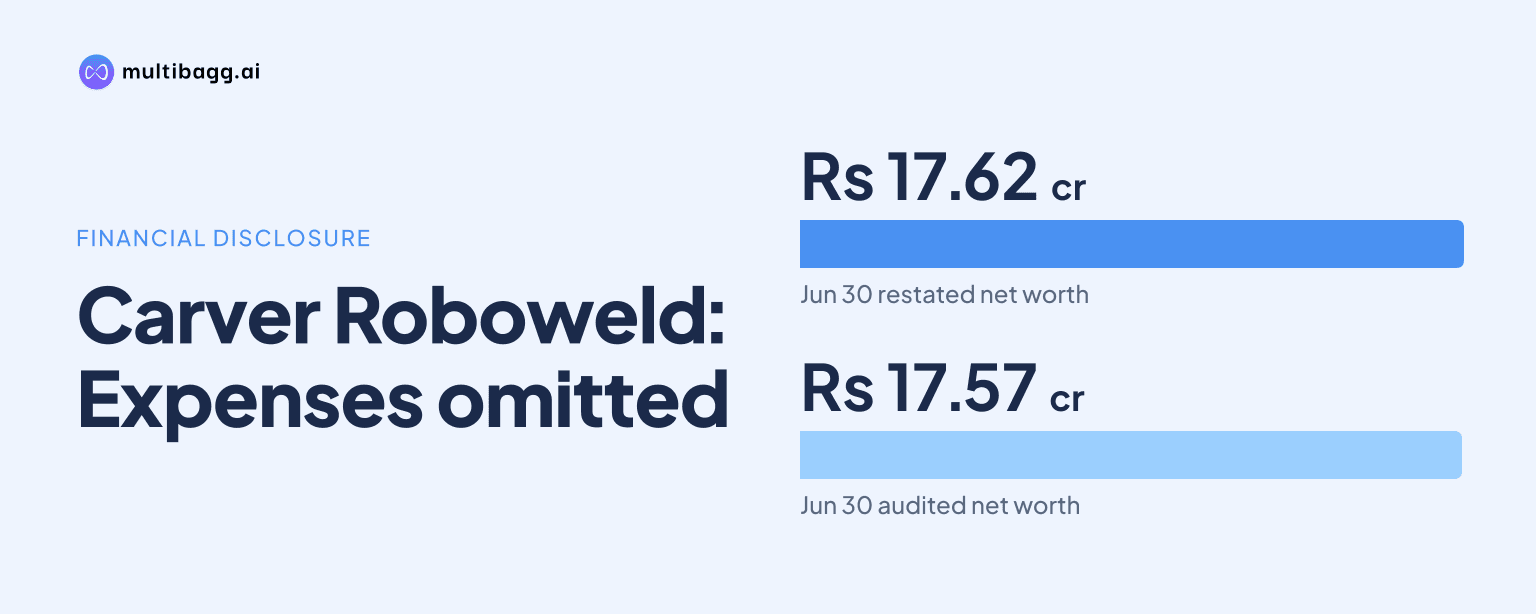
Carver Roboweld restated historical accounts to recognise previously unbooked gratuity, interest on delayed payments to micro, small and medium enterprises (MSME) creditors, tax effects, doubtful debts and expense reclassifications. Its restated net worth was Rs 17.62 crore at June 30, 2026, compared with Rs 17.57 crore in the audited financial statements.
Why did Carver Roboweld restate accounts for omitted expenses?
Carver Roboweld restated accounts because gratuity determined through actuarial valuation had not been recognised in audited financial statements for the years ended March 31, 2024 and March 31, 2025. Gratuity is an unfunded defined-benefit employee plan in Carver Roboweld’s accounting policy. The restated long-term gratuity provision was Rs 11.04 lakh at March 31, 2024, Rs 15.34 lakh at March 31, 2025 and Rs 16.53 lakh at June 30, 2026.
Carver Roboweld also recognised interest payable on outstanding MSME dues that had not been recorded in earlier audited accounts. The related tax adjustments reflected the disallowance of gratuity provisions and Section 43B of the Income Tax Act, 1961 treatment for amounts payable to MSME creditors that were not paid within the prescribed period. Section 43B is the provision cited by Carver Roboweld for tax treatment of these unpaid creditor balances.
The restatement additionally changed the presentation of certain expenses. GST expenses, penalties and interest on statutory dues for the year ended March 31, 2024 were moved from reserves and surplus to the Statement of Profit and Loss. A loss on sale of computer software-related items for the year ended March 31, 2025 received the same treatment, while initial public offering expenses charged to profit and loss in the year ended March 31, 2026 were reclassified as prepaid expenses.
How did Carver Roboweld restate profit across the reported periods?
Carver Roboweld’s restated profit after tax was lower than audited profit in the June 30, 2026 period and in the years ended March 31, 2025 and March 31, 2024, while the year ended March 31, 2026 changed from an audited loss to a restated profit. The reconciliation identifies adjustments for tax, gratuity, deferred tax, fair-value provision and expenses. Profit after tax is the profit remaining after tax charges in the Statement of Profit and Loss.
For the period ended June 30, 2026, Carver Roboweld reported a Rs 2.54 lakh deferred-tax adjustment and a Rs 5,000 tax-provision adjustment, taking audited profit after tax of Rs 1.52 crore to Rs 1.49 crore. The deferred-tax entry was linked to the tax effect of gratuity disallowance and delayed MSME creditor payments under Section 43B. Deferred tax represents the accounting effect of timing differences between taxable income and accounting income.
For the year ended March 31, 2025, the reconciliation lists Rs 5.05 lakh for gratuity, Rs 2.31 lakh for deferred tax, Rs 86,000 for tax and Rs 4.86 lakh for a fair-value provision. Carver Roboweld said the year’s adjustments also covered delayed-MSME-payment interest and the transfer of a software-related asset-sale loss from reserves and surplus to profit and loss. The resulting restated profit was Rs 1.45 crore, against audited profit of Rs 1.48 crore.
For the year ended March 31, 2024, audited profit after tax of Rs 1.32 crore became restated profit of Rs 1.01 crore. The listed entries included a Rs 27.37 lakh tax-provision adjustment, Rs 4.11 lakh gratuity adjustment, Rs 43,000 expense adjustment and Rs 14,000 deferred-tax adjustment. The comparison shows that the disclosed change in reported profit was greatest among the full years for March 31, 2024.
Got a follow-up? Ask IRIS
What did the restatement change in Carver Roboweld net worth?
Carver Roboweld’s restated net worth was Rs 17.62 crore at June 30, 2026, Rs 16.13 crore at March 31, 2026, Rs 4.56 crore at March 31, 2025 and Rs 3.11 crore at March 31, 2024. Net worth in the reconciliation is equity and accumulated reserves after the stated adjustments. The June 2026 restated amount was Rs 12.64 lakh above the audited amount.
At March 31, 2025, the reconciliation includes a Rs 42.49 lakh provision for doubtful debts, which Carver Roboweld describes as the accumulated effect of provisioning for long-standing trade receivables predating the year ended March 31, 2024. The same date also includes Rs 7.93 lakh for gratuity, Rs 5.28 lakh for tax, Rs 2.17 lakh for deferred tax and Rs 1.51 lakh for expenses. These entries accompany the change from Rs 15.15 crore audited net worth to Rs 4.56 crore restated net worth.
At March 31, 2024, the stated net-worth adjustments included Rs 12.88 lakh for gratuity, Rs 90,000 for expenses and Rs 43,000 for tax, partly offset by Rs 14,000 for deferred tax. Carver Roboweld distinguishes this accumulated balance-sheet reconciliation from the annual profit reconciliation, which sets out adjustments for each period. The restated March 31, 2024 net worth was Rs 3.11 crore, versus Rs 6.67 crore in audited financial statements.
Which accounting policies determine the gratuity and tax entries?
Carver Roboweld’s policy requires its unfunded gratuity obligation to be measured using the Projected Unit Credit method, with an actuarial valuation at every balance-sheet date. The Projected Unit Credit method measures the present value of an employee-benefit obligation based on service rendered. Actuarial gains and losses are recognised in the Statement of Profit and Loss in the period in which they occur.
The policy explains why a gratuity entry can affect both expenses and long-term provisions without requiring a same-period cash payment. Carver Roboweld’s gratuity provision increased from Rs 11.04 lakh at March 31, 2024 to Rs 17.34 lakh at March 31, 2026, before declining to Rs 16.53 lakh at June 30, 2026. The restated figures therefore depend on the valuation at each reporting date as well as on the recognition of previously omitted obligations.
Carver Roboweld says deferred tax is recognised for timing differences that arise in one period and can reverse in later periods. Its June 30, 2026 profit reconciliation included a Rs 2.54 lakh deferred-tax adjustment, while its March 31, 2025 net-worth reconciliation included Rs 2.17 lakh. The disclosure links both the gratuity provision and delayed MSME creditor payments to the tax adjustments.
What do the restated accounts show about expense classification?
Carver Roboweld’s restated accounts show two different forms of adjustment: recognition of liabilities or provisions omitted from audited accounts, and reclassification of costs already recorded in another financial-statement line. The Rs 42.49 lakh doubtful-debt provision at March 31, 2025 concerns long-standing receivables, while the unpaid-MSME interest provision concerns a previously unrecognised creditor-related cost. Both can affect reported net worth when recognised.
The classification changes concern where an item is reported. Carver Roboweld moved fiscal 2023-24 GST expenses, statutory penalties and statutory interest from reserves and surplus to profit and loss, and transferred fiscal 2024-25 software-related asset-sale losses on the same basis. In contrast, fiscal 2025-26 initial public offering expenses moved from profit and loss to prepaid expenses, an asset classification that is stated to be used for expenses relating to a later period.
Conclusion
Carver Roboweld’s reconciliations show that restated results reflect a combination of unrecorded employee-benefit and MSME-related obligations, tax effects, doubtful-debt provisioning and classification changes. The March 31, 2025 net-worth reconciliation contains the largest separately identified balance-sheet item, a Rs 42.49 lakh provision for doubtful debts, alongside accumulated gratuity and tax adjustments.
The next disclosed accounting point to watch is the annual actuarial measurement of the unfunded gratuity obligation, which was Rs 16.53 lakh at June 30, 2026. Carver Roboweld’s policy requires valuation at every balance-sheet date, while the supplied restatement pages disclose no further restatement plan.