










Core4: Auditors Find Repeated Bank Statement Mismatches
Key highlights
- Core4’s quarterly stock and debtor statements filed with State Bank of India and Bank of Baroda differed from its books during Fiscal 2025, Fiscal 2026 and June 2026.
- The largest disclosed mismatch was Rs 72.6212 crore in State Bank of India debtor statements in June 2026.
- Core4’s short-term borrowings rose from Rs 16.8539 crore at March 31, 2025 to Rs 34.9736 crore at June 30, 2026.
- Trade receivables increased from Rs 36.1902 crore at March 31, 2025 to Rs 101.5446 crore at June 30, 2026.
powered by IRIS
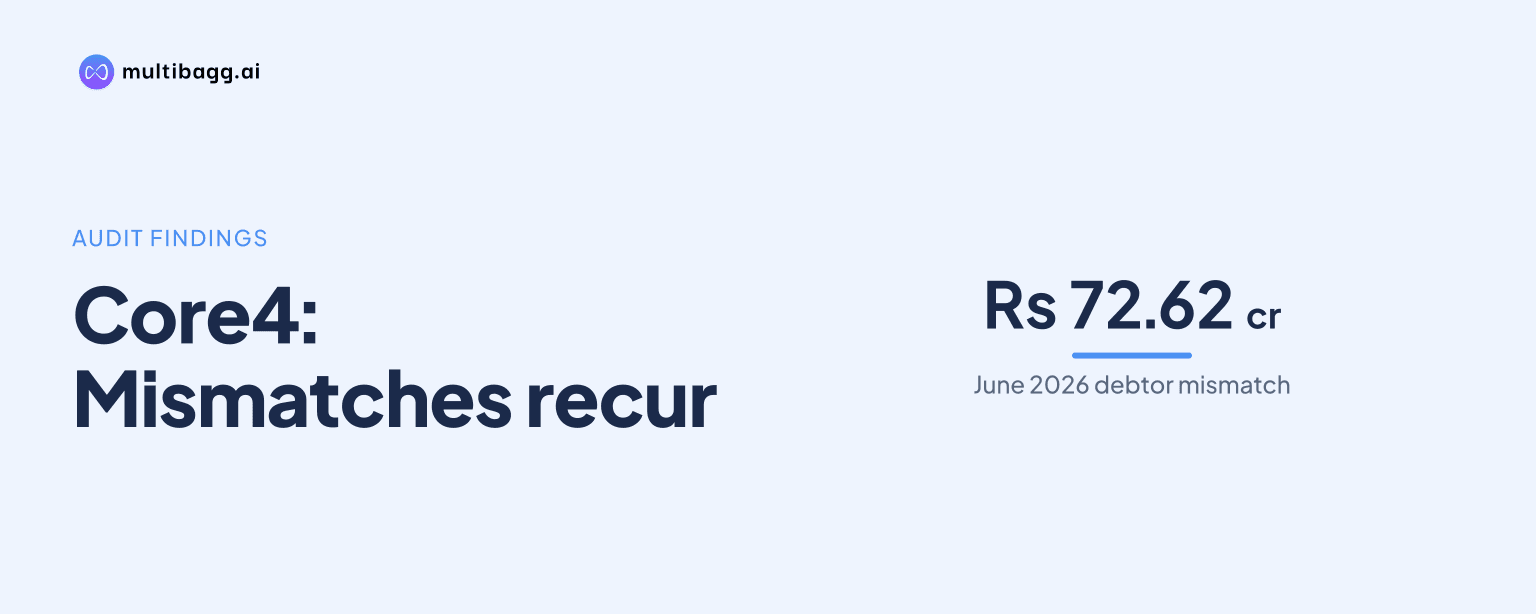
Core4 Engineers Private Limited, referred to as Core4, disclosed auditor observations that its quarterly stock and debtor statements filed with State Bank of India and Bank of Baroda did not agree with its books in Fiscal 2025, Fiscal 2026 and June 2026. The largest disclosed difference was Rs 72.6212 crore for State Bank of India debtors in June 2026.
What did auditors find in Core4’s bank statements?
Auditors found that Core4’s quarterly returns submitted to banks did not agree with its books of account during the reported periods. The observation applied because Core4 had aggregate working-capital limits exceeding Rs 5 crore that were sanctioned against current assets, including stock and trade debtors. The observation was disclosed under the Companies (Auditors’ Report) Order, 2020, known as CARO.
The June 2026 table recorded differences at both State Bank of India and Bank of Baroda. For State Bank of India, Core4 reported stock of Rs 16.3009 crore in both the securities information and books, while debtor information showed Rs 102.0097 crore as securities provided and Rs 29.3885 crore in the books, producing a disclosed Rs 72.6212 crore difference. For Bank of Baroda, stock was Rs 6.682 crore as securities provided and Rs 2.4336 crore in the books, a Rs 4.2484 crore difference; the debtor line showed Rs 82.2138 crore, with no book amount shown in that table.
The prospectus stated that the matters did not require adjustments to Core4’s restated consolidated financial information. It said no statutory-auditor qualifications had not been given effect to in that information, except CARO reporting for Fiscal 2026 and reporting under Rule 11(g) of the Companies (Audit and Auditors) Rules, 2014 for Fiscal 2024, Fiscal 2025, Fiscal 2026 and June 2026. The disclosure therefore identifies disagreement between lender submissions and accounting records, rather than a stated restatement of the financial statements.
How did Core4’s stock and debtor gaps change across periods?
Core4’s mismatches shifted between stock and debtors across Fiscal 2025, Fiscal 2026 and June 2026, but they did not disappear. In Fiscal 2025, State Bank of India stock differences were substantial in June, September and December 2024 before narrowing to Rs 0.0001 crore in March 2025. Debtor differences at both banks increased sharply in March 2025.
In Fiscal 2025, Bank of Baroda stock matched the books in all four listed quarters, rising from Rs 5.0328 crore in June 2024 to Rs 10.3466 crore in March 2025. Its debtor figures differed in every reported quarter: Rs 3.6739 crore in June 2024, Rs 3.8390 crore in September, Rs 4.1534 crore in December and Rs 31.2259 crore in March 2025. State Bank of India’s March 2025 debtor difference was Rs 31.2258 crore.
Fiscal 2026 showed a different pattern. State Bank of India stock differed by Rs 6.4516 crore in September 2025, but matched in June and December 2025 and March 2026. Its debtor differences were Rs 3.1495 crore in June 2025, Rs 41.3956 crore in September, Rs 8.0179 crore in December and Rs 1.7338 crore in March 2026. Bank of Baroda recorded a Rs 6.4516 crore stock difference in September 2025 and debtor differences ranging from Rs 1.9010 crore in June 2025 to Rs 41.7942 crore in September 2025.
Got a follow-up? Ask IRIS
Why do Core4’s bank statement mismatches matter?
Core4’s bank statement mismatches matter because the relevant working-capital limits were sanctioned on the security of current assets. A working-capital facility finances operating needs, while current assets include assets expected to be realised or used in the operating cycle or within 12 months. Stock and trade-debtor statements can therefore form part of the information supplied to lenders for such facilities.
Core4’s short-term borrowings rose from Rs 16.8539 crore at March 31, 2025 to Rs 29.3213 crore at March 31, 2026 and Rs 34.9736 crore at June 30, 2026. Trade receivables increased from Rs 36.1902 crore at March 31, 2025 to Rs 75.4474 crore at March 31, 2026 and Rs 101.5446 crore at June 30, 2026. These reported increases expanded the scale of the balance-sheet categories covered by the lender submissions.
As of June 30, 2026, Core4 had Rs 14.3747 crore outstanding under a working-capital facility with a Rs 20 crore sanction and Rs 9.7948 crore outstanding under an overdraft with a Rs 11 crore sanction. Its Bank of Baroda working-capital facility had Rs 1.39 crore outstanding against a Rs 1.39 crore sanction and was described as having no securities. The auditor observation, however, refers to working-capital limits above Rs 5 crore in aggregate that were secured by current assets.
What explains the reconciliation issue and what remains unresolved?
Core4 identified internal reconciliation as the reason for two specific disclosed differences, but did not give a comprehensive explanation for every mismatch. The March 2026 State Bank of India debtor difference of Rs 1.7338 crore was marked “Due to Internal Reconciliation issue.” The September 2024 State Bank of India debtor difference of Rs 3.6687 crore was also marked as due to an internal reconciliation issue.
A reconciliation compares records and identifies differences, such as those between accounting books and a submission made to a bank. The disclosure does not state when the June 2026 differences were reconciled, whether Core4 filed revised statements with either bank, or whether either lender changed facility terms or availability. It also does not quantify an effect on borrowing availability, interest expense or current-asset values recognised in the restated financial information.
Core4 reported net cash used in operating activities of Rs 10.8065 crore in Fiscal 2026 and Rs 8.3209 crore in the period ended June 30, 2026. Fiscal 2026 working-capital movements included a Rs 39.4612 crore increase in trade receivables and a Rs 38.6058 crore increase in other current assets; trade receivables increased by Rs 26.0972 crore in the June 2026 period. These movements do not establish the reason for the bank-statement differences, but they show the scale of the operating balances tied to working-capital reporting.
Conclusion
Core4’s auditor observation identifies recurring differences between bank submissions and books rather than an isolated quarterly variance. The disclosed figures cover stock and debtors in Fiscal 2025, Fiscal 2026 and June 2026, and the largest stated difference increased from Rs 31.2259 crore for Bank of Baroda debtors in March 2025 to Rs 72.6212 crore for State Bank of India debtors in June 2026.
The next disclosed matter to watch is whether Core4 reports completed reconciliations or revised lender submissions for the June 2026 differences. Core4 stated that it expected to meet funding requirements principally through operating funds and working-capital optimisation, with the balance principally met through external borrowings and additional equity, while short-term borrowings were Rs 34.9736 crore at June 30, 2026.