










EAAA India Alternatives raised 81% of FY26 funds through distributors
Key highlights
- EAAA India Alternatives raised Rs 8,769.20 crore through distributors in FY26, representing 80.79% of total funds raised.
- Distributor-sourced fundraising rose from Rs 4,324.093 crore in FY25 to Rs 8,769.20 crore in FY26.
- EAAA India Alternatives paid Rs 242.838 crore to distributors, chaperoning partners and offshore relationship managers in FY26.
- Private Credit accounted for 39.64% of total FPAUM as of June 30, 2026, down from 47.67% a year earlier.
powered by IRIS
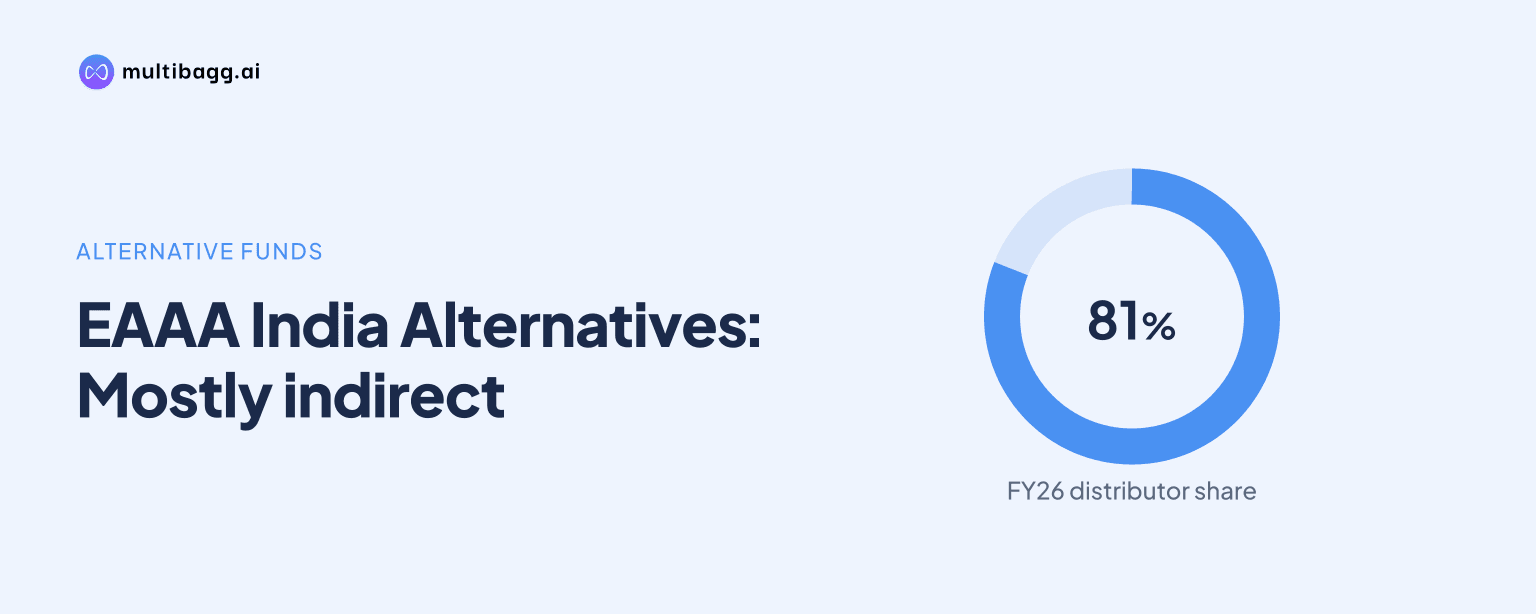
EAAA India Alternatives raised Rs 8,769.20 crore through distributors in the financial year ended March 31, 2026, or FY26, representing 80.79% of total funds raised. The channel’s role makes the company’s domestic fundraising dependent on distributor relationships, non-exclusive contracts and the cost of distributor, chaperoning-partner and offshore relationship-manager payments.
How much did EAAA India Alternatives raise through distributors in FY26?
EAAA India Alternatives raised Rs 8,769.20 crore through distributors in FY26, equal to 80.79% of total funds raised. The proportion increased from 65.47% in FY25 and 72.19% in FY24, showing that distributors supplied more than four-fifths of FY26 fundraising. Distributor-sourced funds also rose from Rs 4,324.093 crore in FY25 and Rs 6,992.48 crore in FY24.
EAAA India Alternatives’ three months ended June 30, 2026 produced a different mix: distributors raised Rs 6,877.75 crore but accounted for 33.75% of total funds raised, against 97.90% in the corresponding 2025 period. The company attributed the lower share to a significant part of fundraising being from fund vehicles, including infrastructure investment trusts, or InvITs, placed through public offers and direct or strategic-investor routes outside the distributor channel. Distributor-sourced funds nevertheless increased from Rs 2,937.00 crore a year earlier.
What does EAAA India Alternatives’ distribution network cover?
EAAA India Alternatives reported 53 wealth-management entities, chaperoning partners and offshore relationship managers in its distribution network as of June 30, 2026, compared with 48 as of June 30, 2025. The company said distributors promote and distribute products domestically to high-net-worth individuals and family offices, while its own team is used primarily for offshore clients and onshore institutional clients.
The distinction matters because the 80.79% FY26 distributor share applies to the company’s aggregate fundraising result, while distributor activity is described principally in relation to domestic wealth channels. Chaperoning partners and offshore relationship managers raised no funds in FY26 or in the three months ended June 30, 2026, according to the disclosure. They had raised Rs 318.617 crore, or 4.82% of total funds, in FY25 and Rs 1,218.333 crore, or 12.58%, in FY24.
EAAA India Alternatives has no exclusivity clauses in its distributor contracts, so distributors can also work with competitors. The company said a loss of distributor support could reduce market reach and the channels through which it acquires investments and clients. Continued distributor-led fundraising therefore requires distributors to continue presenting the company’s products and maintaining access to the relevant domestic investor base.
Got a follow-up? Ask IRIS
What are the costs and conduct risks of distributor-led fundraising?
EAAA India Alternatives paid Rs 242.838 crore to distributors, chaperoning partners and offshore relationship managers in FY26. Payments were Rs 79.32 crore in the three months ended June 30, 2026, compared with Rs 43.157 crore in the corresponding 2025 period. The company also identified payouts to distributors for raising new funds with larger assets under management as a reason it had experienced negative cash flows in the past.
The cost can rise if distributors negotiate higher fees or commissions, EAAA India Alternatives said. This would increase operating costs and could reduce the financial benefit generated by products if fundraising did not increase proportionately. The company said a disruption in distributor relationships could affect future revenue streams from management and advisory fees, general-partner income and Variable Additional Return, or VAR, which is the additional variable return available after a fund achieves applicable investor return conditions under its distribution waterfall.
Distributor conduct is a separate risk because a distributor could misrepresent a product or fail to comply with regulatory requirements in its jurisdiction. EAAA India Alternatives said such actions could result in reputational damage, regulatory scrutiny, sanctions or fines, and require resources to address legal matters. As of the red herring prospectus date, the company said no legal action had been initiated by or against it by any distributor, and it said it focuses on reputed distributors with systems and processes.
How does distributor dependence differ from EAAA India Alternatives’ other concentrations?
EAAA India Alternatives’ distributor reliance concerns future fundraising, whereas its client concentration concerns the assets already generating fees. As of June 30, 2026, its top 10 clients accounted for 26.20% of fee-paying assets under management, or FPAUM. FPAUM means assets on which EAAA India Alternatives is entitled to management and advisory fees, measured under fund documents using items such as committed capital, invested capital, net asset value or gross assets.
EAAA India Alternatives reported no instances in the three months ended June 30, 2026 or in the preceding three financial years where client defaults or delays prevented its funds from making investments or covering fund expenses. That record relates to capital calls, which are requests for committed capital from fund clients, rather than continued distributor access. A distributor disruption would affect new inflows, while a large client reducing commitments or withdrawing investments could affect the FPAUM base and related fees.
The company’s investment-vertical exposure is separate again. Private Credit FPAUM stood at Rs 19,272.416 crore as of June 30, 2026, accounting for 39.64% of total FPAUM, compared with 47.67% a year earlier. Distributors support the raising of new capital, while the mix of FPAUM determines the business verticals in which EAAA India Alternatives earns management and advisory fees.
Conclusion
EAAA India Alternatives’ FY26 fundraising was materially tied to distributors because the channel supplied Rs 8,769.20 crore, or 80.79% of total funds raised. That share was higher than the 65.47% reported in FY25, while Rs 242.838 crore of FY26 payments to distributors, chaperoning partners and offshore relationship managers shows the direct cost attached to third-party fundraising.
The later fundraising mix is the key disclosed measure to watch, particularly whether public-offer and direct or strategic-investor routes continue to reduce the distributor share as they did in the three months ended June 30, 2026. EAAA India Alternatives has also disclosed that distributor agreements are non-exclusive, leaving the durability of the channel dependent on continuing commercial relationships and future commission terms.