










EAAA’s Management Fees Remain Largest as VAR Share Rises
Key highlights
- Management and advisory fees were Rs 579.068 crore, or 60.68% of EAAA’s Rs 963.759 crore total income in Fiscal 2026.
- VAR rose to Rs 290.472 crore in Fiscal 2026 from Rs 94.566 crore in Fiscal 2024, increasing its income share from 16.19% to 30.14%.
- EAAA’s fee-paying assets under management increased to Rs 44,710.442 crore in Fiscal 2026 from Rs 30,398.012 crore in Fiscal 2024.
- VAR-related bonus expense reached Rs 161.087 crore in Fiscal 2026, while total expenses were Rs 615.243 crore.
powered by IRIS
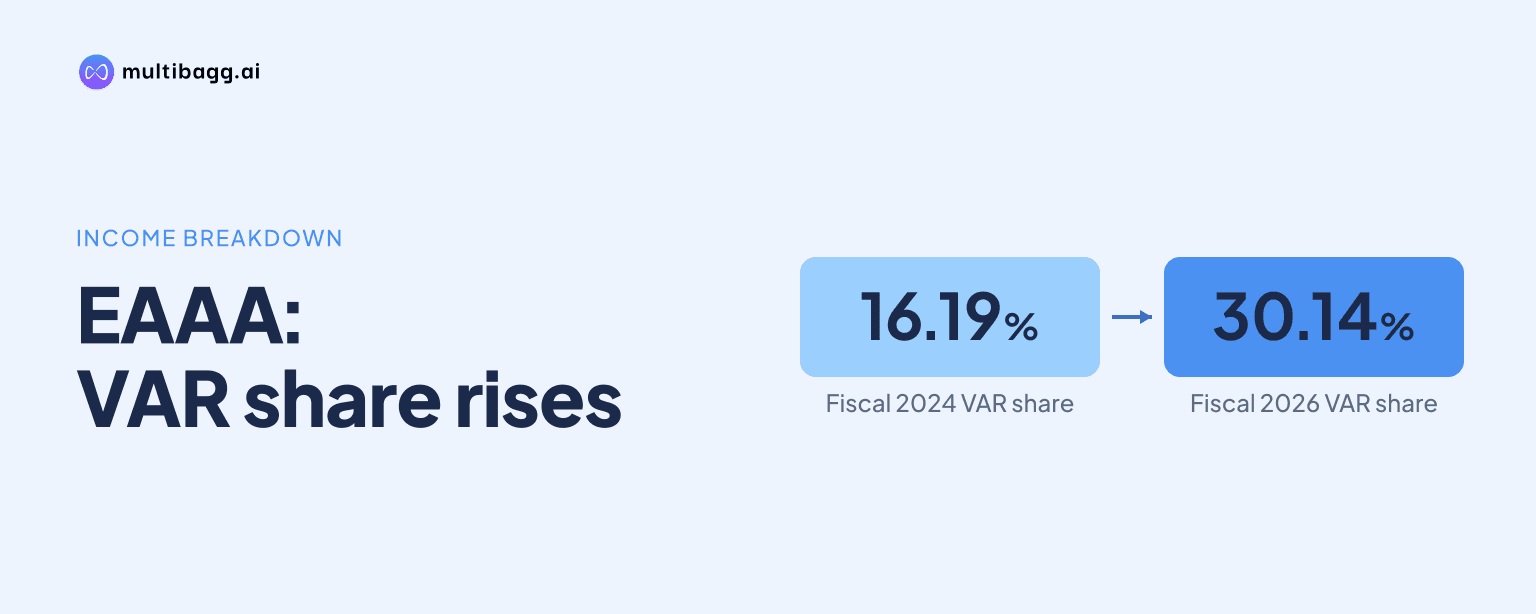
EAAA India Alternatives Limited’s management and advisory fees remained its largest income stream in Fiscal 2026 at Rs 579.068 crore, or 60.68% of total income. Variable Additional Return (VAR), a performance-linked return recognised under fund waterfall conditions, rose to Rs 290.472 crore, or 30.14%, from 16.19% in Fiscal 2024.
How does EAAA generate income from management fees and VAR?
EAAA generates income from management and advisory fees, VAR, general partner income and miscellaneous income. Management and advisory fees are paid for fund management and advisory services and are generally calculated as a percentage of capital committed, capital invested, net asset value, gross block or another measure specified in a fund’s governing documents. In Fiscal 2026, these fees accounted for Rs 579.068 crore of EAAA’s Rs 963.759 crore total income.
VAR is an additional return available to EAAA and its subsidiaries after a fund achieves the hurdle rate of return for investors, based on net asset value (NAV) and/or realisation. A hurdle rate is the return threshold investors must receive before the additional return becomes available. VAR is shown as other operating revenue, whereas general partner (GP) income represents income from investments in funds or portfolio-company co-investments made on the same terms as the primary fund.
Miscellaneous income is other income excluding interest on debt instruments or pass-through certificates and fair-value gains or losses on specified investments. This distinction shows that Fiscal 2026 total income combined contractual management fees, performance-linked VAR, investment-related GP income and a residual other-income category.
Why are management fees still EAAA’s largest income source?
Management and advisory fees remained EAAA’s largest income category in each of Fiscal 2024, Fiscal 2025 and Fiscal 2026, although their share of total income declined as VAR rose. Fees increased from Rs 398.013 crore in Fiscal 2024 to Rs 479.530 crore in Fiscal 2025 and Rs 579.068 crore in Fiscal 2026. Their share of total income moved from 68.12% in Fiscal 2024 to 67.97% in Fiscal 2025 and 60.68% in Fiscal 2026.
The management-fee result is linked to fee-paying assets under management (FPAUM), meaning assets on which EAAA is entitled to earn management and advisory fees. FPAUM increased from Rs 30,398.012 crore in Fiscal 2024 to Rs 33,833.278 crore in Fiscal 2025 and Rs 44,710.442 crore in Fiscal 2026. Management and advisory fee yield, calculated as fees divided by average FPAUM, was 1.47%, 1.49% and 1.47%, respectively, across those three fiscal years.
What conditions must EAAA meet to recognise VAR?
EAAA recognises VAR only after stated performance and timing conditions are satisfied. Under its policy, VAR is recognised after at least three years from a fund’s initial close date and only when fund performance has achieved at least 1.25 times the hurdle rate specified in the relevant fund documents at the date of recognition.
A fund’s waterfall distribution mechanism also determines the calculation and recognition of VAR. A waterfall is the contractual sequence for allocating fund distributions among investors, the sponsor and the general partner. Subject to the stated conditions, EAAA estimates and recognises VAR progressively over the remaining life of the relevant fund up to the expected date of first realisation.
Indian Accounting Standard 109 (Ind AS 109), which covers financial instruments, and Indian Accounting Standard 113 (Ind AS 113), which covers fair-value measurement, govern the accounting treatment cited by EAAA. The company states that VAR arising from alternative investment funds and partnership interests is recognised through profit or loss as part of net fair-value gains or losses, requiring both the contractual waterfall framework and the company’s valuation policy to apply.
Got a follow-up? Ask IRIS
How much has VAR changed EAAA’s income mix?
VAR increased faster than management and advisory fees across the three disclosed annual periods. VAR rose from Rs 94.566 crore in Fiscal 2024 to Rs 290.472 crore in Fiscal 2026, increasing its share of total income by 13.95 percentage points to 30.14%. Over the same period, management and advisory fees rose by Rs 181.055 crore, but their share of total income declined by 7.44 percentage points.
The same shift appeared in the three months ended June 30. VAR was Rs 108.953 crore, or 32.41% of total income, in the three months ended June 30, 2026, compared with Rs 58.298 crore, or 27.54%, in the three months ended June 30, 2025. Management and advisory fees remained the largest category at Rs 166.576 crore, or 49.56%, in the 2026 period, compared with Rs 132.509 crore, or 62.61%, a year earlier.
GP income followed a different annual pattern from VAR. GP income declined from Rs 102.138 crore in Fiscal 2025 to Rs 79.954 crore in Fiscal 2026, reducing its share of total income from 12.98% to 8.30%, although it was Rs 55.229 crore in the three months ended June 30, 2026. The comparison separates performance-linked VAR from returns on EAAA’s sponsor or general-partner capital invested alongside clients.
What determines whether EAAA’s revenue mix can persist?
The management-fee component depends on EAAA attracting capital, investing fund capital and retaining assets that generate fees. As of June 30, 2026, EAAA reported assets under management of Rs 95,344.878 crore and FPAUM of Rs 48,623.176 crore. The difference means not all reported assets under management necessarily form the direct base for management and advisory fee income.
VAR depends on fund performance, hurdle-rate achievement, NAV or realisation outcomes, the applicable waterfall and the three-year minimum period from initial close. EAAA states that raising VAR performance thresholds could align interests with investors but limit the circumstances in which VAR is earned. Changes in fund documentation, regulations or fee structures could therefore change the proportion of income represented by VAR.
Costs can also move with performance-linked income. VAR-related bonus expense was Rs 161.087 crore in Fiscal 2026, compared with Rs 131.131 crore in Fiscal 2025, and was Rs 82.503 crore in the three months ended June 30, 2026. EAAA identifies personnel-related expenses as a significant proportion of total expenses, which were Rs 615.243 crore in Fiscal 2026.
Conclusion
EAAA’s reported income mix shows management and advisory fees providing the largest revenue base through Fiscal 2026, supported by FPAUM growth and an annual fee yield between 1.47% and 1.49% from Fiscal 2024 to Fiscal 2026. VAR became a larger second income stream, rising from 16.19% to 30.14% of total annual income over the same period, while remaining conditional on fund-level performance and distribution terms.
The next disclosed measures to watch are FPAUM growth, management and advisory fee yield, and whether funds meet the stated VAR conditions of a three-year period from initial close and performance of at least 1.25 times the relevant hurdle rate. EAAA also states that it continues to explore organic and inorganic expansion, while noting that past growth may not be maintained.