










HGS derived 66% of FY26 revenue from geophone strings
Key highlights
- Geophone strings and harnesses generated Rs 29.94 crore, or 66.29%, of HGS’s Rs 45.16 crore FY26 revenue.
- HGS’s top 10 customers contributed 72.58% of FY26 revenue, while its largest customer contributed 21.79%.
- HGS’s FY26 EBITDA rose to Rs 16.89 crore from Rs 15.31 crore, lifting the EBITDA margin to 37.40% from 31.19%.
- HGS’s FY26 revenue fell 8.99% to Rs 45.16 crore, but profit after tax increased to Rs 11.64 crore from Rs 10.51 crore.
powered by IRIS
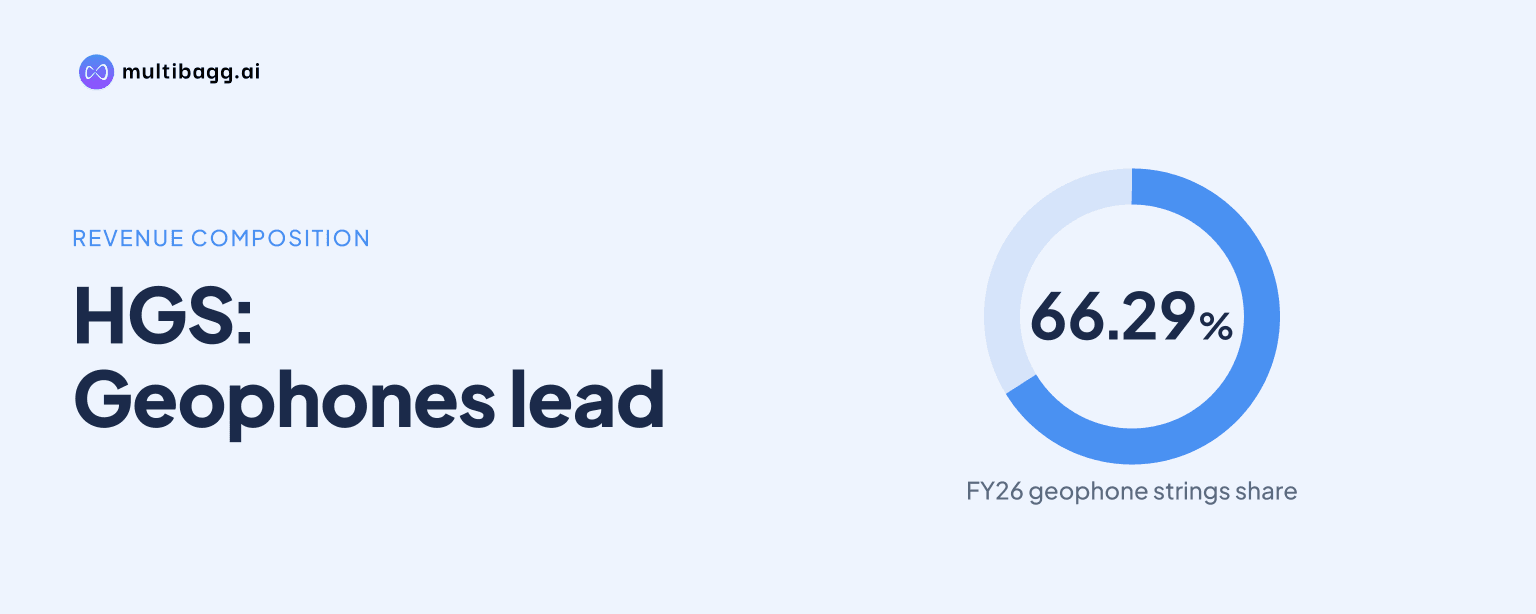
HGS (India) Ltd derived 66.29% of FY26 revenue from geophone strings and harnesses, generating Rs 29.94 crore from Rs 45.16 crore of revenue from operations. HGS’s product mix was therefore led by strings, while its end-market mix moved away from oil and gas exploration toward vibration monitoring and maintained substantial exposure to geophysical seabed surveys.
How did geophone strings produce 66% of HGS’s FY26 revenue?
HGS relied on geophone strings and harnesses for two-thirds of FY26 revenue. A geophone is a sensor that records ground vibration, while a geophone string or harness is an assembly configured for seismic work in land and marsh environments. The category generated Rs 29.94 crore, or 66.29%, of HGS’s Rs 45.16 crore FY26 revenue from operations.
The FY26 share increased from 51.15% in FY25, when geophone strings and harnesses generated Rs 25.10 crore of Rs 49.08 crore in revenue from operations. It was, however, below the 66.98% recorded in FY24, when the category generated Rs 23.76 crore from total revenue of Rs 35.48 crore. The three-year comparison shows that FY26 restored strings as the dominant product after a broader FY25 mix, rather than establishing a steady rise in concentration each year.
The stub period ended April 30, 2026 also showed strings as HGS’s largest product category, contributing Rs 1.81 crore, or 58.25%, of Rs 3.11 crore in revenue. Seismic cables supplied Rs 1.22 crore, or 39.41%, during that period. As the source labels the April 30, 2026 data as a non-annualised stub period, it does not establish the eventual full-year revenue mix.
Which products changed HGS’s FY26 revenue mix?
HGS’s FY26 product mix changed because seismic cables and parts and accessories took smaller shares of revenue while geophone strings gained share. Seismic cables generated Rs 9.21 crore, or 20.39% of FY26 revenue, compared with Rs 13.23 crore, or 26.95%, in FY25. The cable share was also below FY24’s 23.06%, when the category generated Rs 8.18 crore.
Parts and accessories of geophysical instruments generated Rs 4.88 crore, or 10.81%, in FY26. This category includes geophones, seismograph assemblies, seismometers, accelerometers, weather monitors, geophone testers and other equipment. Its FY26 contribution was lower than Rs 9.62 crore, or 19.59%, in FY25, but higher than Rs 3.06 crore, or 8.63%, in FY24.
Geophysical connectors accounted for Rs 7.14 lakh, or 0.16%, in FY26, compared with Rs 17.39 lakh, or 0.35%, in FY25. Other revenue, which HGS defines as services and sale of scrap, was Rs 1.06 crore, or 2.35%, in FY26. After strings and cables, which together supplied 86.68% of FY26 revenue, all remaining product categories represented 13.32%.
How did HGS’s end-market mix shift from oil and gas?
HGS’s end-market mix shifted as oil and gas exploration lost share, vibration monitoring expanded, and geophysical seabed surveys remained a large application. Oil and gas exploration generated Rs 12.51 crore, or 27.70%, of FY26 revenue, down from Rs 16.61 crore, or 33.84%, in FY25. Its FY26 share was also below the 30.20% reported in FY24.
Geophysical seabed surveys generated Rs 12.64 crore, or 27.99%, in FY26, narrowly exceeding oil and gas exploration as HGS’s largest disclosed industry segment. Revenue from seabed surveys was below Rs 14.05 crore in FY25, when the segment accounted for 28.62% of revenue. Its FY26 share nevertheless remained above FY24’s 17.37%, when seabed-survey revenue was Rs 6.16 crore.
Vibration monitoring recorded the clearest FY26 expansion, supplying Rs 9.13 crore, or 20.22%, compared with Rs 4.18 crore, or 8.53%, in FY25. Defence research also rose to Rs 4.01 crore, or 8.89%, from Rs 80.58 lakh, or 1.64%, in FY25. Earthquake seismology moved in the opposite direction, falling to Rs 1.33 crore, or 2.95%, from Rs 7.90 crore, or 16.09%, showing that HGS’s application mix can change materially between financial years.
Got a follow-up? Ask IRIS
What must hold for HGS’s FY26 mix to persist?
HGS’s FY26 mix depends principally on continuing demand for geophone strings and on orders across its end markets. HGS manufactures geophones, strings, seismic cables, geophysical connectors, and parts and accessories at Manesar, Haryana. These products acquire seismic data by recording and transmitting ground-vibration signals used to interpret subsurface geological structures.
HGS’s manufacturing model includes backward integration, meaning internal production of components used in final assemblies. The company states that it operates multiple extrusion and cable lines and 16 injection-moulding machines for internal component production. Its sensors are designed to operate between minus 40°C and plus 200°C, a range relevant to the land, offshore and monitoring applications reflected in the FY26 industry split.
Customer concentration is a separate condition for revenue continuity. HGS sold to 149 domestic and foreign customers in FY26, and around 51 customers placed repeat orders over the preceding three fiscal years. However, the top 10 customers generated Rs 32.78 crore, or 72.58%, of FY26 revenue, compared with 56.24% in FY25, while the top customer alone supplied 21.79%.
How did FY26 earnings compare with FY25?
HGS reported higher FY26 earnings despite lower revenue from operations. Revenue declined 8.99% to Rs 45.16 crore in FY26 from Rs 49.08 crore in FY25, while earnings before interest, tax, depreciation and amortisation, or EBITDA, increased to Rs 16.89 crore from Rs 15.31 crore. HGS defines EBITDA as profit before tax plus depreciation and interest expenses.
HGS’s EBITDA margin, calculated as EBITDA divided by revenue from operations, rose to 37.40% in FY26 from 31.19% in FY25. Profit after tax increased to Rs 11.64 crore from Rs 10.51 crore, and profit-after-tax margin increased to 25.77% from 21.40%. These reported changes occurred alongside the higher share of geophone strings, but the source does not attribute the margin movement to any individual product or end market.
Conclusion
HGS’s FY26 disclosures show that a broad seismic-equipment catalogue remained commercially concentrated in geophone strings and harnesses, which supplied 66.29% of revenue. At the end-market level, oil and gas exploration fell 6.14 percentage points from FY25 to 27.70%, while vibration monitoring rose 11.69 percentage points to 20.22% and seabed surveys accounted for 27.99%.
The next development to watch is HGS’s disclosed Rs 19.36 crore capital-expenditure plan, including Rs 15.05 crore for machinery replacement and upgrades, Rs 3.26 crore for second-floor infrastructure at Manesar, and Rs 1.05 crore for an in-house gold-plating facility. The April 30, 2026 stub period retained strings as the largest category at 58.25%, but its non-annualised status leaves the durability of the FY26 mix unresolved.