










HGS India’s cable capacity data conflict with utilisation figures
Key highlights
- HGS India reported 45,858 metres of seismic-cable production against 90,000 metres of installed capacity in fiscal 2026, but stated utilisation was 0.51% instead of approximately 50.95%.
- The seismic-cable line measured in units was internally consistent, with fiscal 2026 production of 1,751 units, installed capacity of 7,200 units and utilisation of 24.32%.
- Geophone strings or harnesses had fiscal 2026 utilisation of 13.63%, while geophysical connectors had utilisation of 0.11%.
- Parts and accessories of instruments recorded the highest fiscal 2026 utilisation at 57.66%, with output of 4,98,217 units against capacity of 8,64,000 units.
powered by IRIS
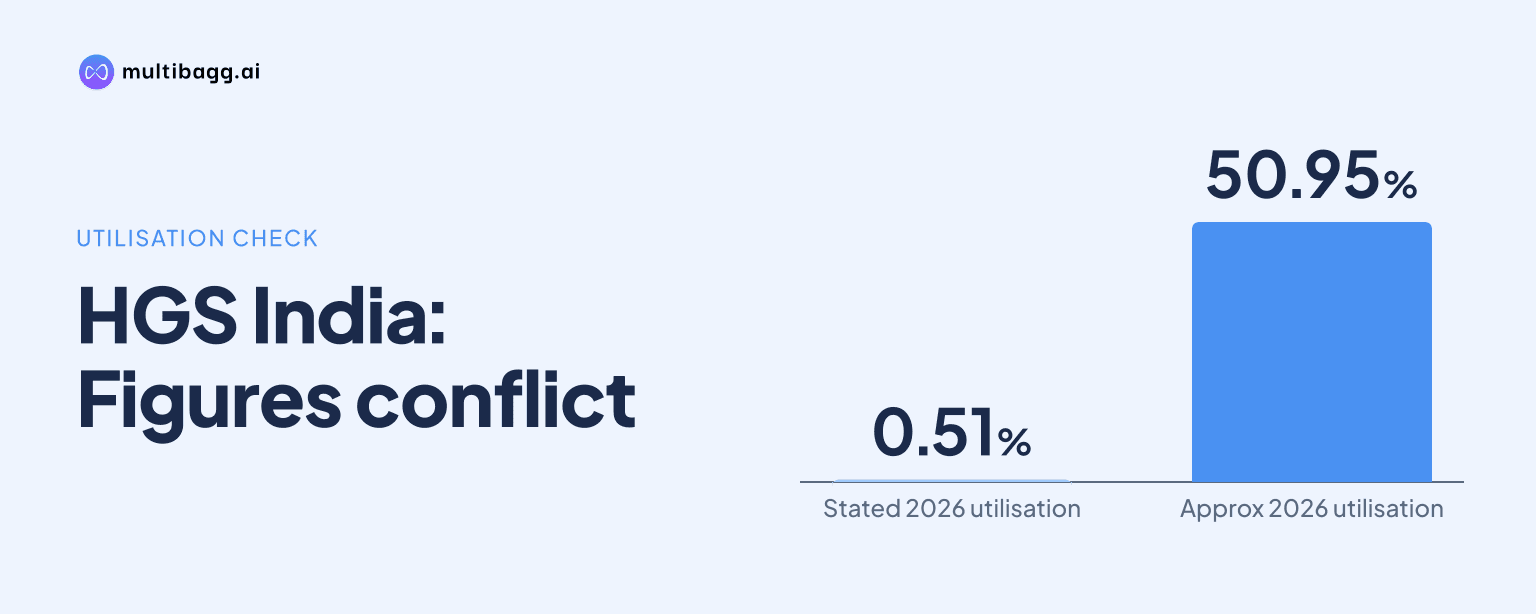
HGS India’s capacity disclosure contains an unresolved numerical inconsistency in seismic cable measured in metres, while several product lines show low use of stated capacity. For fiscal 2026, HGS India reported 45,858 metres of seismic-cable production, 90,000 metres of installed capacity and 0.51% utilisation, figures that do not arithmetically align.
Why do HGS India’s seismic-cable figures not reconcile?
HGS India’s reported seismic-cable production in metres does not reconcile with the utilisation percentages shown against its disclosed installed capacity. The capacity table lists installed capacity of 90,000 metres, output of 45,858 metres in fiscal 2026 and utilisation of 0.51%. Dividing the reported fiscal 2026 output by the stated 90,000-metre capacity produces about 50.95%, rather than 0.51%.
The same discrepancy appears in the two prior fiscal years. HGS India reported 28,299 metres of seismic-cable production in fiscal 2025 and 88,968 metres in fiscal 2024, alongside utilisation of 0.31% and 0.99%, respectively. Those percentages correspond approximately to capacity of 90,00,000 metres, rather than the disclosed 90,000 metres, but the prospectus does not state 90,00,000 metres as installed capacity.
The April 30, 2026 stub-period entry does not resolve the discrepancy because it records zero metres of seismic-cable production and 0.00% utilisation. HGS India labels the April 30, 2026 utilisation figures as not annualised, meaning the short-period output has not been extrapolated to a full year. That qualification explains the period difference, but it does not reconcile the three full-year metre-based percentages with listed capacity.
Are HGS India’s two seismic-cable rows directly comparable?
HGS India presents two seismic-cable rows, but the rows use different units and cannot be treated as directly interchangeable. One row reports seismic cable in numbers, with installed capacity of 7,200 units; the other reports seismic cable in metres, with installed capacity of 90,000 metres. The prospectus does not define whether these are separate production measures, different cable types or two measures of related output.
For seismic cable measured in numbers, the disclosed percentages match the listed 7,200-unit capacity. HGS India reported production of 1,751 units in fiscal 2026, 4,679 units in fiscal 2025 and 3,421 units in fiscal 2024, corresponding to stated utilisation of 24.32%, 64.99% and 47.51%. April 30, 2026 production was 61 units, or 0.85% of annual capacity before annualisation.
The different units create an assessment issue, rather than establishing that HGS India has disclosed one duplicated physical asset. A cable unit can have a length measured in metres, but the filing provides no conversion factor between the 7,200-unit line and the 90,000-metre line. Without that definition, readers cannot combine the two capacity figures or determine whether metre-based capacity is a separate operational constraint.
How low is HGS India’s disclosed manufacturing utilisation?
HGS India reports low utilisation for geophone strings or harnesses and geophysical connectors, alongside a decline in the utilisation of parts and accessories after fiscal 2025. Geophone strings or harnesses had installed capacity of 72,000 units, while fiscal 2026 production was 9,814 units, or 13.63%, down from 27.07% in fiscal 2025. April 30, 2026 production was 45 units, or 0.06% of stated annual capacity.
Geophysical connectors had the lowest reported full-year utilisation among categories with internally consistent percentages. HGS India listed capacity of 2,40,000 units, fiscal 2026 output of 265 units and utilisation of 0.11%; fiscal 2025 output was 2,967 units, or 1.24%, and fiscal 2024 output was 5,467 units, or 2.28%. The April 30, 2026 figure was 38 units, or 0.02% of stated annual capacity.
Parts and accessories of instruments were the most utilised disclosed line in fiscal 2026. This category includes geophones, seismograph assembly, seismometers, accelerometers, Sigma 4+ weather monitors, Boom Box and geophone testers. Output was 4,98,217 units against capacity of 8,64,000 units, or 57.66%, compared with 80.54% in fiscal 2025 and 30.01% in fiscal 2024.
Got a follow-up? Ask IRIS
What determines whether HGS India can use more capacity?
HGS India says capacity utilisation depends on uninterrupted factory operations and market demand for its products. The company also identifies raw-material availability and quality, labour, industry and market conditions, and customers’ procurement practices as factors affecting output. Installed capacity therefore measures possible production rather than an indication that orders, inputs or operating conditions will support that output.
HGS India manufactures from a facility at Manesar, Haryana, for customers in India and overseas. The company surrendered Factory Unit 146, Sector-5, IMT Manesar, Gurgaon during the last three financial years to consolidate operations at Factory 158, Sector-4, Industrial Estate, Ch. Devi Lal IMT Manesar, Gurgaon, Haryana. A shutdown, machinery failure, power interruption, labour dispute or other disruption at that location could reduce production and utilisation.
HGS India’s manufacturing operations are situated in a 100% Export Oriented Unit, or EOU, a unit structured for exports. The company identifies transportation availability, export tariffs, global trade conditions and entry into new international markets as factors that can affect operations and sales. Freight charges were 6.00% of total expenses for the stub period ended April 30, 2026, compared with 3.65% in fiscal 2026 and 3.33% in each of fiscal 2025 and fiscal 2024.
How reliable are HGS India’s installed-capacity estimates?
HGS India says its installed-capacity and historical-utilisation information is based on management assumptions and estimates. The disclosed assumptions include proposed operations, availability and quality of raw materials, potential utilisation levels and operational efficiencies. HGS India cautions that actual utilisation rates may differ significantly from estimated installed capacities or historical estimated utilisation information.
The capacity details and actual utilisation were certified by R.K. Aggarwal, Chartered Engineer, through a certificate dated October 15, 2026. HGS India nevertheless states that undue reliance should not be placed on its installed-capacity or historical-utilisation information. That caution is material for the metre-based seismic-cable row, where output, installed capacity and stated utilisation point to incompatible scales.
HGS India plans to use part of initial public offering proceeds for replacement plant and machinery at its existing facility, an in-house gold-plating facility and second-floor infrastructure development. The company says these fund requirements are management estimates that have not been appraised by a bank, financial institution or independent agency. Assessing expansion needs therefore requires clarity on current capacity definitions as well as demand and execution conditions.
Conclusion
HGS India’s disclosure indicates spare capacity in several product categories, including fiscal 2026 utilisation of 13.63% for geophone strings or harnesses and 0.11% for geophysical connectors. The main disclosure issue is the seismic-cable line measured in metres: fiscal 2026 output of 45,858 metres cannot equal 0.51% of stated capacity of 90,000 metres, while the separate cable line measured in units is internally consistent.
The next matter to watch is whether HGS India clarifies its unit definitions, intended installed capacity and calculation behind the metre-based utilisation percentages. HGS India’s planned expenditure on machinery replacement, gold plating and facility infrastructure is based on management estimates, while actual utilisation remains dependent on orders, raw materials, labour, factory continuity and export-market conditions.