










HGS India’s top 10 customers provided 90% of April revenue
Key highlights
- HGS India’s top 10 customers contributed Rs 2.7967 crore, or 90.05%, of Rs 3.1059 crore in revenue for the period ended April 30, 2026.
- The largest customer accounted for 23.75% of April 2026 revenue, while the top five customers contributed 70.48%.
- Geophone Strings/Harness and Seismic Cables together represented 97.66% of April 2026 revenue.
- Export revenue was Rs 3.06 crore, or 98.52% of total revenue, in the period ended April 30, 2026.
powered by IRIS
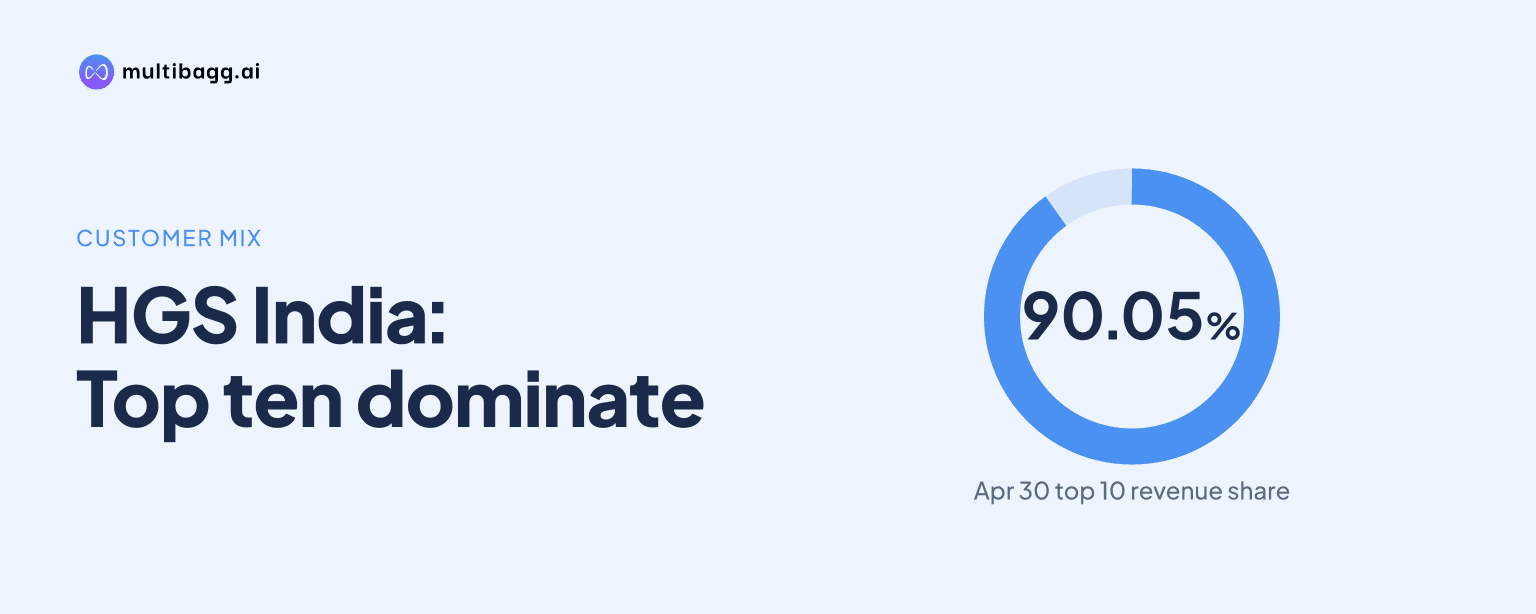
HGS India derived Rs 2.7967 crore, or 90.05%, of Rs 3.1059 crore in revenue from operations from its 10 largest customers in the period ended April 30, 2026. The customer concentration is amplified by HGS India’s disclosure that most direct supplies operate without long-term contracts and purchase orders may be amended or cancelled.
How concentrated was HGS India’s April revenue?
HGS India’s 10 largest customers supplied 90.05% of revenue in the period ended April 30, 2026, compared with 72.58% in fiscal 2026, 56.24% in fiscal 2025 and 61.24% in fiscal 2024. The April 2026 amount was Rs 2.7967 crore from total revenue of Rs 3.1059 crore, leaving Rs 30.92 lakh, or 9.95%, from customers outside the top 10.
Customer concentration was also evident in the smaller groupings. The top five customers generated Rs 2.1889 crore, or 70.48%, of April 2026 revenue, while the largest customer generated Rs 73.77 lakh, or 23.75%. In fiscal 2026, the top-five share was 60.21% and the largest-customer share was 21.79%, against Rs 45.1641 crore in total revenue from operations.
The top-10 share rose by 17.47 percentage points between fiscal 2026 and the April 2026 stub period. The April period covers one month and is therefore not directly comparable with the 12-month fiscal years, but the disclosed figures show a more concentrated revenue mix at April 30, 2026.
Why do HGS India’s customer contracts make concentration more significant?
HGS India says most of its business comprises direct supply to customers without long-term agreements. Because a majority of customers are not bound by long-term arrangements, HGS India says customers may terminate relationships with or without cause, without advance notice and without compensation. A 90.05% top-10 revenue share therefore does not represent contracted future revenue.
Purchase orders generally specify unit price, delivery schedule and quantities, according to HGS India. However, the company says those orders may be amended or cancelled, and customers have no commitment to make new purchase orders. In April 2026, an order change by the largest customer could have affected revenue equal to 23.75% of the period’s Rs 3.1059 crore total.
HGS India also says key customers maintain high requirements for product quality, quantity and delivery schedules. The disclosed exposure persists if a customer is not replaced after a relationship ends, and it would remain material while revenue is concentrated among a limited group and direct supply continues without long-term agreements.
What happens if HGS India orders are cut, delayed or cancelled?
HGS India says reduced, delayed or cancelled orders, as well as anticipated orders that do not materialise, can create a mismatch between raw-material inventories and finished products. The company may be unable to seek compensation for surplus materials bought or goods manufactured after an order is amended or cancelled. It says the resulting inventory-maintenance costs can affect profitability and liquidity.
The risk includes collections as well as order volume. HGS India says it is exposed to payment delays or defaults by major customers, and that its financial position and performance depend on their creditworthiness. Financial difficulties, cash-flow constraints, weaker business performance or a global economic downturn could delay payment of outstanding amounts and affect operating cash flows.
Customer sourcing strategies can also alter sales volumes. The top-10 share rose from 56.24% in fiscal 2025 to 72.58% in fiscal 2026, an increase of 16.34 percentage points. That comparison shows the revenue mix changed before the April 2026 increase, but the prospectus does not state that any historical customer contribution will recur.
Got a follow-up? Ask IRIS
How does customer concentration interact with HGS India’s product exposure?
HGS India’s customer concentration coincides with reliance on two product groups. Geophone Strings/Harness, products used to acquire seismic data, represented 58.25% of April 2026 revenue, while Seismic Cables represented 39.41%. Together, the two categories accounted for 97.66% of the Rs 3.1059 crore reported for the period.
HGS India manufactures geophones, seismic cables and connectors for the seismic industry within the energy and geoscience sector. Its products record and transmit ground-vibration signals for processing, interpretation and analysis of subsurface geological structures. The company says product upgrades, technology changes, quality requirements and lower demand could affect revenue and may require investment in upgraded technology and processes.
The end-market mix also changed across periods. In April 2026, vibration monitoring accounted for Rs 81.56 lakh, or 26.26%, of revenue; earthquake seismology accounted for Rs 73.77 lakh, or 23.75%; and geophysical seabed survey accounted for Rs 69.97 lakh, or 22.53%. In fiscal 2026, geophysical seabed survey was Rs 12.6409 crore, or 27.99%, while oil and gas exploration was Rs 12.5082 crore, or 27.70%.
What could reduce HGS India’s customer concentration?
HGS India says it cannot assure investors that customer concentration will decline significantly. A lower concentration ratio would require more revenue from customers outside the leading group, less reliance on the largest accounts, or contracts providing more certainty than the direct-supply model described in the risk factor. HGS India provides no quantified target or committed plan to reduce the top-10 customer share.
HGS India does disclose an intention to pursue domestic and international growth through a Dual-Hub operating model. Under the model, wholly owned subsidiary HGS Products B.V. in the Netherlands is intended to support marketing activity and customer engagement in developed markets. Export revenue was Rs 3.06 crore, or 98.52% of total revenue, in the period ended April 30, 2026, leaving the company exposed to international demand and trade conditions.
Conclusion
HGS India reported a concentrated April 2026 revenue base, with the top 10 customers contributing 90.05%, the top five contributing 70.48% and the largest customer contributing 23.75%. The disclosed risk arises not only from those shares, but from the lack of long-term contracts for most direct supplies, leaving future purchase orders, inventory planning and cash collection exposed to customer decisions.
The next disclosed matter to watch is HGS India’s execution of the Dual-Hub growth approach through HGS Products B.V. The prospectus sets no target for lower concentration and explicitly says HGS India cannot assure a reduction, so later top-10 revenue shares, customer payment performance and export demand will indicate whether the exposure changes.