










HGS India Exports Make Up 98.52% of April 2026 Revenue
Key highlights
- HGS India generated Rs 3.06 crore of Rs 3.11 crore revenue from operations from exports in the period ended April 30, 2026.
- Exports represented 98.52% of revenue in the April 2026 stub period, up from 84.22% in FY 2025-26 and 59.15% in FY 2024-25.
- Germany contributed 13.25% of total revenue in the April 2026 stub period, compared with 2.08% from the United States and 1.48% from India.
- HGS India’s top 10 customers accounted for 90.05% of revenue in the April 2026 stub period, while its largest customer contributed 23.75%.
powered by IRIS
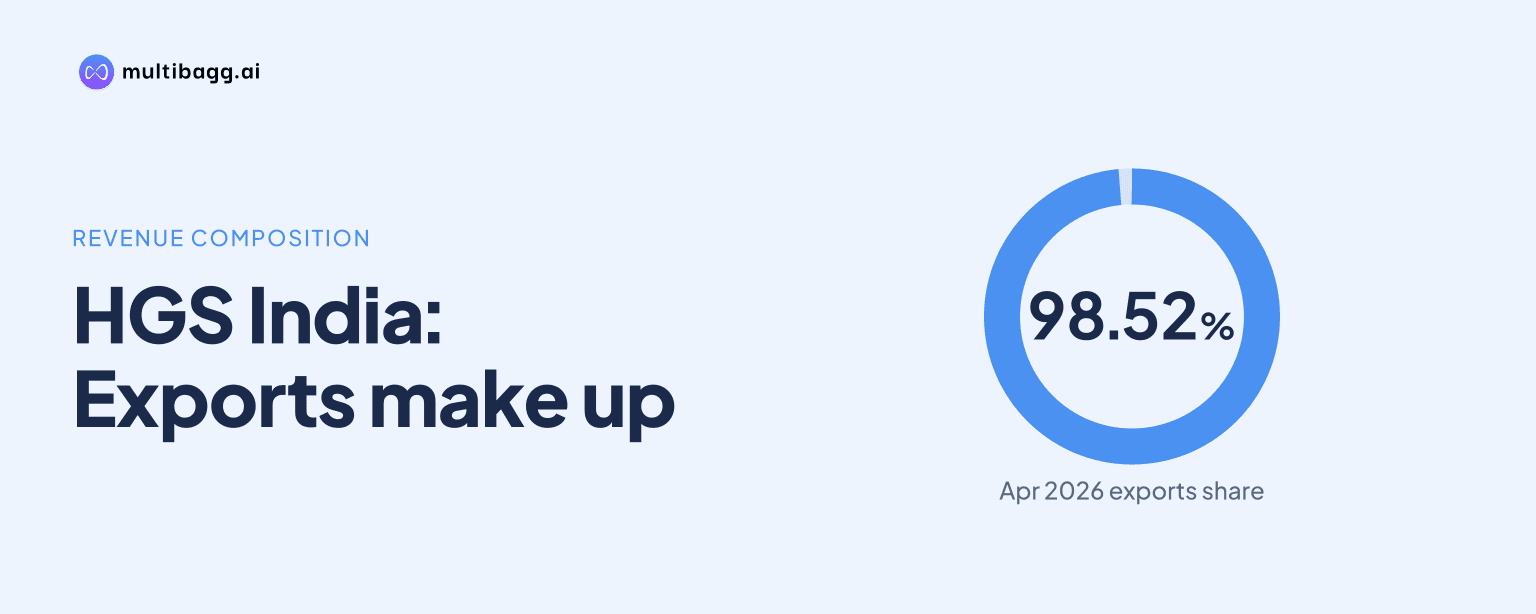
HGS India derived Rs 3.06 crore, or 98.52%, of its Rs 3.11 crore revenue from operations from exports in the stub period ended April 30, 2026. India accounted for 1.48% of revenue, leaving HGS India dependent on overseas demand, trade conditions, currency movements and country-specific regulation.
Why do HGS India exports make up 98.52% of April revenue?
HGS India’s export share reached 98.52% because export revenue was Rs 3.06 crore in the stub period ended April 30, 2026, against total revenue from operations of Rs 3.11 crore. India accounted for 1.48% of revenue in that period, compared with 15.78% in FY 2025-26, 40.85% in FY 2024-25 and 36.83% in FY 2023-24. The latest reported period therefore had a substantially more export-led revenue mix than the preceding three financial years.
The export proportion increased even as revenue from operations changed across the reported periods. Export revenue was Rs 38.04 crore in FY 2025-26, representing 84.22% of Rs 45.16 crore total revenue. The FY 2025-26 export share was higher than 59.15% in FY 2024-25 and 63.17% in FY 2023-24, while total revenue declined from Rs 49.08 crore in FY 2024-25.
HGS India sells primarily outside India to multinational customers with head offices in countries including the United States, Germany, Sweden, Switzerland, Estonia, Slovakia, the Netherlands, South Africa, Saudi Arabia, Australia, Spain, the United Kingdom, Norway, Ukraine, Brazil, Canada, Indonesia, Denmark and the UAE. This geographic reach does not remove concentration risk because HGS India states that revenue has been concentrated in certain geographies in specific periods.
How concentrated is HGS India’s overseas revenue by country?
HGS India’s stub-period revenue ended April 30, 2026 was most visibly concentrated in Germany, which contributed 13.25% of total revenue, while the United States contributed 2.08% and India contributed 1.48%. Germany’s share rose from 12.02% in FY 2025-26, 9.92% in FY 2024-25 and 5.07% in FY 2023-24. Export exposure can therefore shift among individual markets rather than being defined only by India versus overseas sales.
The United States showed a different pattern, accounting for 24.19% of revenue in FY 2025-26, compared with 10.28% in FY 2024-25 and 13.38% in FY 2023-24, before declining to 2.08% in the April 2026 stub period. India’s share fell from 40.85% in FY 2024-25 to 1.48% in the April 2026 stub period as the export share rose from 59.15% to 98.52%.
This structure means an adverse policy, economic or demand development in a market that contributes a meaningful share of revenue could have a disproportionate effect on HGS India’s revenue from operations. HGS India identifies country-level economic conditions, regulatory frameworks, trade policies, geopolitical developments, customer demand and foreign-currency fluctuations as risks. Export dependence will persist only if customers in overseas markets continue ordering and those markets remain accessible for trade.
What does HGS India’s Netherlands-led dual-hub model involve?
HGS India intends to expand its geographical presence in domestic and international markets through a Dual-Hub operating model. Under this model, HGS India is focused on strengthening its European footprint through HGS Products B.V., its wholly owned subsidiary in the Netherlands. HGS Products B.V. serves as a centre for marketing activities and customer engagement in developed markets.
The Netherlands operation is a marketing and customer-engagement hub, rather than evidence that sales are insulated from the rules of other markets. HGS India’s exports accounted for 98.52% of revenue in the period ended April 30, 2026, while its customers operate in multiple jurisdictions with separate import and export requirements, tariffs, taxes, investment policies and licensing conditions. The model’s contribution to growth depends on extending market access while meeting those country-specific requirements.
HGS India’s stated strategy also includes domestic expansion, but India represented only 1.48% of total revenue in the April 2026 stub period. A larger domestic contribution would require a change in the revenue mix, whereas the latest disclosed period remained overwhelmingly international. The prospectus does not quantify a domestic-revenue target or provide a timetable for the Dual-Hub model.
Got a follow-up? Ask IRIS
Which external events could disrupt HGS India’s export sales?
HGS India identifies tariffs, quotas and tariff and non-tariff trade barriers as direct risks to products sold in markets where it operates or intends to expand. A tariff is a tax on imported goods, while non-tariff barriers can include licensing, compliance and other restrictions that affect market access. Governments may also add countries or territories to sanctions lists maintained by India or foreign governments, which could prohibit exports to those locations.
HGS India also identifies Russia’s invasion of Ukraine and tensions in the Middle East, including the Iran-Israel conflict and instability in the Persian Gulf, as developments that may disrupt supply chains and increase volatility in global crude-oil prices. As of the prospectus date, HGS India had not experienced material interruptions in operations in connection with the conflicts it described. The risk remains relevant because HGS India supplies the seismic industry, including oil and gas exploration and geophysical applications.
Foreign exchange is another transmission mechanism because overseas sales are exposed to changes between foreign currencies and the Indian rupee. HGS India also cites local requirements on ownership and corporate structures, environmental, health, safety, labour and accounting obligations. Failure to comply with changed laws, licences or stipulated conditions could lead to penalties or regulatory action, according to HGS India’s risk disclosure.
How does customer concentration add to HGS India’s geographic risk?
HGS India’s export exposure is accompanied by customer concentration. Its top 10 customers generated Rs 2.80 crore, or 90.05%, of revenue in the stub period ended April 30, 2026, while its top five customers generated Rs 2.19 crore, or 70.48%. The largest customer alone accounted for Rs 73.77 lakh, or 23.75%, of revenue.
The top-10 customer share was 72.58% in FY 2025-26, 56.24% in FY 2024-25 and 61.24% in FY 2023-24. The increase to 90.05% in the April 2026 stub period means geographic risk can be amplified if a small number of overseas customers reduce purchases at the same time. HGS India says it does not have long-term agreements with a majority of its customers, and purchase orders may be amended or cancelled.
The effect of an order reduction can extend beyond foregone sales. HGS India states that purchase orders commonly specify unit price, quantities and delivery schedules, but their amendment or cancellation can leave surplus raw-material or finished-goods inventory and increase inventory-maintenance costs. Continued export-led revenue therefore requires both cross-border market access and repeat orders from a concentrated customer group.
Conclusion
HGS India’s revenue mix in the stub period ended April 30, 2026 was almost entirely export-driven: Rs 3.06 crore of Rs 3.11 crore revenue from operations came from overseas sales, compared with an 84.22% export share in FY 2025-26 and 59.15% in FY 2024-25. The Netherlands-led Dual-Hub model supports HGS India’s stated international expansion while leaving results exposed to country-level policy, geopolitics, currency movements and a top-10 customer share of 90.05%.
The next development to watch is whether HGS India’s disclosed domestic-and-international expansion plan changes India’s 1.48% revenue share or maintains the latest export concentration. Results will also depend on continuing trade access in major markets and on whether HGS Products B.V. can support customer engagement in developed markets amid tariffs, sanctions, licensing requirements and foreign regulatory changes.