










HGS India cannot trace RoC filings and transfer records from 1986
Key highlights
- HGS India cannot trace records for 13 equity-share allotments made between December 18, 1986 and May 9, 1997.
- Missing filings include balance sheets for financial years ended March 31, 1987 to March 31, 1998 and annual returns for financial years ended March 31, 1987 to March 31, 2002.
- Share-transfer documentation is unavailable for 2 transfers and 2 transmissions dated between July 29, 1987 and December 22, 2010.
- A March 29, 2026 physical RoC search did not find the records, and HGS India has disclosed no quantified liability or remediation programme.
powered by IRIS
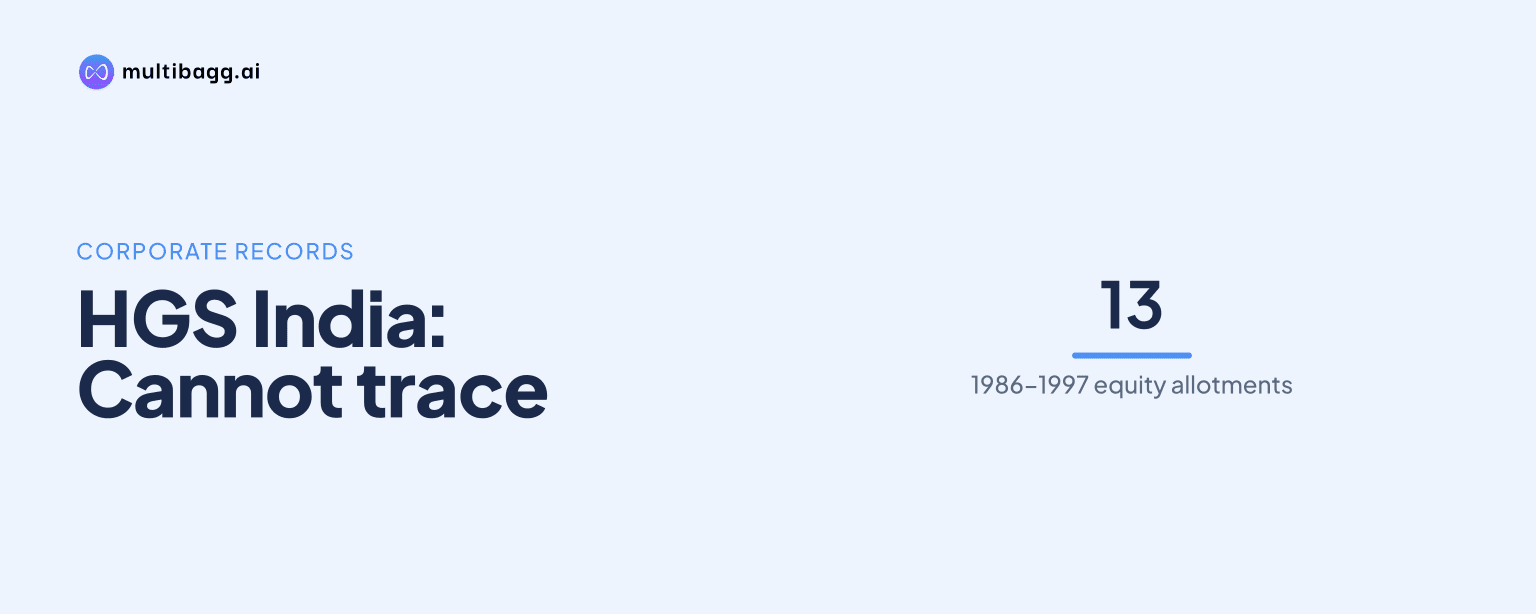
HGS India says it cannot trace specified historical Registrar of Companies, or RoC, filings and corporate records dating to its 1986 incorporation. The unavailable material includes documents for 13 equity-share allotments between 1986 and 1997, financial statements, annual returns, auditor and director appointments, and share transfers. A March 29, 2026 search of physical RoC records also did not locate the listed forms.
What HGS India RoC filings and records cannot be traced?
HGS India cannot trace prescribed forms and documents relating to share allotments, authorised-capital changes, auditors, directors, financial statements, annual returns and share transfers. The company says it does not possess some forms filed with the RoC for Delhi and Haryana from its incorporation in 1986. RoC is the corporate registry that maintains company filings.
The missing material covers several reporting periods rather than one year. Form 2 and related allottee lists concern 13 equity-share allotments from December 18, 1986 to May 9, 1997. Form 23AC balance-sheet filings are unavailable for financial years ended March 31, 1987 through March 31, 1998, while Form 20B annual-return filings are unavailable for financial years ended March 31, 1987 through March 31, 2002.
HGS India also identifies unavailable records for directors and management. These include Form 25C for the redesignation of Anil Dass as Managing Director effective April 1, 1986, Forms 23 and 25C for his reappointment through the financial year ended March 31, 2004, and Form 32 records concerning appointments dated March 11, 1986 and the resignation of Robert Brian Hansen.
Why are HGS India’s historical RoC filings unavailable?
HGS India says the records could not be found in its archives or through a search of physical RoC material. Jhamb & Associates, a Practicing Company Secretary, issued a search report dated March 29, 2026 concerning physical records held by the RoC. Information relating to the forms listed by HGS India remained untraceable after that search.
HGS India says certain historical records are believed to have been misplaced over time when its registered office was shifted in the past. The company does not state that it has obtained replacement copies of the forms or transfer deeds dated from 1986 to 2010. Its account of historic allotments, appointments and transfers in the Red Herring Prospectus is therefore based on limited available information.
The record gaps span different governance functions and extend beyond HGS India’s incorporation period in 1986. Auditor-appointment records run through the financial year ended March 31, 2013, while annual-return records run through the financial year ended March 31, 2002. The missing documentation consequently includes recurring financial reporting and auditor filings as well as the 13 early equity allotments.
Got a follow-up? Ask IRIS
How do missing records affect HGS India’s corporate history?
HGS India says the corporate history presented in its prospectus for equity allotments, auditor appointments, registered-office changes, director appointments, financial-statement filings and share transfers relies on limited information. The 13 missing allotment records span December 1986 to May 1997, while the unavailable transfer documentation includes transfers dated July 29, 1987 and March 17, 2003 and transmissions dated August 30, 2005 and December 22, 2010.
HGS India does not state that the historic share events or filings did not occur. Instead, the company says it believes the relevant RoC forms were filed on time. However, HGS India cannot assure investors that all the listed forms will be available in the future, despite the March 29, 2026 search report.
The disclosed issue is principally one of documentary evidence. HGS India says that, if questions arise concerning historic corporate events, non-availability of statutory records may prevent it from presenting the evidence needed to validate its position. The prospectus does not quantify a potential penalty, demand, provision or liability specifically associated with the untraceable records.
What regulatory risk does HGS India disclose from missing filings?
HGS India says it cannot assure investors that legal proceedings or regulatory action will not be initiated in the future in relation to the missing filings and corporate records. The company states that penal action could adversely affect its operations, financial condition and reputation. This is a risk disclosure as of the prospectus date, rather than a statement that action has been initiated.
The company’s stated exposure depends on whether a regulator, court or other party seeks evidence connected with an event between 1986 and 2013. The listed documentation includes financial-statement forms through March 31, 1998, annual returns through March 31, 2002 and auditor-appointment forms through March 31, 2013. A request relating to any such event could require evidence that HGS India says is presently unavailable.
HGS India’s disclosure does not set out a remediation programme, a reconstruction process, an application to the RoC or a timetable to restore the missing records. The only specific verification step disclosed is the physical-record search reported by Jhamb & Associates on March 29, 2026. The risk would remain relevant unless documents are located or another source of evidence can support the historic filings and corporate actions.
Conclusion
HGS India’s disclosure identifies a records gap covering its 1986 incorporation period and documents dated as late as December 22, 2010, alongside auditor-appointment filings through the financial year ended March 31, 2013. The combined significance is evidentiary: the company says parts of its corporate history rest on limited available information because designated RoC filings and transfer documents cannot currently be traced.
The next development to watch is whether HGS India locates the records or announces a reconstruction or remediation step following the March 29, 2026 physical-record search. The unresolved matter is whether a regulator or another party seeks proof for a historical allotment, appointment, financial filing or share movement, and whether HGS India can substantiate its position without the listed documents.