










HGS (India) Limited sets Rs 11.64 lakh litigation threshold
Key highlights
- HGS (India) approved an Rs 11.64 lakh material-litigation threshold on September 30, 2026, equal to 1% of profit after tax.
- The company has 2 pending material non-tax cases, including a Rs 15.28 lakh property-recovery appeal and a former employee’s reinstatement claim.
- HGS (India) reports 5 company tax claims totalling Rs 6.04 lakh, including a Rs 5.94 lakh indirect-tax dispute.
- The company’s profit after tax rose 162.79%, from Rs 4.00 crore in financial year 2023-24 to Rs 10.51 crore in financial year 2024-25.
powered by IRIS
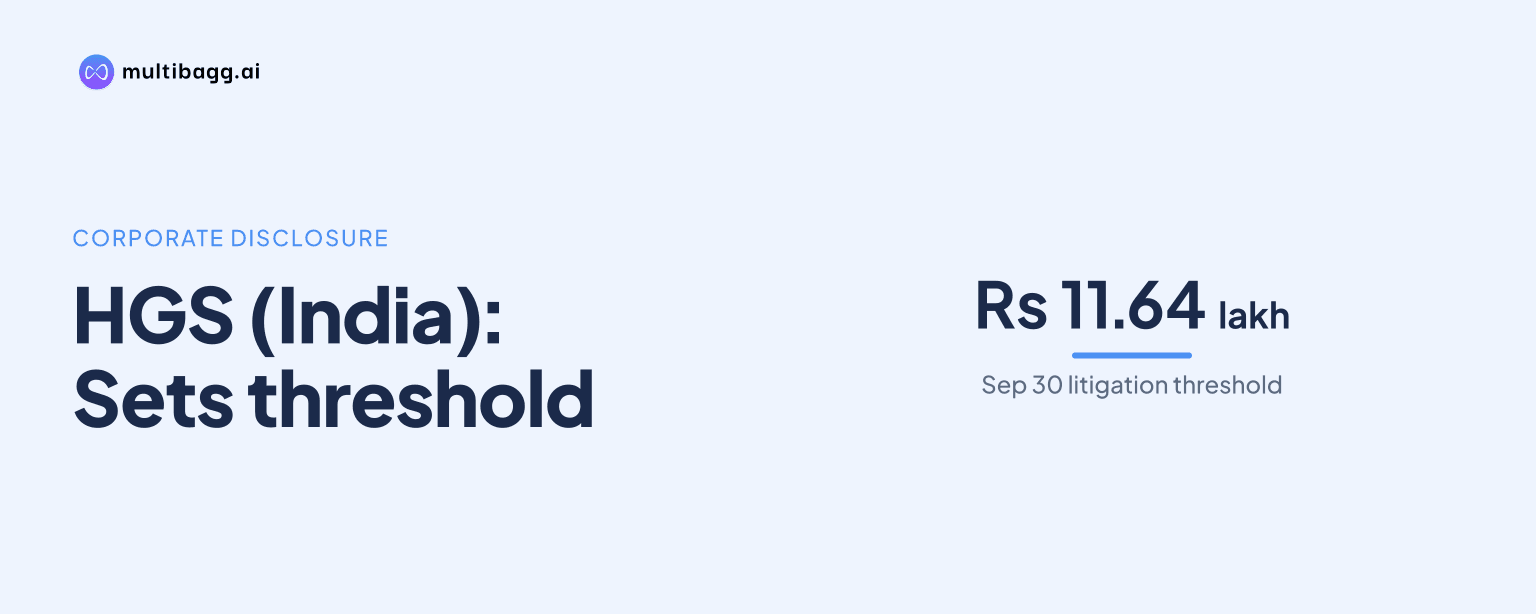
HGS (India) Limited has set Rs 11.64 lakh as its material-litigation threshold under a Board policy approved on September 30, 2026. The company identifies two pending material non-tax cases against it: a Rs 15.28 lakh property-recovery appeal and a former employee’s claim for reinstatement, back wages and continuity of service.
What is HGS (India)'s litigation-materiality threshold?
HGS (India) considers outstanding legal proceedings involving the company, its directors and promoters to be material where the aggregate amount in an individual case exceeds Rs 11.64 lakh, or where the outcome could materially affect its business, operations, prospects or reputation. The Board adopted this materiality policy on September 30, 2026, using the latest annual restated consolidated financial statements.
The Rs 11.64 lakh amount represents 1% of profit after tax under the Board’s policy. Material Litigation is the term HGS (India) uses for proceedings meeting this test or the stated potential-impact test. The policy therefore covers both quantified disputes and cases where the requested relief is not assigned a stated monetary value in the prospectus.
HGS (India) applies a separate definition to creditor disclosures. A creditor was material if amounts due to that creditor exceeded 5% of trade payables, or Rs 6.69 lakh, at April 30, 2026. Total trade payables were Rs 133.88 lakh at that date, showing that the creditor threshold is based on payables while the litigation threshold is based on profit after tax and other financial measures.
Why is HGS (India)'s Rs 11.64 lakh threshold the applicable test?
HGS (India)'s Rs 11.64 lakh threshold is the lower amount among the disclosed materiality criteria. The other test requires the value or expected financial impact to exceed the lower of Rs 90.33 lakh, equal to 2% of turnover; Rs 1.79 crore, equal to 2% of net worth; and Rs 43.57 lakh, equal to 5% of the average absolute profit or loss after tax for the last three years.
The Rs 11.64 lakh policy figure is Rs 31.93 lakh below the next-lowest alternative, the Rs 43.57 lakh three-year profit-or-loss measure. The prospectus separately reports restated profit after tax of Rs 10.51 crore for financial year 2024-25, compared with Rs 4.00 crore in financial year 2023-24, an increase of 162.79%. It nevertheless specifies Rs 11.64 lakh as the threshold derived from its latest annual restated accounts.
The prospectus also defines when notices become litigation for disclosure purposes. Pre-litigation notices, other than notices from statutory, regulatory or taxation authorities and first information reports, are not treated as litigation until HGS (India), relevant directors or promoters, key managerial personnel, or senior management are made defendants before a judicial, quasi-judicial or arbitral forum.
Which HGS (India) company cases are pending?
HGS (India) reports two pending material non-tax litigations against the company and no pending material litigations filed by the company. The first is Civil Appeal No. RSA-3902-2014, filed by M/s Remya Fashions against HGS (India) before the Court of Mr. Shekher Dhawan, District Judge, Gurgaon.
M/s Remya Fashions challenges a January 30, 2013 order that was passed in favour of HGS (India) in a recovery suit. HGS (India) had sought Rs 15.28 lakh plus interest for outstanding dues relating to a plot sold by the appellant, which the company says had been concealed at the time of sale. The Rs 15.28 lakh recovery amount is Rs 3.64 lakh above the company’s Rs 11.64 lakh materiality threshold, excluding interest, and the appeal remains pending.
The second pending case was filed by former employee Ravindra Arya before the Industrial Tribunal-cum-Labour Court-2 in Gurugram under Section 10(1)(c) of the Industrial Disputes Act, 1947. Arya alleged, through a demand notice under Section 2A, non-compliance with Sections 25G, 25H and 25N resulting in illegal termination. He seeks reinstatement, back wages, other benefits and continuity of service; HGS (India) denied the alleged non-compliance and the matter remains pending.
Got a follow-up? Ask IRIS
What company tax matters does HGS (India) disclose?
HGS (India) discloses five company tax claims with a total amount of Rs 6.04 lakh. The tax-litigation table lists four direct-tax claims totalling Rs 10,000 and one indirect-tax claim of Rs 5.94 lakh. These tax items are presented separately from the two pending material non-tax litigations against HGS (India).
The Rs 5.94 lakh indirect-tax matter began with a show-cause notice dated April 22, 2025 concerning allegedly ineligible input tax credit, or ITC, for financial year 2021-22. An order dated December 26, 2025 held that Rs 5.40 lakh of ITC was wrongly availed and utilised under Section 16 and Section 73 of the Central Goods and Services Tax Act, 2017, and imposed a Rs 54,000 penalty. HGS (India) filed an appeal in Form GST APL-01 on February 25, 2026.
HGS (India) states that the tax-return discrepancy arose from delayed returns by M/s SOM Industries for supplies made to the company. The prospectus says the authorities issued a notice to M/s SOM Industries and that the requisite payment was subsequently made by that supplier. The company’s appeal remains the disclosed response to the December 2025 tax order.
How are HGS (India)'s promoter and subsidiary matters separated?
HGS (India) distinguishes company proceedings from matters involving promoters, directors, key managerial personnel, senior management and its subsidiary. It says there are no pending material litigations against its promoters and directors under the materiality policy, but it discloses one pending civil suit filed by its corporate promoter, M/s Sowar Private Limited.
M/s Sowar Private Limited filed Civil Suit No. 2338 of 2023 against Dakshin Haryana Bijli Vitran Nigam Ltd. and others over electricity billing. The corporate promoter alleges that a new billing methodology was applied retrospectively in 2018 for consumption dating back to 2015. It seeks Rs 11.65 lakh as principal and Rs 25.18 lakh including accrued interest; the next hearing was scheduled for December 10, 2026.
The prospectus lists six tax claims involving promoters and directors totalling Rs 13.09 lakh, comprising Rs 11.29 lakh involving Shashi Singh and Rs 1.80 lakh involving Anand Narain Bhatia. The subsidiary has no disclosed direct- or indirect-tax litigation. HGS (India) also states that no criminal proceedings or statutory or regulatory actions are outstanding against its key managerial personnel or senior management.
Conclusion
HGS (India)'s disclosed litigation framework sets Rs 11.64 lakh as the principal monetary materiality threshold, below the Rs 43.57 lakh, Rs 90.33 lakh and Rs 1.79 crore alternative financial benchmarks. That policy captures the Rs 15.28 lakh recovery appeal, while its potential-impact limb is relevant to the employee claim seeking reinstatement and back wages without a disclosed claim value.
The next disclosed developments are the outcomes in the two pending company cases and HGS (India)'s February 25, 2026 appeal against the Rs 5.94 lakh indirect-tax claim. M/s Sowar Private Limited’s separate electricity-billing suit had a December 10, 2026 hearing date, while the prospectus does not provide projected resolution dates or financial outcomes for the pending matters.