










HGS India Drew 90% of April Revenue From Top 10 Customers
Key highlights
- HGS India’s top 10 customers contributed 90.05% of Rs 3.1059 crore revenue in the stub period ended April 30, 2026.
- The largest customer accounted for 23.75% of April 2026 revenue, equal to Rs 73.77 lakh.
- Top-10 customer concentration rose from 72.58% in Fiscal 2026 and 56.24% in Fiscal 2025 to 90.05% in the April 2026 stub period.
- HGS India’s total revenue declined to Rs 45.1641 crore in Fiscal 2026 from Rs 49.0798 crore in Fiscal 2025, while top-10 customer revenue increased to Rs 32.7815 crore from Rs 27.6032 crore.
powered by IRIS
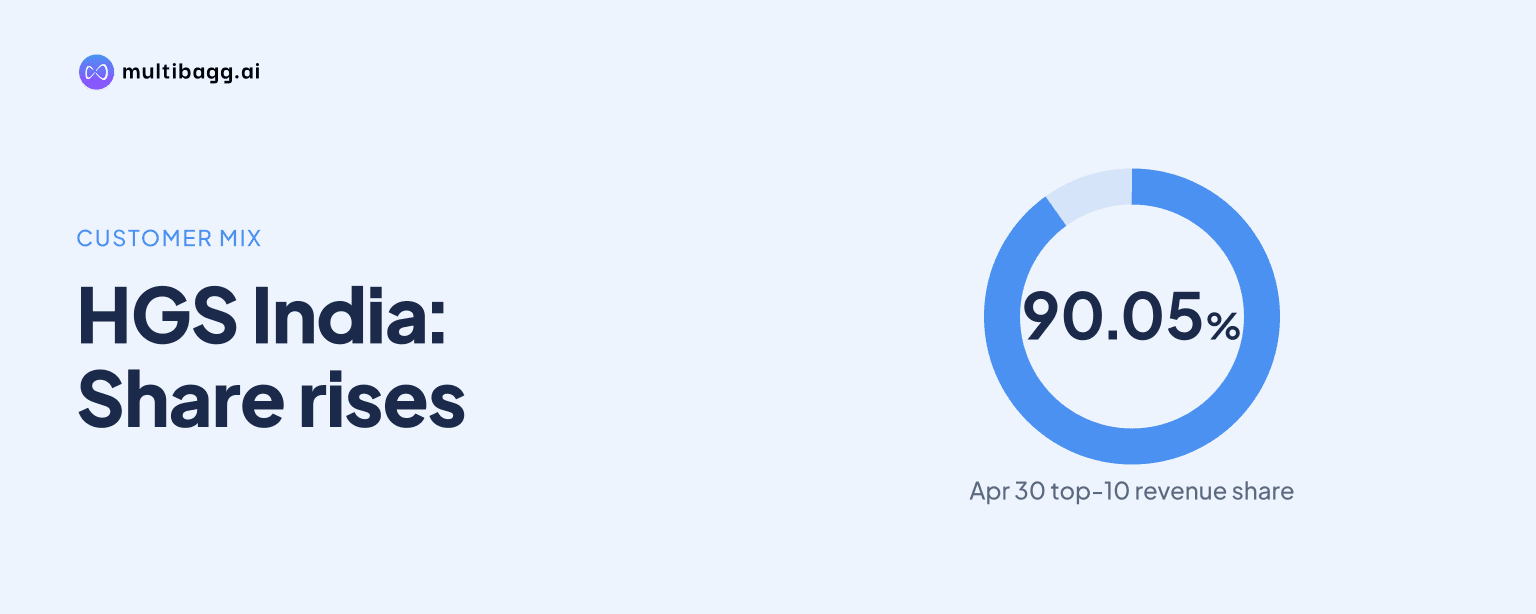
HGS India derived 90.05% of its Rs 3.1059 crore revenue from operations in the stub period ended April 30, 2026 from its top 10 customers. The concentration rose from 72.58% in Fiscal 2026, while HGS India says most direct supplies operate without long-term agreements that commit customers to future orders.
How concentrated is HGS India’s customer revenue?
HGS India’s revenue was concentrated among a small customer group in the stub period ended April 30, 2026, with the top 10 customers contributing Rs 2.7967 crore out of total revenue of Rs 3.1059 crore. Its five largest customers accounted for Rs 2.1889 crore, or 70.48%, and the largest single customer contributed Rs 73.77 lakh, or 23.75%, during the period.
The concentration was lower in each of the three full fiscal years disclosed, although it remained material. The top 10 customers supplied 72.58% of revenue in Fiscal 2026, 56.24% in Fiscal 2025 and 61.24% in Fiscal 2024. This means the April 2026 share was 17.47 percentage points above Fiscal 2026 and 33.81 percentage points above Fiscal 2025, based on HGS India’s restated consolidated financial information prepared under Indian generally accepted accounting principles, or Indian GAAP.
The change was also evident at the largest-customer level. HGS India’s biggest customer represented 23.75% in the stub period ended April 30, 2026, compared with 21.79% in Fiscal 2026, 9.96% in Fiscal 2025 and 11.89% in Fiscal 2024. A reduction, delay or loss of one relationship would affect a greater portion of reported sales unless other orders replace it.
Why do HGS India’s contracts leave orders exposed?
HGS India says most of its business is direct supply to customers and does not have long-term agreements with a majority of them. Customers may therefore terminate the relationship with or without cause, without advance notice and without compensation, according to the risk disclosure. HGS India also states that there is no customer commitment to place new purchase orders, so sales can fluctuate between periods.
Purchase orders generally specify a unit price, delivery schedule and quantity, but HGS India says they may be amended or cancelled. Cancellation or amendment can leave HGS India unable to seek compensation for surplus raw materials bought, or goods manufactured, for the affected order. The disclosure does not quantify any cancellation cost, but identifies inventory mismatch and increased inventory-holding costs as possible outcomes.
This exposure would continue if customer purchases remain determined order by order rather than through binding long-term supply commitments. HGS India specifically says it cannot assure investors that it will significantly reduce customer concentration in the future. Customer sourcing strategies can also change sales volumes, making continuing demand from major accounts necessary to maintain the revenue shares reported for April 2026 and Fiscal 2026.
Got a follow-up? Ask IRIS
What does the trend show across four reported periods?
HGS India’s total revenue from operations declined to Rs 45.1641 crore in Fiscal 2026 from Rs 49.0798 crore in Fiscal 2025, before the Rs 3.1059 crore reported for the stub period ended April 30, 2026. Despite the Fiscal 2026 decline in total revenue, revenue from the top 10 customers increased to Rs 32.7815 crore from Rs 27.6032 crore in Fiscal 2025, lifting their share by 16.34 percentage points.
The comparison shows that concentration did not move in a single direction over all periods. Top-10 customer revenue share fell from 61.24% in Fiscal 2024 to 56.24% in Fiscal 2025, then increased to 72.58% in Fiscal 2026 and 90.05% in the stub period ended April 30, 2026. The filing identifies April 30, 2026 as a stub period, and it records the highest top-10 concentration among the four disclosed periods.
The top-five group likewise rose from 37.11% in Fiscal 2025 to 60.21% in Fiscal 2026 and 70.48% in the stub period ended April 30, 2026. In revenue terms, the top five generated Rs 27.1899 crore in Fiscal 2026, compared with Rs 18.2159 crore in Fiscal 2025, even as total revenue fell by Rs 3.9157 crore. That contrast explains how a narrower set of customers came to account for a larger share of sales.
What operational and cash-flow risks follow from this dependence?
HGS India identifies reduced, delayed or cancelled orders, an inability to negotiate favourable terms, and the loss of customers as risks arising from its selected-customer reliance. HGS India also says its customers impose stringent standards for product quality, quantity and delivery schedules. A key customer that is not replaced after reducing purchases could therefore affect revenue, operating results and financial condition, according to the prospectus.
Inventory planning is directly linked to the order terms. If expected orders do not materialise, or if customers delay or reduce orders, HGS India says raw-material and finished-product inventories can become mismatched with demand. The resulting cost is not limited to production: HGS India cites higher inventory-maintenance costs, which could affect profitability and liquidity.
Payment exposure creates a separate dependency on the creditworthiness of major customers. HGS India says payment delays or defaults could arise from customers’ financial or cash-flow difficulties, deteriorating business performance or a global economic downturn. The filing gives no customer-wise receivables amount, but states that late payment or non-payment by any major customer could adversely affect financial performance and operating cash flows.
Conclusion
HGS India’s disclosed figures show that customer concentration increased materially: the top 10 customers accounted for 90.05% of revenue in the stub period ended April 30, 2026, compared with 56.24% in Fiscal 2025 and 72.58% in Fiscal 2026. The exposure is amplified by the absence of long-term agreements for most direct supplies, because purchase orders can be changed or cancelled without a continuing commitment to new orders.
The next matter to watch is whether HGS India can reduce this concentration, which HGS India says it cannot assure, while maintaining demand from its largest accounts. Order cancellations, delivery changes, inventory mismatches and payment delays remain the disclosed mechanisms that could affect costs, liquidity and operating cash flows.