










HGS India’s seismic-cable lines ran at 0% to 0.85% utilisation
Key highlights
- HGS India’s April 30, 2026 stub-period utilisation was 0% for metre-based seismic cable, 0.85% for cable units and 0.02% for geophysical connectors.
- Seismic-cable unit utilisation fell from 64.99% in FY2025 to 24.32% in FY2026 and 0.85% in the April 2026 period.
- HGS India produced 61 seismic cable units against installed capacity of 7,200 units in the April 2026 period.
- Parts and accessories utilisation was substantially higher at 57.66% in FY2026 and 80.54% in FY2025, showing uneven capacity use across product lines.
powered by IRIS
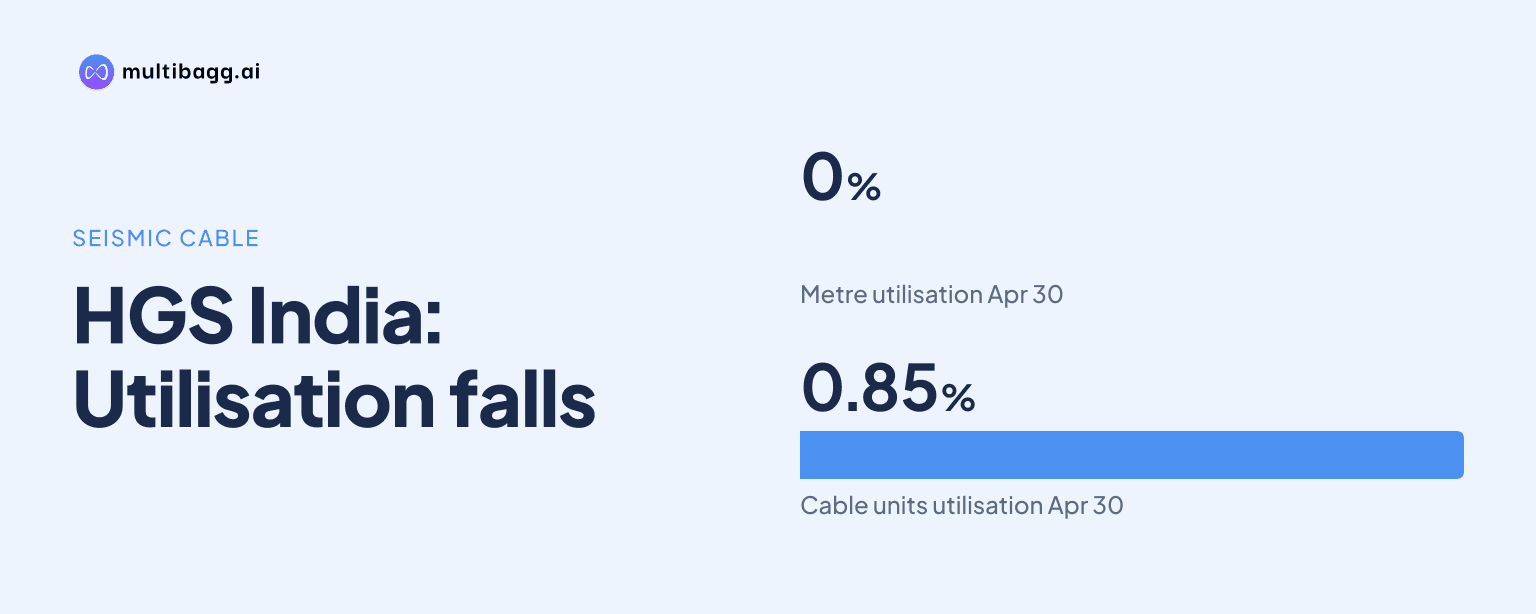
HGS India’s seismic-cable and connector manufacturing lines were used at exceptionally low levels in the period ended April 30, 2026: metre-based seismic cable recorded 0% utilisation, cable units 0.85%, and geophysical connectors 0.02%. The figures compare actual production with installed annual capacity and were not annualised for the one-month period.
Why was HGS India’s seismic-cable capacity utilisation so low?
HGS India’s disclosed production data show that seismic-cable output was far below installed capacity in both units of measurement during the period ended April 30, 2026. The company produced 61 seismic cables against installed capacity of 7,200 cable units, producing the stated 0.85% utilisation. It produced no metre-based seismic cable against installed capacity of 90,00,000 metres, resulting in 0% utilisation.
The low utilisation matters because capacity is fixed manufacturing capability that needs sufficient production volumes to be used effectively. HGS India says utilisation depends on factory operations, product demand, raw-material availability, labour, industry and market conditions, and customers’ procurement practices. Therefore, higher demand alone would not necessarily lift output unless materials, labour and customer orders are also available at the required time.
The April 2026 figures are for a stub period and are expressly marked “not annualized.” They should therefore not be treated as a full-year production rate. HGS India also states that installed capacity and historical utilisation incorporate management assumptions about proposed operations, raw-material availability and quality, potential utilisation, and operational efficiency; R.K. Aggarwal Chartered Engineer certified the data on October 15, 2026.
How did seismic-cable utilisation change across the reported periods?
HGS India’s unit-based seismic-cable utilisation fell sharply from 64.99% in FY2025 to 24.32% in FY2026 and then 0.85% in the April 2026 stub period. Actual output declined from 4,679 cable units in FY2025 to 1,751 in FY2026 and 61 in the April 2026 period, against unchanged installed capacity of 7,200 units.
The metre-based line had low utilisation throughout the disclosed comparison, rather than a decline only in April 2026. Output was 88,968 metres in FY2024, 28,299 metres in FY2025, and 45,858 metres in FY2026, while installed capacity remained 90,00,000 metres. That means the FY2026 increase in metres produced versus FY2025 did not materially change the reported utilisation rate, which remained 0.51%.
The comparison also shows that the cable-unit line and metre-based line do not move in the same way. FY2025 was the highest disclosed year for cable units at 64.99%, but metre-based cable was only 0.31% that year. This distinction is important because HGS India reports seismic cable in two different units and capacities, so a recovery in one measure would not by itself establish a recovery in the other.
Got a follow-up? Ask IRIS
How underused were HGS India’s connector and other production lines?
HGS India’s geophysical connector line was also minimally used, with 0.02% utilisation in the period ended April 30, 2026. Actual production was 38 connectors against annual installed capacity of 240,000 units. The line had already operated at only 0.11% in FY2026, 1.24% in FY2025 and 2.28% in FY2024.
Geophone Strings/Harness was comparatively more utilised than cable metres or connectors, but its April 2026 rate was still 13.63%. HGS India produced 9,814 units against installed capacity of 72,000 units in the stub period. The disclosed full-year comparison shows 18.47% utilisation on output of 13,297 units in FY2025, while FY2026 output was 19,491 units and utilisation was 27.07%.
The parts and accessories line illustrates that utilisation can vary substantially across the factory. Its April 2026 production was 36,893 units against installed capacity of 8,64,000 units, or 4.27%, but FY2025 utilisation was 80.54% on production of 6,95,845 units. FY2026 production was 4,98,217 units and utilisation was 57.66%, showing that the company’s manufacturing capacity was not uniformly underused across all categories.
What does low capacity use mean for HGS India’s operating risk?
Low capacity use creates an operating risk for HGS India because its future performance depends on effectively using expanded manufacturing capacity. The company says an inability to do so could adversely affect its business, prospects and financial performance. The risk is especially relevant where output is linked to demand from customers whose purchase orders may specify price, delivery schedule and quantities but may be amended or cancelled.
HGS India’s revenue mix also makes production planning consequential. Geophone Strings/Harness represented 66.29% of FY2026 revenue from operations, while Seismic Cables represented 20.39%. In the period ended April 30, 2026, those shares were 58.25% and 39.41%, respectively, meaning seismic cables accounted for a larger revenue share in the stub period even as both disclosed cable production measures showed 0% to 0.85% utilisation.
Revenue from operations declined to Rs 45.16 crore in FY2026 from Rs 49.08 crore in FY2025, while the cable-unit production rate fell to 24.32% from 64.99%. The prospectus does not assign a quantified financial impact to under-utilisation or establish that output changes caused the revenue movement. It does, however, identify market demand, customer procurement, labour and raw-material availability as mechanisms that can affect capacity use.
Conclusion
HGS India’s capacity table identifies a specific operational constraint not visible from revenue alone: metre-based seismic cable had no production in the April 2026 stub period, while cable-unit and connector lines operated at 0.85% and 0.02%, respectively. The pattern is not universal, since the parts and accessories line reached 57.66% in FY2026 and 80.54% in FY2025, but the difference across product lines points to uneven use of installed capacity.
The next disclosed evidence to watch is whether customer demand, raw-material availability, labour and procurement patterns translate into higher output on the 7,200-unit cable line, 90,00,000-metre cable line and 240,000-unit connector line. HGS India cautions that historical utilisation rates are based partly on management assumptions and estimates, so future operating performance will depend on actual production rather than the capacity figures alone.