










HGS plans Rs 19.36 crore upgrade despite low utilisation
Key highlights
- HGS plans to spend Rs 19.36 crore at its Manesar factory, including Rs 15.05 crore on replacement machinery, Rs 1.05 crore on gold plating and Rs 3.26 crore on infrastructure.
- Four of HGS’s five disclosed product categories operated below 25% of installed capacity in FY 2025-26; geophysical connectors had the lowest utilisation at 0.11%.
- HGS reported FY 2025-26 revenue of Rs 45.16 crore, with geophone strings and harnesses contributing Rs 29.94 crore, or 66.29%.
- Exports accounted for Rs 38.04 crore, or 84.22%, of FY 2025-26 revenue, while imported purchases represented 73.65% of total purchases.
powered by IRIS
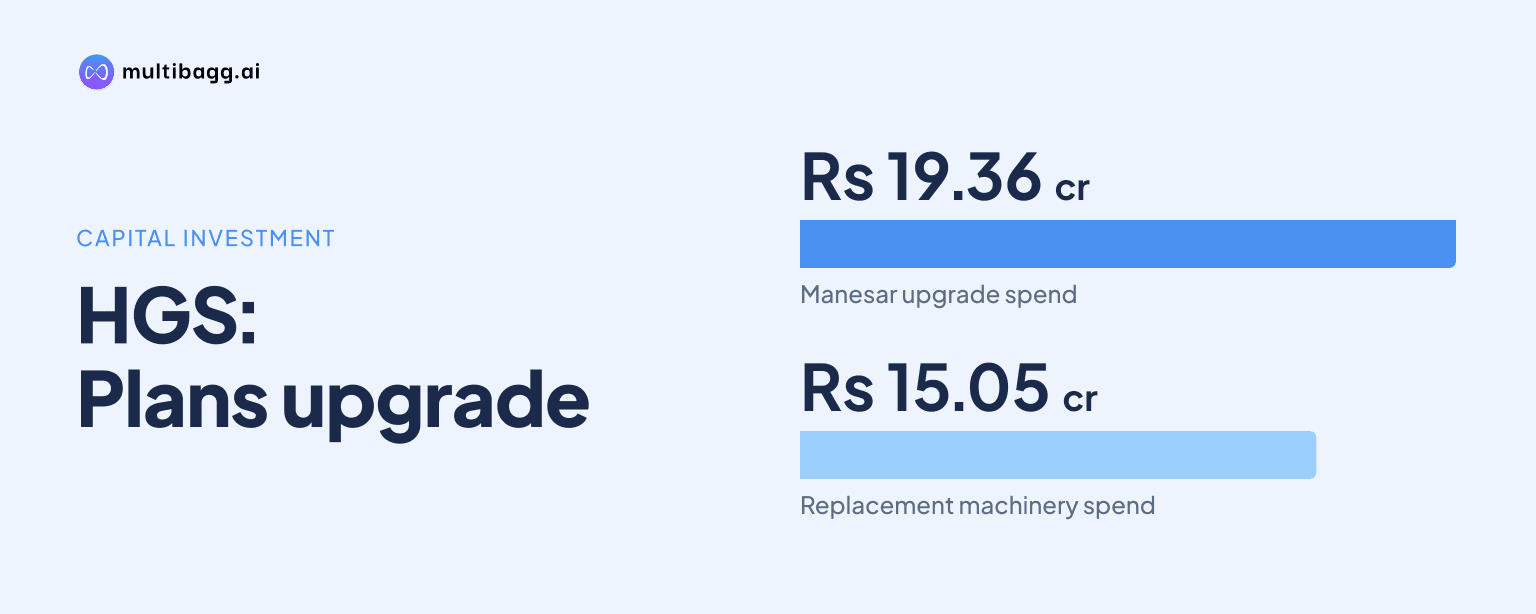
HGS (India) Limited plans Rs 19.36 crore of plant expansion, machinery replacement and factory infrastructure despite low FY 2025-26 utilisation across several production lines. The largest allocation, Rs 15.05 crore, is for replacement equipment, while geophone strings operated at 13.63%, seismic cables by unit at 24.32%, and connectors at 0.11% of installed capacity.
Why is HGS spending Rs 19.36 crore while utilisation is low?
HGS is allocating Rs 19.36 crore to backward integration, replacement machinery and infrastructure at its Manesar, Haryana factory, rather than disclosing a quantified increase in installed capacity. Replacement of existing plant and machinery accounts for Rs 15.05 crore, or about 78% of the stated expenditure, covering the geophone manufacturing, extrusion, assembly, geophone line assembly and moulding departments.
HGS has earmarked Rs 1.05 crore for an in-house gold electroplating facility, including a production line, X-ray thickness measurement system, auxiliary equipment, tooling, technical-knowledge transfer and laboratory setup. The company states that gold-plating thickness verification is among the specialised processes outsourced to accredited external laboratories. The planned facility is intended to provide more control over manufacturing, quality standards and costs.
A further Rs 3.26 crore is planned for second-floor building infrastructure at the Manesar factory. HGS says the development will provide structural capacity for an assembly line and allow a workflow redesign intended to integrate departments and reduce material transit time. The company intends to use net offer proceeds for the projects, meaning implementation depends on those proceeds becoming available.
How far below installed capacity were HGS production lines?
HGS operated four of its five disclosed product categories below 25% of installed capacity in FY 2025-26, while parts and accessories of instruments reached 57.66%. Installed capacity is the stated production capability, and utilisation is actual production as a percentage of that capacity. The April 30, 2026 figures are for a stub period and are expressly not annualised.
HGS recorded lower utilisation in FY 2025-26 than in FY 2024-25 in four categories. Seismic cable measured in units had the largest decline, falling 40.67 percentage points to 24.32% from 64.99%; geophone strings fell 13.44 points to 13.63%. Connector utilisation declined 1.13 points to 0.11%, while parts and accessories fell 22.88 points to 57.66%.
The April 30, 2026 stub period showed 45 geophone strings, 61 seismic cables by unit, no seismic cable metres, 38 connectors and 36,893 parts and accessories. These volumes represented utilisation of 0.06%, 0.85%, 0.00%, 0.02% and 4.27%, respectively. Because the period is not annualised, it does not provide a like-for-like comparison with the three full fiscal years.
What will the HGS capital plan change at the Manesar factory?
HGS says the capital programme is designed to replace equipment, improve operational efficiency and bring gold plating in-house, not to add a stated amount of installed capacity. The Rs 15.05 crore replacement programme includes multi-spindle winding machines, an automatic lathe, laser-marking equipment, a speed extrusion line, a buncher, moulding machines, wire and string soldering workstations, quality-control gauges, magnetisers, ovens and microscopes.
The machinery is used across a process that covers extrusion, moulding, first-article inspection, geophone assembly, product integration, final quality control and dispatch. HGS states that its first five manufactured units undergo quality-control inspection before mass production begins. Geophone assembly also includes coil winding, magnet installation, magnetising, nitrogen filling and vibration testing.
The benefit of the expenditure therefore depends on the new assets being installed and used, on the proposed plating line replacing relevant outside processes, and on production volumes increasing. HGS has stated that it intends to improve utilisation by increasing production volumes, absorbing fixed costs across higher output and managing supply-chain costs through inventory levels and economic orders. It has not disclosed a target utilisation rate, revised installed capacities or a project completion date.
Got a follow-up? Ask IRIS
Which sales trends could support higher HGS production?
HGS reported FY 2025-26 revenue from operations of Rs 45.16 crore, compared with Rs 49.08 crore in FY 2024-25 and Rs 35.48 crore in FY 2023-24. Geophone strings and harnesses remained the largest product category, generating Rs 29.94 crore, or 66.29% of FY 2025-26 revenue, up from Rs 25.10 crore, or 51.15%, in FY 2024-25.
Seismic cables generated Rs 9.21 crore in FY 2025-26, or 20.39% of revenue, down from Rs 13.23 crore, or 26.95%, a year earlier. Parts and accessories generated Rs 4.88 crore, or 10.81%, while connectors generated Rs 7.14 lakh, or 0.16%. Product revenue does not directly establish utilisation because HGS does not disclose product-specific prices, inventory movements or outsourced content.
HGS has introduced its HG-5VHS, a very-high-sensitivity sensor, and HG-2, a low-frequency sensor, in a first round of commercialisation. It has also deployed a geophone sensor network with specialised government institutions for avalanche monitoring and supplied strong-motion accelerographs to government entities. These initiatives identify potential end markets but do not represent disclosed contracted volumes or future revenue.
How do customer and import exposure affect the plan?
HGS’s higher-production objective is linked to a concentrated revenue base. Its top 10 customers generated Rs 32.78 crore, or 72.58%, of FY 2025-26 revenue, compared with 56.24% in FY 2024-25. The top five generated Rs 27.19 crore, or 60.21%, and the largest customer generated Rs 9.84 crore, or 21.79%.
Exports accounted for Rs 38.04 crore, or 84.22%, of FY 2025-26 revenue, up from 59.15% in FY 2024-25. HGS sold to 149 domestic and foreign customers in FY 2025-26 and received repeat orders from around 51 customers during the preceding three fiscal years. As of April 30, 2026, its products were sold in around 47 countries, including India.
Imported purchases were Rs 12.32 crore, or 73.65% of FY 2025-26 purchases, compared with 68.99% in FY 2024-25. The top 10 suppliers represented Rs 11.60 crore, or 69.32%, of FY 2025-26 purchases, while the largest supplier represented Rs 4.30 crore, or 25.72%. HGS says it maintains alternative sources for each component category, but its proposed in-house plating operation addresses only one part of its manufacturing and sourcing process.
Conclusion
HGS is directing most of its Rs 19.36 crore programme toward replacing existing machinery while several FY 2025-26 production lines were materially below installed capacity. The plan combines Rs 15.05 crore of equipment replacement with Rs 1.05 crore for gold-plating backward integration and Rs 3.26 crore for assembly-line infrastructure, rather than a disclosed expansion in rated output.
The next developments to watch are the availability of net offer proceeds, installation of the in-house plating facility and second-floor infrastructure, and changes in production volumes and utilisation. HGS has disclosed plans to expand exports, develop domestic sales under the Make-in-India initiative and improve utilisation, but has not set capacity, utilisation or completion targets.