










India’s Transmission and Distribution Market shifts beyond states
Key highlights
- India’s T&D market is forecast to grow from Rs 36.0 thousand crore in FY25 to Rs 60.063 thousand crore in FY30F, a 10.8% CAGR.
- Central T&D demand is projected to rise from Rs 7.9 thousand crore to Rs 21.6 thousand crore between FY25 and FY30F, a 22.3% CAGR.
- Private T&D demand is forecast to increase from Rs 4.3 thousand crore to Rs 10.9 thousand crore by FY30F, a 20.4% CAGR.
- State buyers’ share of the T&D market is expected to decline from 66.1% in FY25 to about 45.9% in FY30F, despite state spending rising to Rs 27.6 thousand crore.
powered by IRIS
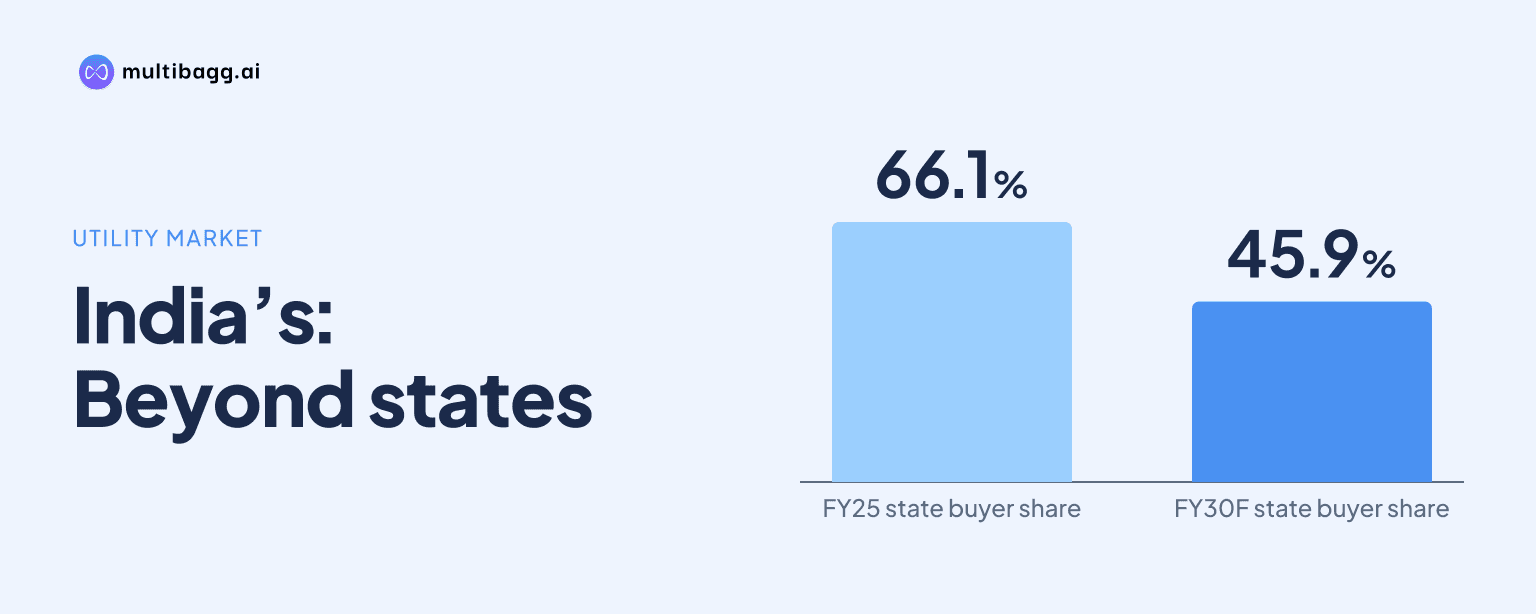
India’s Transmission and Distribution Market is shifting beyond state-led demand as central and private buyers are forecast to grow at compound annual growth rates of 22.3% and 20.4% from FY25 to FY30F, against 3.0% for states. The market is projected to reach Rs 60.063 thousand crore by FY30F.
Why is India’s T&D market shifting beyond state buyers?
India’s T&D market is shifting because state demand is forecast to rise from Rs 23.8 thousand crore in FY25 to Rs 27.6 thousand crore in FY30F, while central and private demand is set to expand faster. Engineering, procurement and construction (EPC) covers domestic revenue from designing, supplying, constructing and commissioning transmission lines, substations and distribution networks.
States were the largest end-user category in FY25, accounting for Rs 23.8 thousand crore, or 66.1%, of the Rs 36.0 thousand crore market. State utilities and municipalities have funded grid modernisation, feeder segregation, smart metering and urban infrastructure, including water and wastewater facilities. Fiscal constraints and the movement of large projects towards central and private participants are expected to limit state expansion through FY30F.
Central buyers are forecast to increase from Rs 7.9 thousand crore in FY25 to Rs 21.6 thousand crore in FY30F, while private buyers are projected to rise from Rs 4.3 thousand crore to Rs 10.9 thousand crore. Based on the rounded FY30F segmentation total of Rs 60.1 thousand crore, the state share would fall to 45.9%, while central and private buyers together would account for 54.1%. The change is therefore a shift in the mix of project owners, not a forecast decline in state spending in absolute terms.
How quickly will central and private T&D market demand grow?
Central demand is forecast to be the fastest-growing end-user segment at a 22.3% CAGR from FY25 to FY30F, followed by private demand at 20.4%. The projected 3.0% CAGR for states is below the 10.8% CAGR forecast for India’s T&D market over the same period.
The rounded segment data show that central demand is expected to add Rs 13.7 thousand crore between FY25 and FY30F, compared with Rs 3.8 thousand crore for states. Private buyers are forecast to add Rs 6.6 thousand crore. Together, the central and private segments account for Rs 20.3 thousand crore of the Rs 24.1 thousand crore increase in the rounded segmentation data.
The FY25-FY30F forecast is slower than the preceding five years. India’s T&D market rose from Rs 17.0 thousand crore in FY20 to Rs 36.0 thousand crore in FY25, representing a 16.2% CAGR, and is forecast to grow at 10.8% annually to FY30F. The forecast reflects expected under-execution of transmission targets despite continued investment in grid assets.
What is driving central T&D EPC spending?
Central T&D market demand is being driven by renewable-energy evacuation and interregional transmission projects under the Rs 9 lakh crore transmission plan for 2023 to 2032. Renewable-energy evacuation is the movement of electricity from generation sites into the wider grid. Faster approvals and standardised bidding are identified as supports for the central segment’s 22.3% forecast CAGR.
The transmission plan is linked to the objective of integrating 500 gigawatts of renewable capacity by 2030. The National Electricity Plan envisages adding 1.91 lakh circuit kilometres of transmission lines from 2023 to 2032, taking the network to about 6.48 lakh circuit kilometres. Circuit kilometres measure the length of individual electrical circuits and indicate the scale of planned grid construction.
The market definition includes high-voltage and medium-voltage infrastructure used for power evacuation and grid interconnection, as well as last-mile distribution networks. Central projects can therefore generate EPC demand for line construction, substations and grid connections. That demand requires planned projects to proceed through approvals, bidding and construction stages.
Got a follow-up? Ask IRIS
What is behind the rise in private T&D market buyers?
Private T&D market demand is forecast to rise because industrial and independent developers are participating more in tariff-based competitive bidding, industrial power projects, grid digitalisation and automation. Tariff-based competitive bidding is a procurement mechanism in which projects are competitively awarded based on quoted tariffs or charges. The private segment is projected to reach Rs 10.9 thousand crore in FY30F from Rs 4.3 thousand crore in FY25.
Private buyers are forecast to remain smaller than central buyers in FY30F, at Rs 10.9 thousand crore compared with Rs 21.6 thousand crore, but their 20.4% CAGR exceeds the market-wide 10.8% rate. The forecast links private expansion to industrial demand and investment in automation and digitalisation. Private participation broadens the market beyond state utilities, which represented 66.1% of FY25 demand.
The identified opportunity areas include grid expansion, substation construction and feeder modernisation associated with the Revamped Distribution Sector Scheme, Green Energy Corridor and National Electricity Plan. Feeder modernisation concerns electricity distribution feeders, while grid digitalisation and automation concern systems used to manage and monitor power networks. Historical under-execution of transmission targets remains a constraint on the delivery of planned projects.
How does the end-user shift affect the wider T&D market?
The end-user shift enables India’s T&D market to grow despite slower state expansion because central and private buyers are forecast to offset the state segment’s 3.0% growth. The market is projected to rise by Rs 24.063 thousand crore, from Rs 36.0 thousand crore in FY25 to Rs 60.063 thousand crore in FY30F. The outcome depends on continued investment in renewable integration, grid reliability and asset modernisation.
The measure is domestic EPC revenue, rather than the value of electrical equipment sold separately or electricity supplied to consumers. Revenue is generated at the design, supply, construction and commissioning stages for transmission lines, substations and distribution networks. Planned transmission investment therefore becomes market revenue only when projects move into execution.
Conclusion
India’s T&D market is forecast to become less dependent on state utilities between FY25 and FY30F. States remain the largest individual end-user category in FY30F at Rs 27.6 thousand crore, but central renewable-energy evacuation and interregional projects, alongside private participation, are expected to drive most forecast expansion towards Rs 60.063 thousand crore.
The next measure to watch is delivery against the Rs 9 lakh crore transmission plan for 2023 to 2032 and the National Electricity Plan’s target to add 1.91 lakh circuit kilometres by 2032. Past under-execution of transmission targets is an unresolved constraint, so the forecast central and private growth rates require approvals, bidding and construction to progress as planned.