










India leaves 63.5% of urban sewage untreated in financial year 2023
Key highlights
- India generated 79,500 MLD of urban sewage in FY2023 but had only 29,000 MLD of operational treatment capacity.
- FY2023 installed treatment capacity was 40,000 MLD, leaving an 11,000 MLD gap versus operational capacity.
- AMRUT 2.0 projects approved by March 2025 covered 6,739 MLD of treatment capacity and were valued at Rs 67,607.67 crore.
- Urban sewage generation is projected to reach 110,350 MLD by FY2031E, while installed treatment capacity is estimated at 72,561 MLD in the annual series.
powered by IRIS
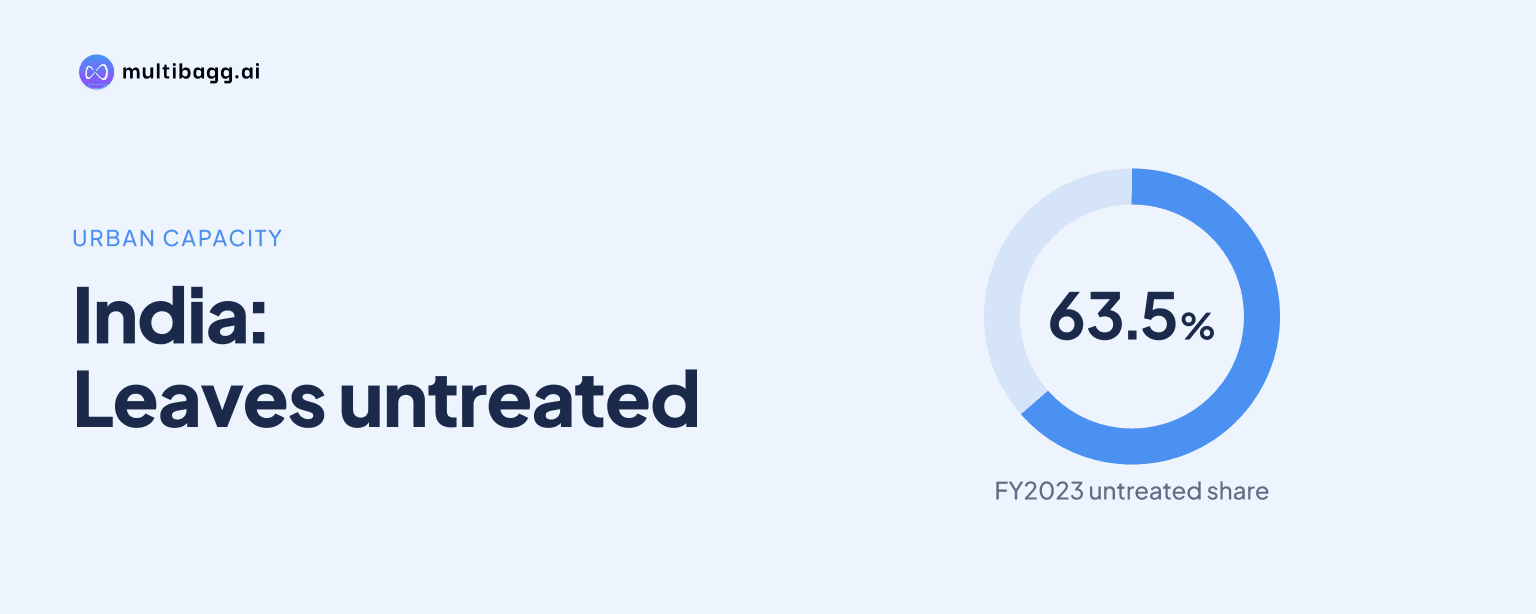
India left 63.5% of urban sewage untreated in financial year 2023 (FY2023) because operational treatment capacity was 29,000 million litres per day (MLD), against sewage generation of 79,500 MLD. The resulting 50,500 MLD shortfall shows that treatment infrastructure had not matched urban wastewater volumes.
Why does India leave 63.5% of urban sewage untreated?
India leaves 63.5% of urban sewage untreated because only 29,000 MLD of the 79,500 MLD generated in FY2023 was operationally treatable. FY2023 installed capacity was 40,000 MLD, equal to 49.7% of generation, meaning the gap is wider when measured against plants in operation than against installed assets.
The distinction between installed and operational capacity is material because installed capacity records plant capability, while operational treatment capacity records capacity available for treatment. The 11,000 MLD difference between FY2023 installed capacity of 40,000 MLD and operational capacity of 29,000 MLD equals almost 22% of the 50,500 MLD untreated-sewage shortfall. The source links untreated sewage with river and groundwater pollution, ecosystem damage, contaminated drinking water and waterborne diseases.
How has India’s sewage treatment gap changed over time?
India’s installed treatment coverage increased between FY2015 and FY2023, but sewage generation increased by more MLD and the absolute installed-capacity gap widened. Urban sewage generation rose from 61,948 MLD in FY2015 to 79,500 MLD in FY2023, an increase of 17,552 MLD, while installed capacity rose from 23,277 MLD to 38,430 MLD, an increase of 15,153 MLD.
India’s estimated installed-capacity coverage rises from 37.6% in FY2015 to 75.4% in FY2031E in the annual series, despite projected generation of 110,350 MLD. The FY2023 annual series reports 38,430 MLD of installed capacity, compared with 40,000 MLD in the separate FY2023 generation-and-capacity exhibit. The narrative also separately cites FY2031E processing capacity of 83,172 MLD and a 27,178 MLD gap, whereas the annual table reports 72,561 MLD of installed capacity; the source identifies the FY2025 and FY2026 figures as Frost & Sullivan estimates rather than official actuals.
What is driving India’s sewage treatment capacity pipeline?
India’s sewage treatment capacity pipeline is being driven by urbanisation, water-reuse policy and government-funded sewerage projects. India’s urbanisation rate is shown rising from 35.4% in FY2021 to an estimated 40.0% in FY2030 and FY2031, while urban sewage generation is projected to increase by 30,850 MLD between FY2023 and FY2031E.
The Atal Mission for Rejuvenation and Urban Transformation (AMRUT) added more than 4,400 MLD of sewage treatment plant (STP) capacity under AMRUT 1.0. Under AMRUT 2.0, 592 sewerage and septage-management projects worth Rs 67,607.67 crore, covering 6,739 MLD of sewage treatment capacity, had been approved by March 2025. By July 2026, 605 projects worth Rs 71,133 crore had been taken up, covering about 40,021 kilometres of sewer network.
The National Mission for Clean Ganga (NMCG) provides another defined project pipeline. Under Namami Gange, 218 sewerage projects costing Rs 35,794 crore and aggregating 6,610 MLD had been taken up, while 138 STP projects with 4,050 MLD were completed and operational. As of February 2026, NMCG had sanctioned 524 projects costing Rs 43,030 crore, completed 355 projects, and targeted cumulative sanctioned treatment capacity of 7,000 MLD by December 2026.
Got a follow-up? Ask IRIS
What must happen for new capacity to close India’s treatment gap?
India can close the treatment gap only if new plants are connected, operated and maintained while capacity additions keep pace with rising sewage generation. The source estimates annual installed-capacity additions of 2,840 MLD in FY2023, 12,777 MLD in FY2025 and 4,134 MLD in FY2026, showing that the pace of additions varies materially by year.
Technology selection also affects the capacity build-out. Sequential Batch Reactor (SBR) penetration is listed at 65% in each year from FY2025 through FY2031E, after 67% in FY2024. A separate SBR market estimate, including replacement demand, projects the overall annual market to rise from 2,590 MLD in FY2022 to 5,491 MLD in FY2031E, with replacement potential increasing from 281 MLD to 576 MLD.
Operational performance remains a separate constraint from construction. The source identifies slow implementation, fragmented regulation, socioeconomic complexities, limited awareness and lack of available data as market restraints. It also identifies inadequate sewerage infrastructure, skilled-workforce shortages, energy requirements and weak operational funding as factors that can leave STPs underperforming after construction.
Which policies are intended to increase treatment and reuse?
India’s policy framework is intended to expand treatment and increase reuse of treated wastewater for non-potable applications. The National Framework for Safe Reuse of Treated Wastewater, issued in 2023, supports reuse for industrial processes, landscaping and irrigation, while AMRUT 2.0 emphasises treatment of wastewater generated in statutory towns.
The draft Liquid Waste Management Rules, 2024, published on October 7, 2024, propose registration for bulk water users consuming more than 5,000 litres per day, an Extended User Responsibility mechanism and reuse obligations from 2030-31. Proposed minimum reuse obligations are 50% for new residential bulk users and 25% for existing residential bulk users; institutional, commercial and establishment users would face 40% for new users and 20% for existing users.
India’s regulatory system does not prescribe one STP technology. Central Pollution Control Board (CPCB) standards are enforced by State Pollution Control Boards through consent-to-establish and consent-to-operate mechanisms, with technology selected according to sewage characteristics, plant scale, land availability and compliance with discharge standards. Projects exceeding 20,000 square metres of built-up area are typically required under applicable frameworks to install on-site STPs.
Conclusion
India’s FY2023 untreated-sewage figure reflects both insufficient treatment capacity and the difference between installed and operational treatment capacity. AMRUT 2.0 and Namami Gange provide disclosed project pipelines, but projected sewage generation of 110,350 MLD by FY2031E means that capacity expansion must continue alongside plant operation, sewer connections and maintenance.
The next measure to watch is whether sanctioned projects become operating plants and whether reuse requirements move from draft rules into enforceable obligations from 2030-31. NMCG’s target of 7,000 MLD of cumulative sanctioned capacity by December 2026 and the FY2031E capacity estimates provide milestones, while the absence of a newer nationwide CPCB inventory leaves actual national performance unresolved.