










Indian private credit AUM is projected to reach $63.5bn
Key highlights
- Indian private credit AUM is projected to rise from USD 26.7 billion in CY26F to USD 63.5 billion in CY30F.
- Indian private credit AUM fell from USD 24.2 billion in CY24 to USD 21.8 billion in CY25 before the CY26F recovery estimate.
- SCB corporate loans declined from 69% of portfolios in FY18 to 55.3% in FY26, while retail loans increased to 44.7%.
- Direct lending, special situations and real estate debt together account for USD 46.0 billion of the USD 65.3 billion CY30F product-level total.
powered by IRIS
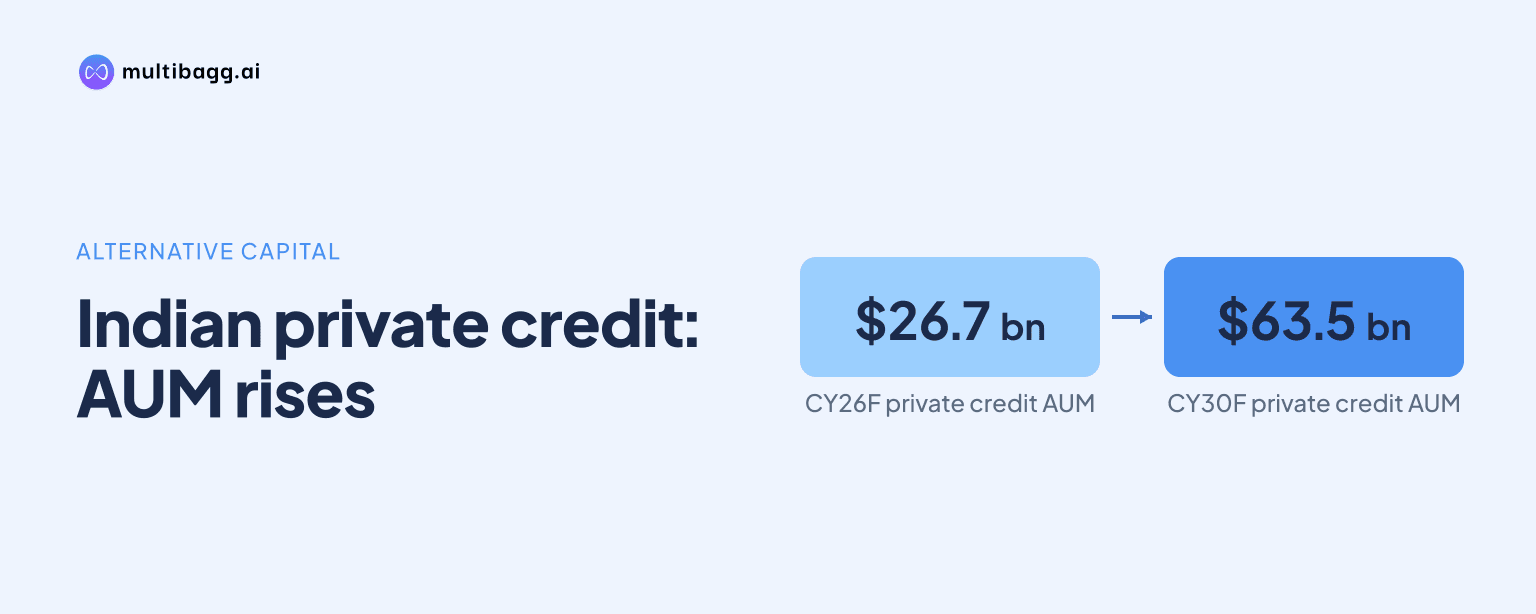
Indian private credit assets under management (AUM) are projected to rise from USD 26.7 billion in CY26F to USD 63.5 billion in CY30F. CareEdge Research attributes the outlook to tighter conventional lending, while banks and non-banking financial companies (NBFCs) have shifted loan portfolios toward retail credit.
Why is Indian private credit AUM projected to reach USD 63.5 billion?
Indian private credit AUM is projected to reach USD 63.5 billion because the market remains small relative to India’s economy and is expected to meet financing demand outside conventional lending channels. CareEdge Research places Indian private credit AUM at 0.6% of gross domestic product (GDP), compared with 4% to 4.5% of GDP in developed markets, and projects Indian penetration of about 1% to 1.1% by CY30F.
The projected expansion follows uneven historical growth. Indian private credit AUM rose from USD 8.1 billion in CY18 to USD 24.2 billion in CY24, then declined to USD 21.8 billion in CY25 before the CY26F estimate of USD 26.7 billion. The CY30F forecast therefore requires renewed fundraising and deployment rather than simply extending the CY18-to-CY24 trajectory.
CareEdge Research identifies tightening traditional lending standards, a growing credit gap and increasing early-stage companies as the drivers of the CY26F-to-CY30F outlook. The forecast depends on Indian private credit managers continuing to provide structures including growth funding, promoter equity-backed lending, real estate debt, stressed debt, special situations financing and mezzanine financing where borrowers cannot readily use bank credit or public bonds.
How does the shift to retail lending support Indian private credit?
The shift to retail lending supports Indian private credit by reducing the share of corporate credit in bank and NBFC portfolios. Scheduled commercial banks (SCBs) cut corporate loans from 69% of portfolios in FY18 to 55.3% in FY26, while retail loans rose from 31% to 44.7%. NBFC corporate loans fell from 80% to 62.5% over the same period, while their retail share increased from 20% to 37.5%.
The portfolio changes leave less conventional lending capacity for large-scale corporate financing, according to the industry outlook. Indian private credit can address this gap through repayment schedules and covenants tailored to borrowers seeking capacity expansion or growth without equity dilution. Equity dilution means issuing ownership interests that can give investors a claim on profits and future appreciation.
The corporate bond market remains principally available to highly rated companies, which limits a funding route for mid-sized and lower-rated borrowers. External commercial borrowings have recovered in recent years, but rupee depreciation can increase the servicing cost of foreign-currency debt. Indian private credit’s role therefore depends partly on its ability to offer domestic financing at terms borrowers can service.
What financing needs does Indian private credit address?
Indian private credit addresses financing requirements of mid-sized, lower-rated and certain large companies through flexible loan terms, customised repayments and covenants. A covenant is a contractual obligation or restriction imposed on a borrower, while secured credit is backed by collateral such as real estate, machinery or inventory. The market’s emphasis on secured credit, counterparty evaluation and cash-flow monitoring is central to its lender-protection framework.
The industry outlook links the opportunity to the Infrastructure Leasing & Financial Services crisis and subsequent NBFC liquidity pressures, which prompted traditional lenders to reduce riskier and leveraged lending. In 2020, one of India’s largest asset managers wound up six debt mutual fund schemes amid liquidity issues exacerbated by the COVID-19 pandemic. The source states that mutual funds subsequently became more cautious about lower-rated corporate debt.
Indian private credit products range from direct lending to venture debt and special situations. Direct lending, also called core or performing credit, generally serves small and medium-sized enterprises that cannot readily raise conventional capital. Venture debt serves early-stage, high-growth companies that have already received equity financing, while special situations can include stressed debt, or debt issued by financially distressed companies.
CareEdge Estimates set target internal rates of return (IRR), an annualised investment-return measure, at 12% to 18% for direct lending, 18% to 22% for venture debt and 20% to 25% for special situations. These are target ranges, not realised returns. Their delivery depends on collateral, borrower performance, cash-flow monitoring, covenant enforcement and the management of default, liquidity and valuation risk.
Got a follow-up? Ask IRIS
Which Indian private credit strategies are forecast to expand fastest?
Indian private credit is forecast to expand fastest in venture debt, direct lending and real estate debt from CY26 to CY30. The source projects compound annual growth rates (CAGR) of 35% for venture debt, 30% for direct lending and 26% for real estate debt. Distressed debt and mezzanine financing are projected to grow by 5% to 7% over the same period.
Direct lending is projected to rise from USD 5.2 billion in CY26F to USD 14.8 billion in CY30F, while venture debt is forecast to increase from USD 2.2 billion to USD 6.9 billion. Real estate debt is projected to grow from USD 5.7 billion to USD 14.4 billion. Special situations are forecast to rise from USD 7.6 billion to USD 16.8 billion, supported by expected insolvency-process changes and an estimated USD 82 billion to USD 85 billion stressed-asset market.
The product table totals USD 65.3 billion in CY30F, compared with the stated market forecast of USD 63.5 billion. Direct lending, special situations and real estate debt would together account for USD 46.0 billion of the USD 65.3 billion product total, or about 70.4%. The difference means the USD 63.5 billion figure is the stated overall market outlook, while USD 65.3 billion is the aggregate presented in the product-level table.
How does insolvency policy affect Indian private credit?
India’s insolvency policy affects Indian private credit by determining the recovery process when corporate borrowers default. The Insolvency and Bankruptcy Code, 2016 requires insolvency proceedings to be completed within 180 days, with a possible 90-day extension. The source contrasts this framework with the earlier Companies Act process, which it describes as longer and without strict completion timelines.
The Insolvency and Bankruptcy Code (Amendment) Act, 2026 received Presidential assent in April 2026. The amendments include tighter admission timelines, restrictions on late-stage case withdrawals, greater Committee of Creditors involvement during liquidation and safeguards for approved resolution plans. They also provide a creditor-initiated resolution process for specified corporate debtors and one-time restoration in specified cases before liquidation.
The policy changes are intended to reduce procedural delays, strengthen creditor oversight and improve predictability of recovery outcomes. Their relevance to Indian private credit AUM depends on implementation, the operation of the stated timelines and whether creditors can preserve value through resolution rather than liquidation.
Conclusion
Indian private credit’s CY30F projection rests on two linked conditions: demand from companies seeking tailored financing and a shift in conventional lenders’ portfolios toward retail credit. The 0.6% AUM-to-GDP level and projected 1% to 1.1% penetration by CY30F describe the scale of the potential expansion, while the CY25 decline to USD 21.8 billion shows that growth has not been uniform.
The next indicators are the disclosed CY26F-to-CY30F product forecasts, notably 35% projected venture-debt growth, 30% direct-lending growth and 26% real-estate-debt growth. Implementation of the April 2026 insolvency amendments and the unresolved difference between the USD 63.5 billion market forecast and USD 65.3 billion product total will also affect how the outlook is assessed.