










Johnson® had 66% FY26 revenue from 10 customers, no long-term contract
Key highlights
- Johnson® generated Rs 139.4135 crore, or 66.24% of FY 2025-26 revenue from operations, from its 10 largest customers.
- Johnson® largest customer contributed Rs 38.631 crore, or 18.35% of FY 2025-26 revenue from operations.
- Johnson® top-10 customer concentration increased from 28.18% in FY 2023-24 to 66.24% in FY 2025-26.
- Johnson® derived Rs 149.2396 crore, or 70.91% of FY 2025-26 revenue from operations, from Gujarat.
powered by IRIS
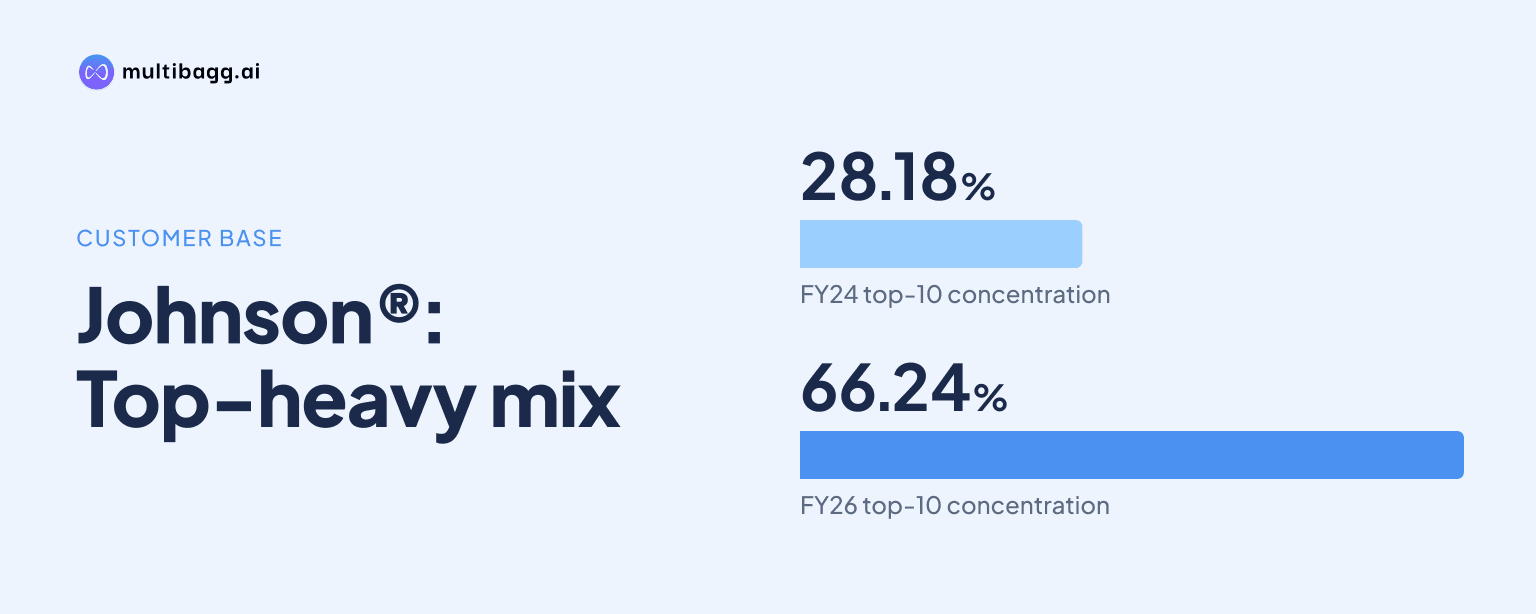
Johnson® generated Rs 139.4135 crore, or 66.24% of FY 2025-26 revenue from operations, from its 10 largest customers. Johnson® also reported no long-term or exclusive customer arrangements, meaning this FY26 revenue concentration did not carry contractual requirements for customers to repeat historical orders.
Why did 10 customers account for 66% of Johnson® FY26 revenue?
Johnson® relied on its 10 largest customers for Rs 139.4135 crore, equal to 66.24% of FY 2025-26 revenue from operations. The top five customers provided Rs 114.1978 crore, or 54.26%, and the top three generated Rs 95.5753 crore, or 45.41%. The disclosed figures show that more than half of annual revenue came from five customer relationships.
Johnson® also recorded Rs 38.631 crore from its single largest customer in FY 2025-26, representing 18.35% of revenue from operations. Johnson® identifies the loss of customers or a reduction in their contract awards as a risk that could affect business, financial condition, operating results and cash flow. The effect of a change in orders would depend both on the affected customer’s share of sales and whether other orders replaced that revenue.
How did Johnson® customer concentration change between FY24 and FY26?
Johnson® customer concentration increased across the three full financial years disclosed. Its top 10 customers accounted for 28.18% of revenue from operations in FY 2023-24, 51.87% in FY 2024-25 and 66.24% in FY 2025-26. The FY 2025-26 share was therefore 38.06 percentage points above the FY 2023-24 level.
The revenue associated with the top 10 customers rose from Rs 24.8952 crore in FY 2023-24 to Rs 72.5029 crore in FY 2024-25 and Rs 139.4135 crore in FY 2025-26. Over the same periods, the top-three group rose from 11.75% to 25.62% and then 45.41% of revenue from operations. The figures indicate that the concentration increase occurred both within the 10-customer group and among the highest-ranked accounts.
Johnson® largest customer contributed 5.44% of FY 2023-24 revenue, 17.53% in FY 2024-25 and 18.35% in FY 2025-26. Its revenue contribution increased from Rs 4.8056 crore in FY 2023-24 to Rs 24.5107 crore in FY 2024-25 and Rs 38.631 crore in FY 2025-26. This progression matters because one customer represented nearly one-fifth of FY 2025-26 revenue from operations.
Are Johnson® customer sales covered by long-term contracts?
No. Johnson® states that it has no long-term or exclusive arrangements with any customer, including the customers that generated 66.24% of FY 2025-26 revenue from operations. Johnson® says it cannot assure investors that it will continue to sell the quantities historically supplied to those customers.
The absence of long-term or exclusive arrangements means customers are not disclosed as being required to place future orders on current or similar terms. Johnson® states that competitors may offer better margins or other incentives, and that customers may consequently not continue placing orders. For the top-five group, which accounted for Rs 114.1978 crore in FY 2025-26, continued revenue depends on ongoing customer purchasing decisions.
Johnson® says it intends to retain customers through cost-effective and time-efficient project implementation. The stated approach is intended to provide better value and increase engagement with new and existing customers. That plan can affect retention only if customers continue to accept Johnson® execution, pricing and other commercial terms; it does not create a long-term customer arrangement.
Got a follow-up? Ask IRIS
What do the latest partial-period figures show about Johnson® customers?
Johnson® top 10 customers generated Rs 62.666 crore, or 55.44% of revenue from operations, in the period ended August 31, 2026. That percentage was lower than the 66.24% reported for FY 2025-26, but the five-month period is not directly comparable with a full financial year. The top-three group accounted for Rs 37.9355 crore, or 33.56%, in the period ended August 31, 2026.
Johnson® top customer generated Rs 56.75 lakh, or 0.50% of revenue from operations, in the period ended August 31, 2026, compared with 18.35% in FY 2025-26. The reported movement shows that the identity and contribution of leading customers can change in the normal course of business. The aggregate top-10 share nonetheless remained above half of revenue in the later period.
What other disclosed factors can affect Johnson® customer revenue?
Johnson® derived Rs 149.2396 crore, or 70.91% of FY 2025-26 revenue from operations, from Gujarat, compared with Rs 98.5493 crore, or 70.50%, in FY 2024-25. West Bengal contributed Rs 12.7584 crore, or 6.06%, and Rajasthan contributed Rs 11.3567 crore, or 5.40%, in FY 2025-26. Johnson® identifies Gujarat, Rajasthan, West Bengal and Uttar Pradesh as regions from which it derived a major portion of sales in Fiscal 2026.
Johnson® reported cost of goods sold of Rs 179.1593 crore in FY 2025-26, equal to 85.12% of revenue from operations. Its inputs include aluminium and copper wire and rods, polyvinyl chloride (PVC) and cross-linked polyethylene (XLPE), which Johnson® says are subject to price fluctuations. Johnson® generally seeks to pass cost increases to customers but says it may not pass on every increase, making customer acceptance of revised pricing relevant to revenue and operating results.
What must hold for Johnson® FY26 revenue concentration to persist?
Johnson® would need key customers to continue ordering commercially workable volumes and to accept applicable prices, despite having no long-term or exclusive arrangements. Johnson® would also need to implement projects cost-effectively and on time, which is its disclosed customer-retention plan. The Rs 139.4135 crore reported from the top 10 customers in FY 2025-26 is historical revenue rather than an assured future order base.
Johnson® would also need to manage changes in its leading-customer mix. The top customer’s contribution moved from 18.35% in FY 2025-26 to 0.50% in the period ended August 31, 2026, while the top-10 share was 55.44% in that later period. Subsequent revenue will therefore depend on both the total concentration among major customers and the composition of that group.
Conclusion
Johnson® disclosed a more concentrated customer profile in FY 2025-26 than in FY 2024-25 and FY 2023-24: 10 customers generated 66.24% of revenue from operations, compared with 51.87% and 28.18%, respectively. With no long-term or exclusive customer arrangements, the reported sales concentration depends on continued orders and commercial terms rather than contracted continuity.
The next relevant update is whether the top-10 share remains near the 55.44% reported for the period ended August 31, 2026 and whether the leading-customer mix changes further. Johnson® disclosed that it plans to retain customers through cost-effective, timely project implementation, while customer demand, regional conditions and acceptance of input-cost pass-throughs remain unresolved factors.